

Pilot5 Legal
Pilot5 Inc. · Writing · Productivity · Business
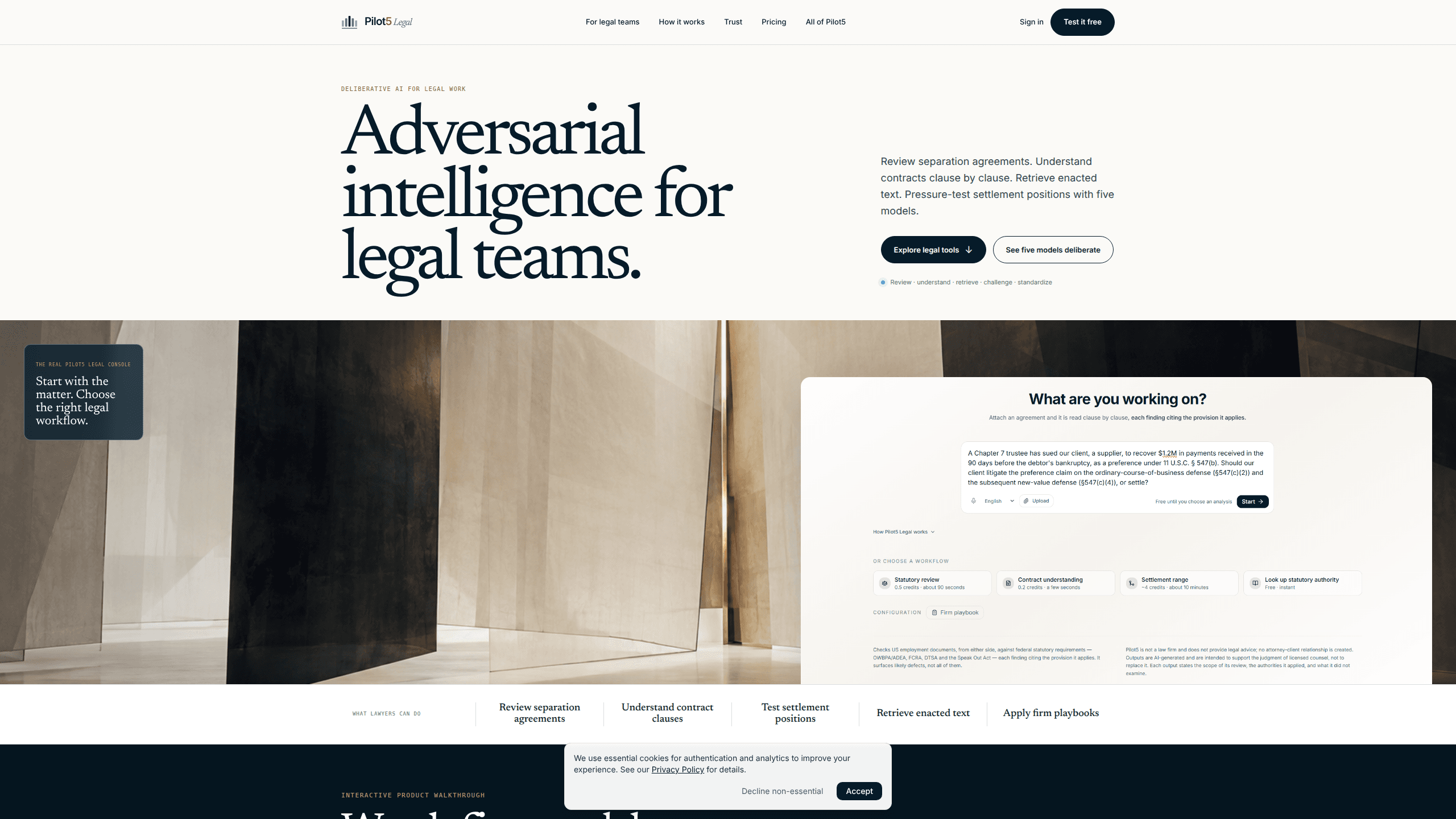
Pilot5 Legal is a legal AI console that runs five frontier models on one matter, lets them challenge each other, and returns one sourced recommendation with the dissent kept.
About Pilot5 Legal
What Is Pilot5 Legal
Pilot5 Legal is the legal edition of Pilot5's adversarial AI platform, built as AI for lawyers rather than a general chatbot. It went live on October 5, 2026 at legal.pilot5.ai and was built first for US practice, with a console for statutes, contracts and cross-border research. The core idea is simple: a lawyer shouldn't meet the other side's best argument for the first time in court.
The multi-model deliberation puts five frontier models on the same brief. Each one works the matter alone, then they cross-examine each other's reasoning, and the system returns a single recommendation with its sources and the strongest remaining objection. Every claim is tagged as sourced or inferred. Case citations are checked against CourtListener for the reporter cite, court, year and party names before you see them.
That check is about existence, not good law. Pilot5 Legal isn't a citator, a drafting tool or a research database, and it doesn't give legal advice. The statutory workflows cover US federal law plus eleven states and the District of Columbia at launch, so matters outside that footprint need a manual look. The judgment, the signature and the duty of candor stay with the lawyer.
Getting Started
- Create an account at legal.pilot5.ai. New accounts get 10 free credits and no card is required.
- Answer the Companion's questions about the matter: the side you represent, what you want to achieve, jurisdiction and circuit, procedural posture, standard of review, deadlines and risk tolerance.
- Approve the brief. The estimated cost appears before the run starts, and unused credits are returned.
- Pick a workspace. Run a full panel deliberation, a Statutory Review, a Contract Understanding pass or a free Statutory Authority Lookup.
- Read the verdict, the evidence check, the decision matrix and the Minority Report, then confirm each authority in its primary source. Every deliberation is stored and can be retrieved by ID.
Product Information
A quick look at Pilot5 Legal's pricing, supported platforms, and performance.
Best for
The users, tasks, and scenarios where this tool fits best.
Users
- US litigators
- In-house counsel and general counsel
- Compliance officers
- Small firm partners and solo practitioners
Tasks
- Separation agreement review
- Contract clause mapping
- Statutory citation checks
- Cross-border research
Scenarios
- Signing an opinion letter or filing a brief
- Board or client briefings
- Standardising a firm's positions
Key features
Five models with fixed mandates
Each panel run assigns the same five roles. The Architect maps the structure and the chain of obligations. The Strategist reads enforcement posture, circuit splits and timing. The Engineer tests thresholds, notice periods and the arithmetic in a penalty calculation. The Counsel states exposure, duty and privilege. The Contrarian argues the other side. First-round analyses are written blind, so no model can anchor on another.
Blind cross-examination and a preserved dissent
In later rounds the models critique each other's work under neutral labels, ANALYSIS_1 through ANALYSIS_5, then revise. When one position refuses to converge, Pilot5 Legal keeps it as a Minority Report with its own verdict, its own reasoning and the condition under which it would turn out to be right.
The Companion brief
Nothing runs until the brief is approved. The Companion interviews you in plain language about the decision, the situation and the constraints, then turns the answers into a structured brief. It is the step that catches a badly framed question before five models spend credits answering it.
Statutory Review against primary text
At $0.50 per review, this tool takes an employment agreement such as a separation agreement and checks it clause by clause. Each requirement is marked satisfied, partial, needs review or missing, and the statutory or regulatory text is quoted from an official source. If the text can't be retrieved, the review says so rather than filling the gap.
Source tags and a citation existence check
Every claim in the output carries a [SOURCED] or [INFERRED] tag, so analytical judgment is visibly separate from authority. Case citations are matched against CourtListener on reporter cite, court, year and parties. This is a fabrication check, not a citator: it confirms the case exists and says nothing about whether it still controls.
Runs inside the assistant you already use
Through the Model Context Protocol, a deliberation starts from Claude, ChatGPT, Perplexity, Microsoft Copilot Studio, Mistral Le Chat or Cursor, and the answer comes back in the same window. A REST API covers custom workflows, and connectors pull matter context from Slack, GitHub, Notion, Google Drive, Jira, Confluence, PostgreSQL and SharePoint.
Pros and cons
Pros
- The dissent survives the synthesis, so you read the argument that could beat you instead of an average of five opinions.
- Cost is quoted before a run starts, credits are reserved at launch and settled on completion, and the excess comes back.
- Statutory Review quotes enacted text and marks every requirement, which makes gaps in an agreement easy to point to.
- No per-seat licence, free tools for citation lookup and firm playbooks, and entry pricing at $29 per month.
- It fits existing habits: the panel opens from Claude, ChatGPT or Cursor without a new platform to learn.
Cons
- It won't tell you whether a case is still good law, so a separate citator stays in the budget.
- Statutory coverage is US-first: federal law plus eleven states and DC at launch, which leaves other jurisdictions to manual checks.
- Statutory Review is limited to employment agreements such as separation agreements, not the full range of contract types.
- Credit costs are hard to predict in advance, since a run depends on mode, complexity and context, and heavier panels can take 7.5 to 8 credits.
Frequently asked questions
It is a legal research and decision-support console from Pilot5 Inc. Five AI models analyse one matter independently, challenge each other's reasoning, and return a single recommendation with sources and a preserved dissent. It launched on October 5, 2026 and is built first for US practice.
Related content
Explore related tools, skills, and articles for Pilot5 Legal.
Pilot5 Legal Alternatives

Google EmbeddingGemma 2
Google DeepMind · Writing · Image · CodingGoogle EmbeddingGemma 2 is a 740M-parameter open model that turns text, code, images, audio, and video frames into vectors in one 768-dimension space, running on phones and laptops.

MePersona
MePersona, Inc. · Writing · Productivity · MarketingMePersona is an AI unified inbox for creators. It learns your voice, drafts replies to fan messages from 12 platforms, and sends only what you approve.

Fluence
Yay Software (Yannick Huchard) · Writing · Voice & Language · ProductivityFluence is an Android app that reads PDFs, EPUBs, Word files and web articles aloud, follows each sentence as it speaks, and answers questions about the text on the phone itself.