

Pinecone
Pinecone Systems, Inc. · Coding
Pinecone is a managed vector database for AI search. It stores embeddings and returns similar results in milliseconds, and it runs without any server setup.
About Pinecone
What Is Pinecone
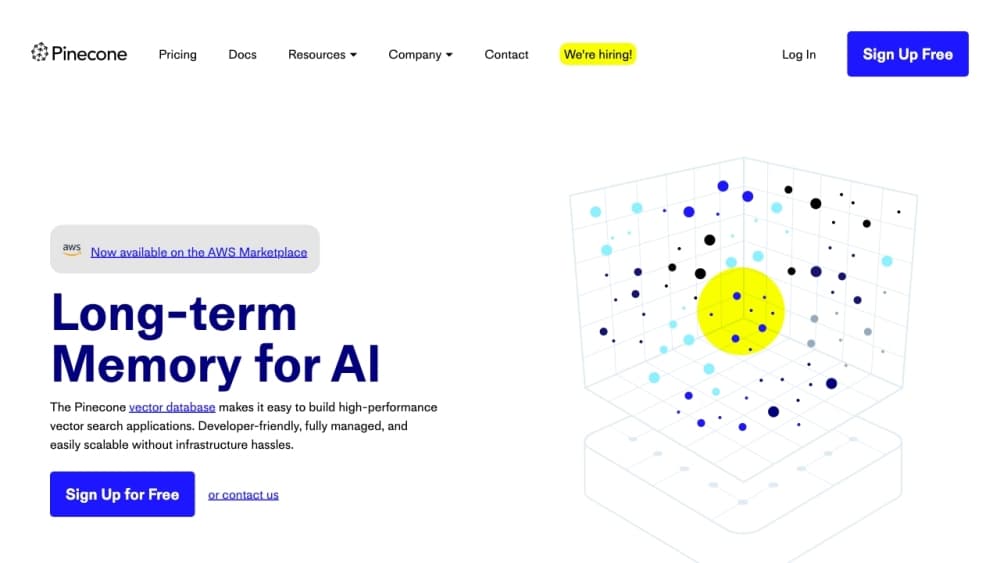
Pinecone is a vector database, which is a store built to hold the numerical fingerprints that AI models produce for text, images, and audio. Those numbers are called embeddings, and a vector database runs a similarity search to find the entries closest in meaning rather than matching exact keywords. Pinecone was founded in 2019 by Edo Liberty and runs as a fully managed cloud service, so you call an API instead of installing and tuning a search cluster yourself.
The product meets a specific need: retrieval that powers AI. When you build a chatbot over your own documents, a recommendation engine, or a semantic search box, you need a fast way to pull the most relevant items for each query. Pinecone handles that step and pairs it with embedding and reranking models, so you can go from raw data to ranked results in one service.
The main trade-off is that Pinecone is closed and cloud-only. There's no version you run on your own hardware, so teams with strict data residency rules have to use the bring-your-own-cloud option or look elsewhere. That matters most for companies that can't send data to a shared environment.
Getting Started
- Sign up at app.pinecone.io and grab an API key.
- Create an index and set the dimensions to match your embedding model.
- Upload embeddings with the Python, Node.js, or other SDK, and attach metadata for filtering.
- Query by vector or by text and get ranked matches back in a few milliseconds.
- Add embedding and reranking models through Pinecone Inference when you don't want to host them.
Product Information
A quick look at Pinecone's pricing, supported platforms, and performance.
Best for
The users, tasks, and scenarios where this tool fits best.
Users
- App and backend developers
- AI and ML teams building RAG
- Startups scaling quickly
Tasks
- Semantic search
- Retrieval for chatbots
- Recommendations
- Semantic caching and deduplication
Scenarios
- Launching a first AI feature
- A document assistant over internal files
- Traffic that spikes and dips
Key features
Serverless Indexes That Scale on Their Own
Pinecone separates storage from compute, so an index grows to billions of vectors without manual sharding or capacity planning. You pick a cloud and region, then queries scale with demand. Updates become searchable in seconds, which suits data that changes throughout the day.
One Index for Every Search Strategy
A single index can hold dense vectors, sparse vectors, and full-text fields served from one API. You get semantic search for meaning, keyword search for precision, and BM25 full-text search in the same place. Hybrid search blends these signals in one call, and built-in reranking sorts the final list.
Hosted Embedding and Reranking Models
Pinecone Inference hosts embedding and reranking models on its own infrastructure, so you don't stand up a separate model server. That covers the whole retrieval chain in one product, from turning text into vectors to reordering the results before they reach the model.
Namespaces for Multitenancy
Namespaces partition one index into isolated sections, with up to 100,000 per index on Standard and a million on Enterprise. You keep each customer's or department's data separate while sharing a single index, which cuts both cost and management overhead.
Metadata Filtering
Every vector can carry metadata, and you filter on it at query time to narrow results by source, date, category, or any custom field. Filtering before the candidate search keeps results tight and avoids pulling rows the user never wanted.
Managed Security and Compliance
Data is encrypted at rest and in transit, and access controls include RBAC, SSO, private endpoints, and customer-managed keys. Standard and Enterprise plans add HIPAA support, audit logs, and a 99.95% uptime SLA, which lets teams put sensitive workloads on the same platform.
Pros and cons
Pros
- The serverless design removes capacity planning, so teams skip weeks of cluster tuning.
- Dense, sparse, and full-text search live in one index, which saves running a second search engine.
- Embedding and reranking models ship with the platform, so you don't host a model server for retrieval.
- Response times stay in the low milliseconds even at millions of records, according to Pinecone's published numbers.
Cons
- Pinecone is closed source and cloud only, so teams that need to run retrieval inside their own network must use the bring-your-own-cloud setup or pick a different tool.
- The Starter plan caps daily usage, and a busy prototype can hit those limits fast, pushing you toward Builder at $20 a month.
- Production plans start at a $50 monthly minimum, which is more than a hobby project needs.
- Managing embeddings still falls on you unless you pay for Inference, so the platform isn't a full replacement for an AI team.
Frequently asked questions
Pinecone stores embeddings and returns similar items fast, which makes it a fit for semantic search, retrieval for chatbots, and recommendation engines. Developers use it as the retrieval layer that feeds relevant context to an AI model.
Related content
Explore related tools, skills, and articles for Pinecone.
Pinecone Alternatives

Base Code
Base44 (Wix) · Coding · ProductivityBase Code is a shared cloud development environment from Base44. Teammates describe changes to an existing GitHub codebase in chat, preview them live and send them back as pull requests.

Google EmbeddingGemma 2
Google DeepMind · Writing · Image · CodingGoogle EmbeddingGemma 2 is a 740M-parameter open model that turns text, code, images, audio, and video frames into vectors in one 768-dimension space, running on phones and laptops.

GitGlow
GitGlow · Coding · ProductivityGitGlow is a local-first desktop Git client that lets independent developers review their own code and their AI agents' changes in one place before shipping.