

Pipedream
Pipedream, Inc. · Coding · Productivity
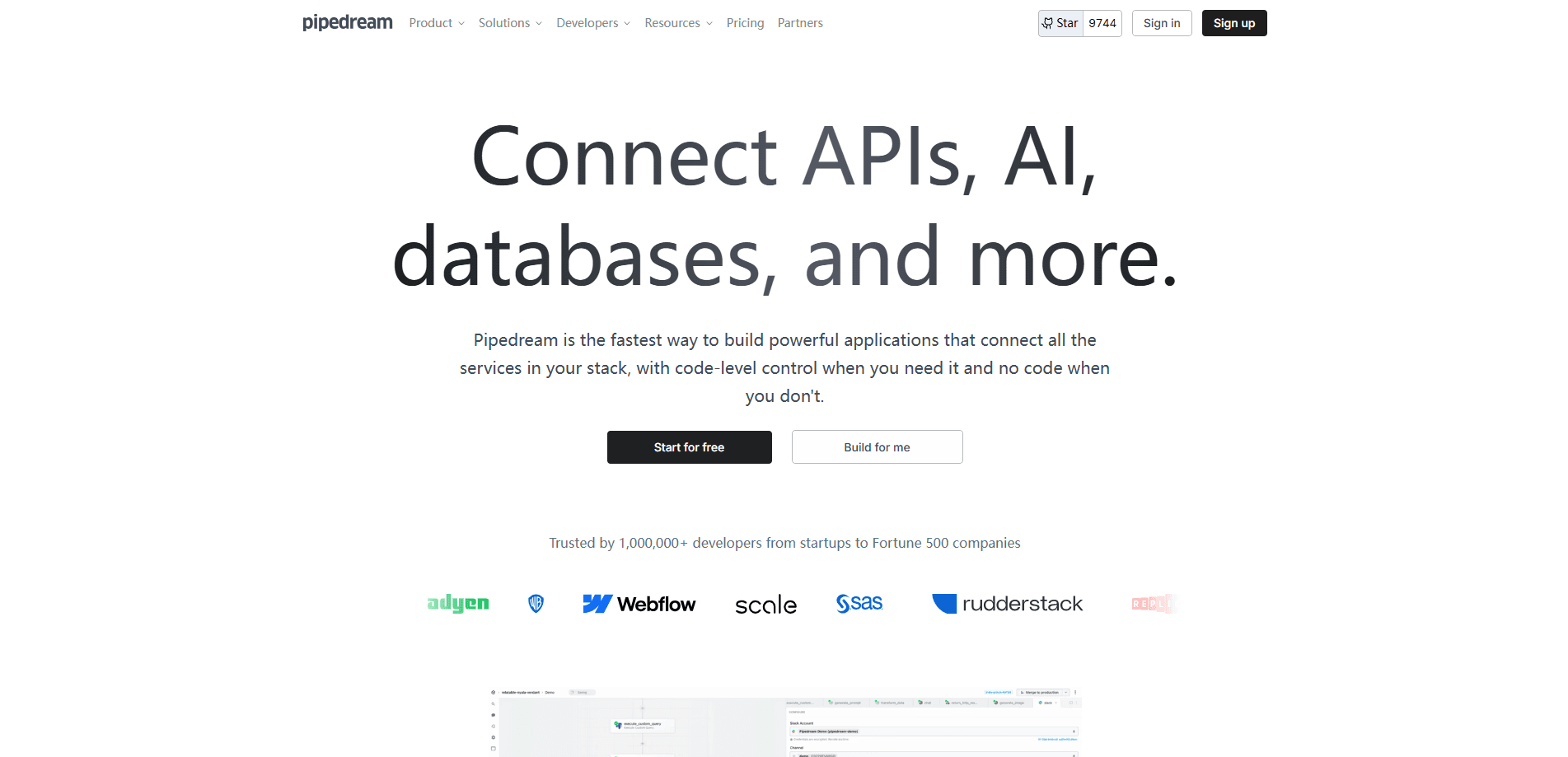
Pipedream is a developer integration platform with managed auth and 10,000+ tools across 3,000+ APIs, so you can wire AI agents and workflows without building connectors yourself.
About Pipedream
What Is Pipedream
Pipedream is an integration platform that sits between your app and the APIs your users already use. You drop in an SDK or Connect Link, your users authorize their accounts, and Pipedream stores and refreshes the credentials. From there you call prebuilt tools, run raw requests through a proxy, or hand the whole thing to an AI agent through an MCP server.
The company says the platform covers more than 3,000 APIs and 10,000+ tools and triggers, and that more than a million accounts have been connected through it. Teams use it for AI agents and chatbots, workflow builders, SaaS automation, CRM syncs, and in-app messaging, among other jobs. The pitch is that you handle your product and Pipedream handles the integration plumbing.
The limits are worth knowing before you commit. The free plan is for development only, so serving real external users needs a paid plan. Pricing then splits into two meters: external users and usage credits. Startup includes 100 users and 10,000 credits a month, with $2 per extra user and $0.012 per extra credit after that. Business adds SSO, SCIM, HIPAA and volume pricing. Workday announced a definitive agreement to acquire Pipedream in November 2025, with the deal expected to close in early 2026.
Getting Started
- Sign up for a free account at pipedream.com, no credit card needed, and confirm your email
- Install an SDK such as @pipedream/sdk or grab a Connect Link to let users authorize their accounts
- Pick the apps your users need and decide between prebuilt tools, the Connect proxy or MCP
- Call the tools from your code or agent, then move to a paid plan when you serve real users in production
Product Information
A quick look at Pipedream's pricing, supported platforms, and performance.
Best for
The users, tasks, and scenarios where this tool fits best.
Users
- Backend and platform engineers
- AI product teams
- SaaS and integration teams
- Startup and growth-stage developers
- Automation and ops developers
Tasks
- Managed authentication
- Give agents tools
- Proxy custom requests
- Build workflows
- Sync data across systems
- Track usage
Scenarios
- A new signup connects Gmail
- An agent needs to post a deploy notice
- A support bot pulls a ticket
- A workflow watches a webhook
- A finance team syncs invoices
Key features
Managed Auth for 3,000+ APIs
Pipedream handles the hard part of integrations, which is authentication. You accept OAuth or API keys on behalf of your users through a client SDK or a Connect Link, and Pipedream stores and refreshes the credentials for you. The catalog spans more than 3,000 APIs, so you skip registering OAuth clients for each one. Credentials are encrypted at rest and scoped per project, and the docs say you can revoke any account with a single API call, which matters when a user disconnects.
10,000+ Prebuilt Tools and Triggers
The platform ships a source-available registry of tools and triggers you can use as no-code building blocks or as scaffolding for your own code. Pipedream says the count runs past 10,000 across its 3,000+ APIs. A tool is a single action like sending a Slack message, and a trigger is an event like a new row in a sheet. You can add the whole registry to a SaaS app or a workflow builder, or contribute a new component through GitHub.
MCP Server for AI Agents
Pipedream's MCP server gives an AI agent a large toolbox through one endpoint. You point any MCP client at Pipedream's remote server, pass an external user ID, and the agent picks the tool and calls it with auth already handled. That means an agent can send a message, update a record or fetch data without you wiring each action by hand. It is the piece that turns an integration catalog into something an agent can actually use.
Connect Proxy for Raw API Calls
Not every request fits a prebuilt tool, so the Connect proxy lets you send custom API calls while still avoiding customer credentials in your code. You route the request through Pipedream, which injects the fresh token for that user and forwards it. You get code-level control over the request while the platform keeps secrets out of your app. It is the fallback for the long tail of endpoints no component covers yet.
SDKs, Visual Builder and Custom Code
Pipedream meets developers where they work. There are SDKs for TypeScript, Python and Java, plus a REST API, so you can build integrations in your own stack. For automations, a visual builder lets you chain triggers and actions without code, and you can drop into Node.js or Python when a step needs logic. The mix means the same platform serves a no-code workflow and a fully coded agent backend.
Production Runtime and Usage Metering
When you move past development, Pipedream runs your integrations in its managed runtime, so there is nothing to host or scale. Usage is metered two ways: external users and usage credits. Credits track Connect usage, and each action, MCP tool call, proxy request or emitted event spends credits per 30 seconds of compute. A usage records API lets you track spend programmatically, which helps teams forecast cost as adoption grows.
Pros and cons
Pros
- Managed auth across 3,000+ APIs removes the slowest part of building integrations
- 10,000+ prebuilt tools and an MCP server make it fast to give agents real reach
- Fully free to build and test, with no credit card, so you can prototype at no cost
- SDKs for TypeScript, Python and Java plus a visual builder cover both coders and no-code users
- SOC 2 Type 2, GDPR, SSO, SCIM and HIPAA on the higher plan suit bigger buyers
Cons
- The free plan is development only, so serving real users in production needs a paid plan
- Costs scale on two meters at once, since external users and usage credits bill separately
- Credits are spent per 30 seconds of compute, so heavy agent traffic can add up quickly
- Business features like SSO, SCIM and HIPAA are custom priced, so you have to talk to sales
- The platform leans toward developers, and builders without coding background will lean on the visual tools
Frequently asked questions
Pipedream is an integration platform for developers and AI agents. It provides managed authentication and 10,000+ prebuilt tools across 3,000+ APIs, plus an MCP server, a Connect proxy and SDKs. You use it to connect your app or agent to the services your users already work in without building each connector yourself.
Related content
Explore related tools, skills, and articles for Pipedream.
Pipedream Alternatives

Base Code
Base44 (Wix) · Coding · ProductivityBase Code is a shared cloud development environment from Base44. Teammates describe changes to an existing GitHub codebase in chat, preview them live and send them back as pull requests.

Google EmbeddingGemma 2
Google DeepMind · Writing · Image · CodingGoogle EmbeddingGemma 2 is a 740M-parameter open model that turns text, code, images, audio, and video frames into vectors in one 768-dimension space, running on phones and laptops.

GitGlow
GitGlow · Coding · ProductivityGitGlow is a local-first desktop Git client that lets independent developers review their own code and their AI agents' changes in one place before shipping.