

Plakar
Plakar Korp · Other
Plakar is an open-source backup tool that deduplicates, compresses, and encrypts snapshots before they leave your system, with 40+ connectors and a self-hosted management console.
About Plakar
What Is Plakar
Plakar is a backup tool built around an open engine and an open archive format. It takes files, databases, cloud buckets, and whole machines and turns them into snapshots stored in a Kloset store, a portable container that supports deduplication, compression, and end-to-end encryption. As deduplication backup software, it stores only the unique blocks that change between runs. The company behind it, Plakar Korp, released version 1.0 in May 2025 and joined the Linux Foundation and CNCF in January 2026.
The core problem it targets is cost and lock-in. Legacy backup software often charges by capacity and keeps data in a format only one vendor can read. Plakar deduplicates and compresses everything client-side, so you pay for the storage you actually use and you can move a Kloset store between providers without conversion. It ships as a command line tool for developers and as a web UI for teams.
A few limits are worth knowing before you commit. The open-source engine covers files and integrations, but some connectors, such as agentless VSS and SQL Server backups, are closed source and built for the paid Control Plane. Plakar also expects you to manage your own infrastructure, so it isn't a hands-off cloud service for someone who has never run a backup job.
Getting Started
- Install the plakar binary on Linux, macOS, or Windows, then verify it with plakar version.
- Create a Kloset store on local disk, S3, or another supported backend and set a passphrase.
- Point plakar at a source, such as a filesystem path or an S3 bucket, and run your first snapshot.
- Check the snapshot with an integrity command, then mount or restore it to confirm the data comes back.
- Optional: install an integration package for databases or virtual machines, or deploy Plakar Control Plane for a web console.
- Schedule recurring jobs through cron, systemd timers, launchd, or the Control Plane scheduler.
Product Information
A quick look at Plakar's pricing, supported platforms, and performance.
Best for
The users, tasks, and scenarios where this tool fits best.
Users
- Developers and sysadmins
- Small and midsize teams
- Security and platform engineers
Tasks
- Backing up servers, laptops, and file shares
- Protecting databases live
- Archiving large data sets cheaply
- Automating resilience as code
Scenarios
- Ransomware recovery
- Cloud exit or provider switch
- Multi-cloud inventory tracking
Key features
Client-Side Deduplication and Compression
Plakar chunks and deduplicates data before it leaves your machine, so only unique blocks travel over the network and land in storage. Content-defined chunking keeps deduplication effective even when files shift slightly between runs. The result is smaller stores, lower egress bills, and backups that finish faster on repeat jobs.
End-to-End Encryption You Control
Every snapshot is an encrypted backup with keys that stay in your hands, and the passphrase can live in the environment, a file, or your password manager. An independent 2025 cryptography audit by Jean-Philippe Aumasson confirmed the design, and follow-up work moved it to Argon2id hashing and AES-GCM-SIV chunk encryption. If you handle sensitive data, you are not trusting the storage provider with the contents.
40+ Integrations Across the Stack
Plakar connects to filesystems, S3 and Azure Blob, PostgreSQL, MySQL, MongoDB, Kubernetes, VMware, Proxmox, Notion, and mailboxes over IMAP, among others. Each integration understands the source, so a database backup is consistent rather than a raw file grab. That breadth means one tool can cover an estate that used to need three or four.
Portable Kloset Store and the .ptar Format
A Kloset store is an open container you can move between local disk, S3, an OCI registry, or another backend without reformatting. The related .ptar format wraps the same features into a single portable file, meant to replace .tgz for large archives. Both answers to the same worry: data you can take with you.
Resilience as Code with Control Plane
Plakar Control Plane is a self-hosted console that manages inventories, integrations, policies, and schedules, and lets you declare all of it as code. Backup policies can come from the UI, from resource tags, or from versioned rules, so teams keep their existing workflow. A graph view and unified dashboard show which jobs ran and what is protected.
Mountable Snapshots and a Web UI
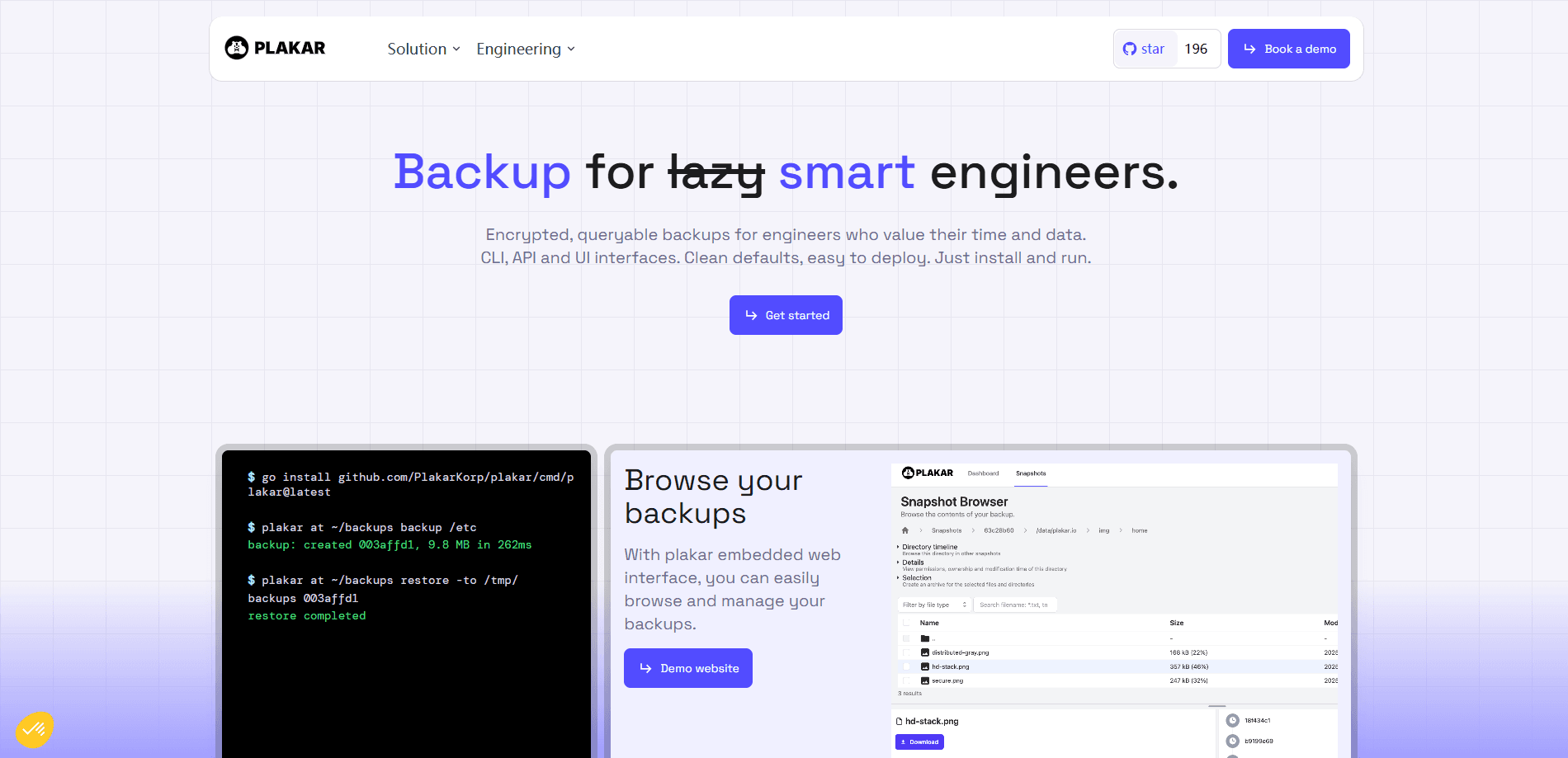
You can mount a snapshot as a browsable filesystem and pull out a single file, and the UI lets you browse snapshots, restore, manage integrations, and view alerts. Mounting over FUSE and HTTP means the backup shows up wherever you need it. This turns "find the version from last Tuesday" into a browse, not a full restore.
Pros and cons
Pros
- The core engine is open source under the ISC license, so you can audit it and run it without a license fee.
- Client-side deduplication and compression cut storage and egress costs, which matters most on large or repetitive data sets.
- Encryption keys stay under your control, and an independent audit backed up the crypto design.
- Broad integration coverage spans databases, cloud buckets, VMs, and SaaS apps from one tool.
- Control Plane folds in a free plan and code-based configuration, so small teams and IaC shops both fit.
Cons
- Some connectors, such as agentless VSS and SQL Server backups, are closed source and tied to Control Plane, so the open engine alone won't cover everything.
- Self-hosting is the default model, which adds operational work compared to a fully managed backup service.
- Paid Control Plane pricing isn't published as a fixed tier, so larger teams need to talk to sales to budget.
Frequently asked questions
Plakar is used to back up and restore data, from single files to databases, cloud buckets, and full machines. It handles the snapshot, storage, and recovery work, and it keeps costs down by deduplicating and compressing data before it's written.
Related content
Explore related tools, skills, and articles for Plakar.
Plakar Alternatives

Odyssey 3
Odyssey · OtherOdyssey-3 is Odyssey's foundation world model. It simulates physics in real time, turns a prompt into an interactive environment, and adapts to robots, cars and games.

JarvisCore
Prescott Data · Coding · Productivity · OtherJarvisCore is an open source Python runtime where AI agents work as equal peers on an agent mesh, claim tasks from a shared ledger, and reach external services through a zero-trust broker.
Clef
Cloudflare · Business · OtherClef is Cloudflare's open-source decision model for Workers AI. It returns calibrated probabilities for typed questions, not generated text, so agents can classify, route, and act fast.