

Plouton AI
Plouton AI · Business
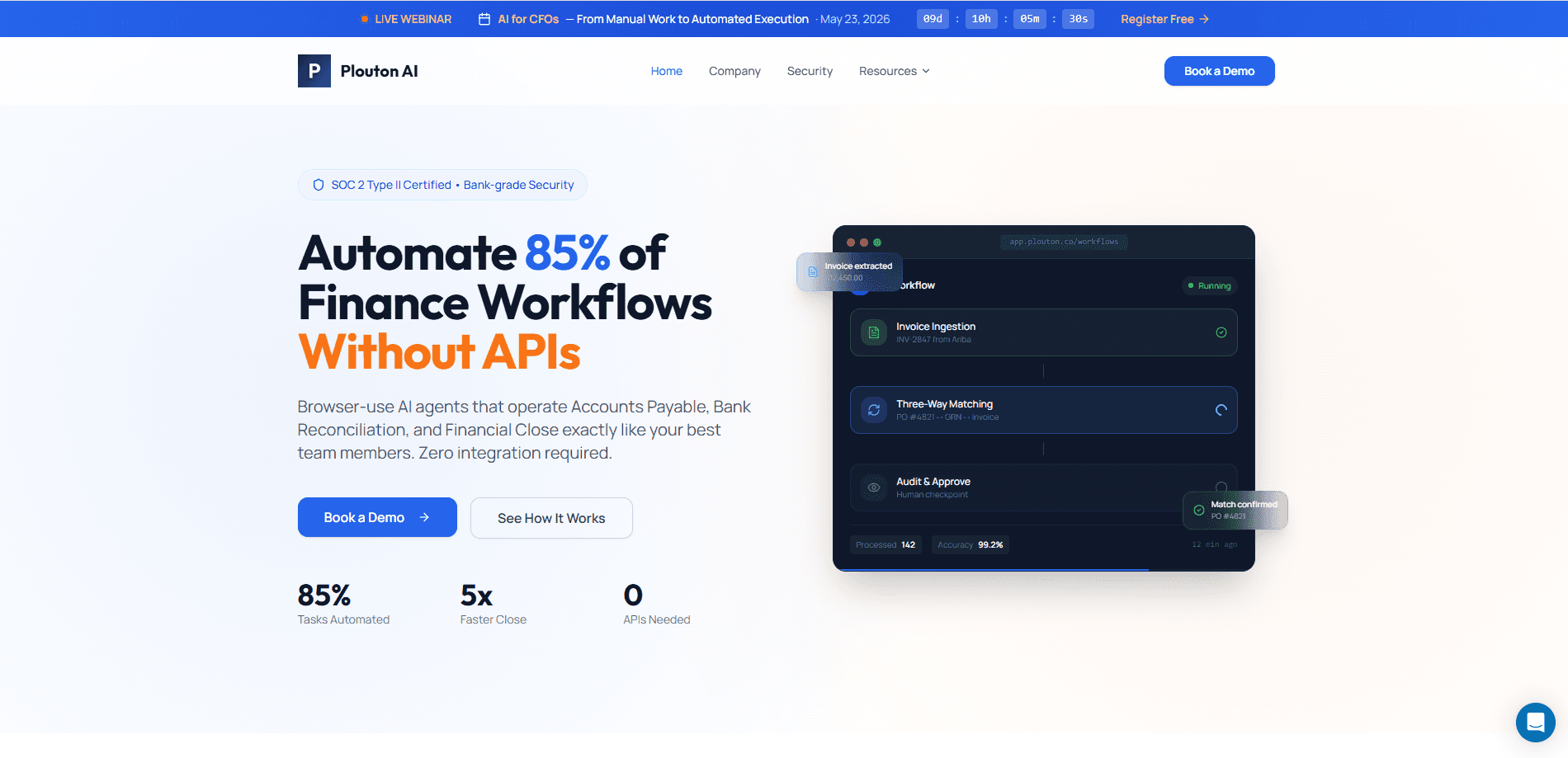
Plouton AI is a browser-based AI agent platform built to run finance work inside the tools a company already uses. Instead of asking teams to migrate to a new financial system, it logs into existing portals the way a person would and handles accounts payable, bank reconciliation, and month-end close. It carries SOC 2 Type II certification, logs every action for audit, and works without APIs. Think of it as month-end close automation and accounts payable automation that runs inside your portals, not on top of them. It's a no-code finance automation layer for teams that don't want a rebuild. The bank reconciliation software side is the sharpest piece: it matches records, then leaves you the exceptions.
About Plouton AI
What Is Plouton AI
Plouton AI is a browser-based AI agent platform for finance teams. It automates accounts payable, bank reconciliation, and month-end close by operating inside the finance portals a company already runs, rather than replacing them. That covers the messy, repetitive work that eats the back half of every month: pulling invoices, matching transactions, and chasing the balances that never quite line up.
The pitch is aimed at companies whose accounting lives in tools that don't talk to each other. Plouton AI works without APIs, so you don't need a system that exposes a clean integration surface. It drives the actual web interfaces instead. Every move it makes is logged for auditability, and it carries SOC 2 Type II certification plus bank-grade security controls.
There are limits worth knowing up front. Because it runs in the browser, agent speed depends on how responsive those portals are. Any site that blocks automated logins can get in the way. Plouton AI also doesn't publish public pricing or a live API on its site, so exact costs and the depth of any developer integration are things you'd have to confirm with the vendor.
Getting Started
- Book an introductory call with the Plouton AI team through the official site and describe your current finance stack.
- Have the vendor connect the finance portals you already use, since the platform drives existing interfaces rather than a fresh system.
- Grant access credentials for accounts payable, bank reconciliation, and close workflows.
- Run a first cycle in a supervised mode, so your team reviews and approves each automated action.
- Move to regular autonomous runs once you've confirmed the agent handles your portals and rules correctly.
Product Information
A quick look at Plouton AI's pricing, supported platforms, and performance.
Best for
The users, tasks, and scenarios where this tool fits best.
Users
- Finance and accounting teams
- Controllers and finance managers
- Operations leads at companies with legacy finance tools
Tasks
- Accounts payable processing
- Bank reconciliation software
- Month-end close automation
- Audit preparation
Scenarios
- A lean finance team closing on a fixed calendar
- Companies moving off spreadsheets
- Teams handling high invoice volume
Key features
Browser-based finance agents
Plouton AI runs as an agent that operates inside the finance portals you already use. It works through the web interface the way a person would, which matters if your accounting tool never offered an API to begin with. Nothing gets ripped out. You just point it at the tools you run today.
Accounts payable automation
The platform handles accounts payable work, from invoice intake through posting it where it belongs in your system. That removes the copy-and-paste cycle that slows down AP clerks and introduces errors. Fewer typos. Faster turnaround. Your team ends up reviewing instead of typing.
Bank reconciliation
Plouton AI matches bank records against the ledger and isolates the items that don't reconcile. Reconciling every line by hand is where most of a busy month disappears. The agent narrows that work to exceptions, which is a much shorter list.
Month-end close support
It runs the recurring steps that make up month-end close, inside the portals your team already knows. Closing rarely fails because of one hard task. It fails because of many small ones stacked together. Automating the routine steps shortens the whole stretch.
No-API integration
Working without APIs is the core design choice here. Plouton AI doesn't need a company's finance systems to expose a clean interface, so it fits stacks that were never built for automation. Is that a big deal? For anyone stuck with older tools, yes. That's a real difference.
Audit logging
Every action the agent takes is logged, which keeps the automation reviewable. When auditors or internal reviewers ask what changed and why, you have a trail to point to. For finance work specifically, that traceability is the point.
SOC 2 Type II and bank-grade security
Plouton AI carries SOC 2 Type II certification and bank-grade security controls. That's a meaningful check for finance data, since it speaks to how the vendor handles access and controls. It doesn't replace your own review, but it sets a floor.
Supervised runs
The platform supports keeping a human review and approval step in the loop. You don't have to hand over the books on day one. Teams can start supervised, confirm behavior, then widen what the agent handles.
Pros and cons
Pros
- Works inside existing finance portals rather than forcing a system migration, so switching cost stays low.
- Covers three related jobs (accounts payable, bank reconciliation, and month-end close) instead of just one.
- No-API design means it fits accounting tools that never exposed an integration surface.
- SOC 2 Type II certification and bank-grade security give finance and compliance reviewers something concrete to check.
- Audit logging keeps automated actions traceable, which matters for internal and external review.
Cons
- Public pricing isn't listed, so you can't compare cost before talking to sales.
- No API availability means developers can't build custom integrations on top of the platform.
- Running through browser interfaces can be slower and more fragile than a native system integration, especially on portals that block automated logins.
- No free plan means there's no self-serve way to test the platform before committing.
Frequently asked questions
It automates finance work, specifically accounts payable, bank reconciliation, and month-end close. It runs inside the finance portals you already use rather than replacing your accounting system.
Related content
Explore related tools, skills, and articles for Plouton AI.
Plouton AI Alternatives

Knocket
Knocket (Tencent RTC team) · Productivity · Business · ChatbotKnocket is a free live chat and contact page tool that lets visitors message you from your website, app, or a shareable link, with every reply handled from Telegram or one inbox.

shippedit.me
Krawlup · Marketing · Businessshippedit.me now redirects to Krawlup, a web platform that audits SEO, AEO and page speed every week, then hands the fixes to AI coding agents over MCP.

Ayven
Alknoma · Productivity · BusinessAyven is an AI control centre by Alknoma that turns a plain-language goal into a dated plan, hands the work to your people and AI agents, and asks for your approval only when the call is yours.