

Plugins Radar
Plugins Radar · Marketing · Business
Plugins Radar tracks where your ChatGPT plugin ranks in directory and in-chat search, which competitors outrank it and what changed, with hourly checks on 9,885 listings.
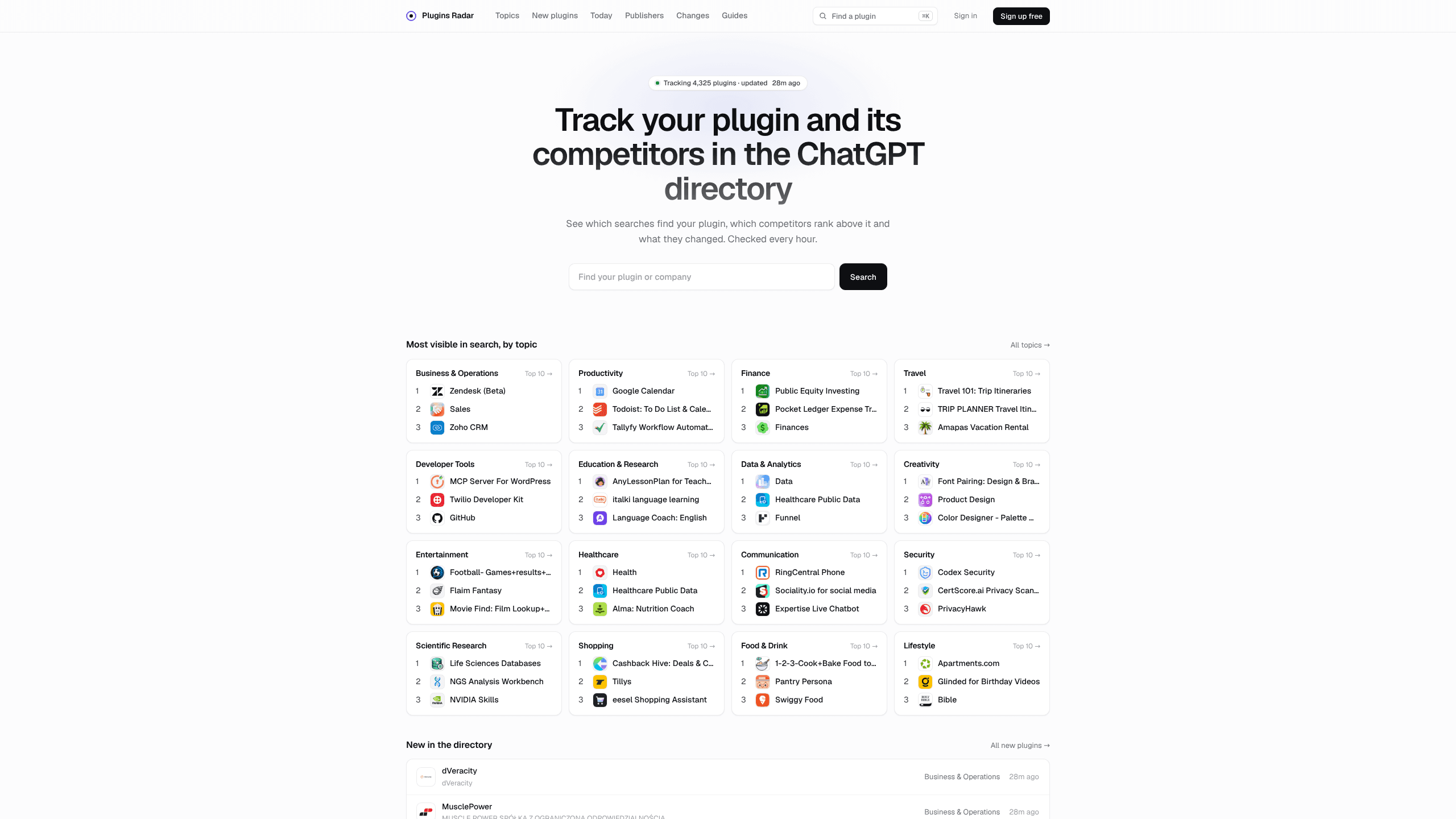
About Plugins Radar
What Is Plugins Radar
Plugins Radar is a ChatGPT plugin rank tracker that watches the public directory and reports how listings perform in search. The web dashboard reads that directory every hour, records each plugin's position for 532 fixed searches across 16 topics, and keeps every version of the pages it checks. The result is a timeline: when a plugin appeared, where it moved, and which rivals moved with it.
The problem it solves is visibility. The directory returns one list of up to 50 results with no second page, and most people never scroll past the first few. A plugin can sit there for weeks without appearing for the words its buyers type. Plugins Radar shows those gaps, names the plugins that fill them, and scores your listing against the 20 most visible listings in your category.
Scope is narrow by design. It only covers plugins already in the public ChatGPT directory, so it says nothing about visibility in Google, Perplexity or Claude. Scores are its own measurement rather than OpenAI data, and the site states plainly that it isn't affiliated with OpenAI. That independence is useful, but it also means you're trusting a third party's model of how the directory orders results.
Getting Started
- Open pluginsradar.com and search for your plugin by name. The public page shows its search positions, category page rank and listing score without an account.
- Create a free account with a work email. There's no password, since the site emails a sign-in link that also creates the account on first use.
- Add the plugin and the rivals you want to watch. Competitors can be picked from the plugins that already share searches with yours.
- Read the search table. Each tracked search lists your current position, a 7-day line, the number of results and the plugin holding #1.
- Work through the listing check in order of weight, then look again after the next hourly update, since a name or tagline edit shows up in the following pass.
Product Information
A quick look at Plugins Radar's pricing, supported platforms, and performance.
Best for
The users, tasks, and scenarios where this tool fits best.
Users
- Indie plugin developers
- Growth and SEO leads at SaaS companies
- Product marketers who write the copy
Tasks
- Weekly rank checks
- Competitor tracking
- Auditing a listing before submission
- Finding words you're missing
Scenarios
- A plugin with no installs
- The morning after a competitor edits its tagline
- Deciding what to build next
Key features
Hourly checks on the whole directory
Plugins Radar reads the public directory pages every hour: the home page, the 16 category pages, individual listings and the results for 532 searches. As of early November 2026 it covers 9,885 listings, split into 8,758 apps and 1,127 Codex plugins. Every version is stored, so the site can show a plugin appearing, moving or editing its copy, not just where it sits today.
Search positions with a 7-day line
Each plugin page opens with four numbers: rank within its topic, rank across all plugins, position on its category page and a listing score. Below that, every tracked search gets a row with the current position, a 7-day chart, the number of results and the plugin at #1. Directory rankings hold fairly steady. 65% of searches had the same leader through the week of Oct 26 to Nov 1, and only 7.3% kept an identical top 10.
Competitor maps built from shared searches
Competitors are the plugins that appear alongside yours for the same queries, wherever the directory files them. A CRM plugin competes with a sales email plugin if both show up for "sales". This catches cross-category rivalry that a category page hides, and it changes the question you ask: your real competition is whoever holds #1 for the words you want.
Keyword gaps
The gap table lists tracked searches where your closest competitors reach the top 10 and your plugin doesn't appear at all. On GitHub's page, "product review" shows up as a gap with a competitor sitting at #3. Gaps are the most concrete part of the product, because each row names a search, a rival and the position to beat.
Listing check with weighted scoring
The listing check compares your name, tagline, example prompts, description and links with the 20 most visible plugins in your category, then scores each item by how much it moves search rank. Name matches carry the most weight: Plugins Radar reports that 53% of top-3 results have the search term in the name. A score of 35 out of 100 against a leader average of 58 tells you how far the copy has to travel.
Change feed and Featured page tracking
The Today and Changes pages list new plugins, removed plugins, listing edits and the biggest moves. Featured placement gets its own view: 50 slots picked by OpenAI, with 77 changes in the week to Nov 1. For a maker whose installs jumped after a home page feature, this is the only public record of when that slot changed hands.
Visibility in ChatGPT conversations
Directory search is one surface. Plugins Radar also checks answers to common category questions and records how often ChatGPT mentions a plugin in a suggestion card. On the GitHub page that section reports 28 answers checked, with the detail behind sign-in. It's the closest thing to measuring whether ChatGPT recommends you when nobody types a plugin name.
Pros and cons
Pros
- Free for the basics: positions, category rank and listing score are visible on every public plugin page with no account.
- Hourly refresh with history behind it, so a drop can be dated to a day instead of noticed a month late.
- The competitor model uses shared searches rather than categories, which surfaces rivals that a category view misses entirely.
- The methodology page states what changed and when. The tracked search set grew from 192 to 532 in October 2026, and the site says older scores aren't comparable, which is more candor than most rank trackers offer.
- The change feed covers competitors' edits to names and taglines, the two fields that decide directory rankings.
Cons
- ChatGPT directory only. No Google, Perplexity, Claude or Gemini coverage, so it can't replace a general ChatGPT app visibility tool.
- Proprietary scores. The listing check shows its weights, but the search weighting and the 0 to 100 topic score are Plugins Radar's model, not OpenAI's ranking.
- An account is needed for the useful half. Keyword gaps beyond the first rows, in-chat visibility and full listing checks all sit behind email sign-up.
- No public API or data export shows up on the site, which blocks teams that want these numbers in a dashboard next to their other SEO data.
Frequently asked questions
Yes. Browsing any plugin page costs nothing and needs no account. A free email sign-up unlocks the longer tables, the full listing check and the ChatGPT visibility section. No paid tier is published.
Related content
Explore related tools, skills, and articles for Plugins Radar.
Plugins Radar Alternatives

ngram 2.0
ngram · Video · Marketingngram 2.0 is an AI video generator for teams. It turns a prompt, a screen recording, or a product URL into a narrated explainer, product demo, or AI avatar video, and every scene stays editable.

shippedit.me
Krawlup · Marketing · Businessshippedit.me now redirects to Krawlup, a web platform that audits SEO, AEO and page speed every week, then hands the fixes to AI coding agents over MCP.

MePersona
MePersona, Inc. · Writing · Productivity · MarketingMePersona is an AI unified inbox for creators. It learns your voice, drafts replies to fan messages from 12 platforms, and sends only what you approve.