
Pocket Adviser AI Stock Market Adviser
Pocket Adviser · Business
Pocket Adviser is an Australian AI stock market adviser that turns your goals into a personalised ASX ETF portfolio and adjusts the plan as your situation changes. Access runs through a waitlist.
About Pocket Adviser AI Stock Market Adviser
What Is Pocket Adviser
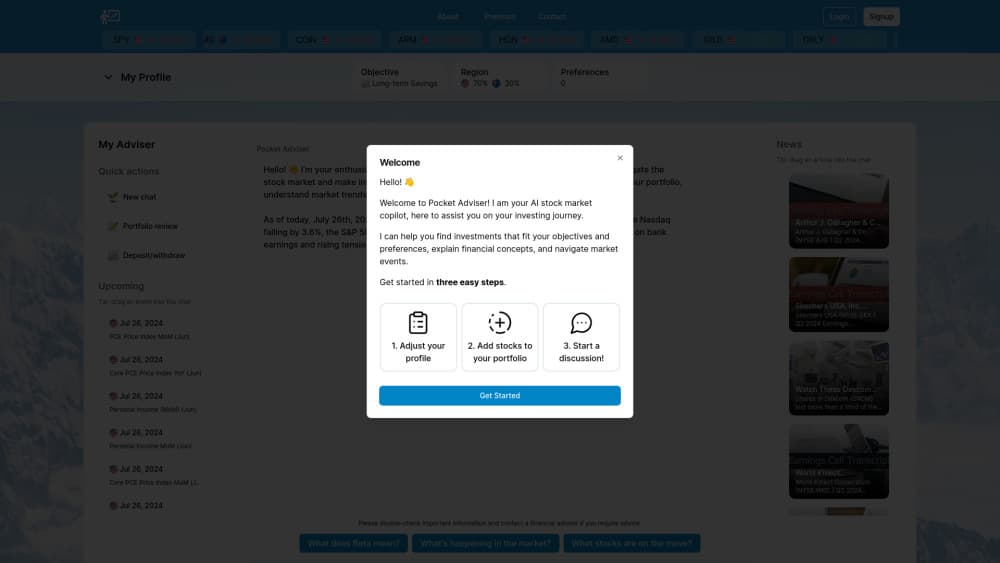
Pocket Adviser is a digital financial advice service built for Australians who want a real investment plan without paying a human adviser several thousand dollars a year. It's an unusual product in a market where robo advice has mostly stayed theoretical. You answer questions about your goals, income, debts, and comfort with risk. The software then builds a portfolio of ASX-listed ETFs and explains why each holding sits in it.
The company is based in Melbourne and was founded in 2024 by Lachie Duncan, who left a financial advice career to build it. In October 2026 it received the green light from ASIC to give advice through its own algorithm for two years under the Enhanced Regulatory Sandbox exemption. That exemption covers investment advice on exchange-traded funds listed on the ASX, and nothing wider.
The narrow scope is the first thing to know. Pocket Adviser doesn't pick individual shares, doesn't touch crypto, and doesn't advise on overseas markets. It's also not open to everyone yet: sign ups go onto a waitlist and get let in over time, with pricing still unpublished. If you're outside Australia, the service isn't built for you at all.
Getting Started
- Join the waitlist on pocketadviser.com.au with your email, then wait for an invitation.
- Once you're in, answer the onboarding questions on your goals, timeframe, income, savings, and existing debts.
- Review the portfolio the algorithm proposes, including the ETFs and the reasoning behind each one, before you commit.
- Connect your bank and investment accounts so the app can track spending and portfolio progress in one place.
- Revisit the plan when your circumstances shift and the advice updates with them.
Product Information
A quick look at Pocket Adviser AI Stock Market Adviser's pricing, supported platforms, and performance.
Best for
The users, tasks, and scenarios where this tool fits best.
Users
- Australians in their twenties and thirties starting out
- People who've been quoted four figures for a financial plan
- Self-directed investors who want a second opinion
Tasks
- Building a first ETF portfolio
- Checking whether your investments still match your goals
- Getting spending under control in the same place you invest
- Explaining a portfolio to yourself in plain language
Scenarios
- A first $5,000 you want working instead of sitting in a savings account
- Preparing for a goal with a date attached, such as a house deposit or a move overseas
- A market sell-off that has you second guessing
Key features
Personalised portfolio construction
The algorithm takes your goals, time horizon, income, debts, and risk tolerance and produces a portfolio of ASX-listed ETFs with target weightings. You see the reasoning for each fund, not just a list of tickers. The output is tailored to your situation, which is the main difference from a generic model portfolio you'd copy from a blog. It behaves like an AI financial adviser with a deliberately small remit.
ASX ETF focus
Advice is limited to exchange-traded funds listed on the ASX, with no single stocks and no overseas exchanges. That constraint keeps the recommendation set small enough to explain clearly. It also means the service can't help if your goal is picking growth shares or buying US tech directly.
Advice that updates with you
The plan is dynamic rather than a one-off document. When your savings rate, debts, or goals change, the recommendation changes with them, and market movement feeds into the review. You're not left holding a plan written for the person you were two years ago.
Account connections and progress tracking
You can link bank and investment accounts so the app shows your portfolio value and progress toward each goal in one view. Spending gets sorted automatically, which makes the monthly "how much can I invest" question a lookup rather than a spreadsheet exercise.
Budgeting in the same app
Budgeting sits inside the product instead of being sold separately. You build a budget, align spending with your goals, and get suggestions on where money is leaking. For someone whose real problem is cash flow rather than asset allocation, this is the part that gets used weekly.
Regulated advice framework
Pocket Adviser operates under ASIC's Enhanced Regulatory Sandbox, which holds it to the same conduct obligations as a licensed adviser for the two year exemption period. It's also a member of the Australian Financial Complaints Authority, so disputes have an external path. That structure matters more here than in most AI tools, because the output is financial advice.
Pros and cons
Pros
- Advice tailored to your actual numbers instead of a template portfolio, with written reasoning attached to each ETF.
- Far cheaper than the $4,668 average annual cost of financial advice in Australia reported for 2025.
- Investing and budgeting live in one app, so the plan connects to what you can actually save.
- Regulated under an ASIC sandbox exemption and covered by AFCA for complaints.
- Plain language explanations that make the portfolio understandable to someone with no finance background.
Cons
- Waitlist only, so you can't sign up and use it today, and pricing hasn't been published.
- Limited to ASX-listed ETFs, which rules out individual shares, international exposure beyond what those funds hold, and crypto.
- No API or integrations for developers, and no way to plug the advice into another planning tool.
- Built for Australian residents and Australian tax settings, so it's useless if you live or invest elsewhere.
Frequently asked questions
No free tier is advertised. Pricing hasn't been published while the service works through its waitlist, so the cost of advice is unknown until you're invited. The company's pitch is affordability compared with human advice, not zero cost.
Related content
Explore related tools, skills, and articles for Pocket Adviser AI Stock Market Adviser.
Pocket Adviser AI Stock Market Adviser Alternatives

Knocket
Knocket (Tencent RTC team) · Productivity · Business · ChatbotKnocket is a free live chat and contact page tool that lets visitors message you from your website, app, or a shareable link, with every reply handled from Telegram or one inbox.

shippedit.me
Krawlup · Marketing · Businessshippedit.me now redirects to Krawlup, a web platform that audits SEO, AEO and page speed every week, then hands the fixes to AI coding agents over MCP.

Ayven
Alknoma · Productivity · BusinessAyven is an AI control centre by Alknoma that turns a plain-language goal into a dated plan, hands the work to your people and AI agents, and asks for your approval only when the call is yours.