

Pokee AI
Pokee AI · Other
Pokee AI is an enterprise AI agent platform that turns a single plain-language instruction into a finished multi-step task across more than 90 connected tools. Instead of stitching together scripts and manual handoffs, teams point Pokee at documents, code repos, tool catalogs, and conversation history, then let its reasoning engine plan, act, verify, and cite each step. The pitch is simple. Same agents, your choice of boundary. You can run a Pokee-managed tenant, or go all the way to fully air-gapped hardware. It's built for companies that want an AI workflow assistant without shipping their data to somebody else's servers.
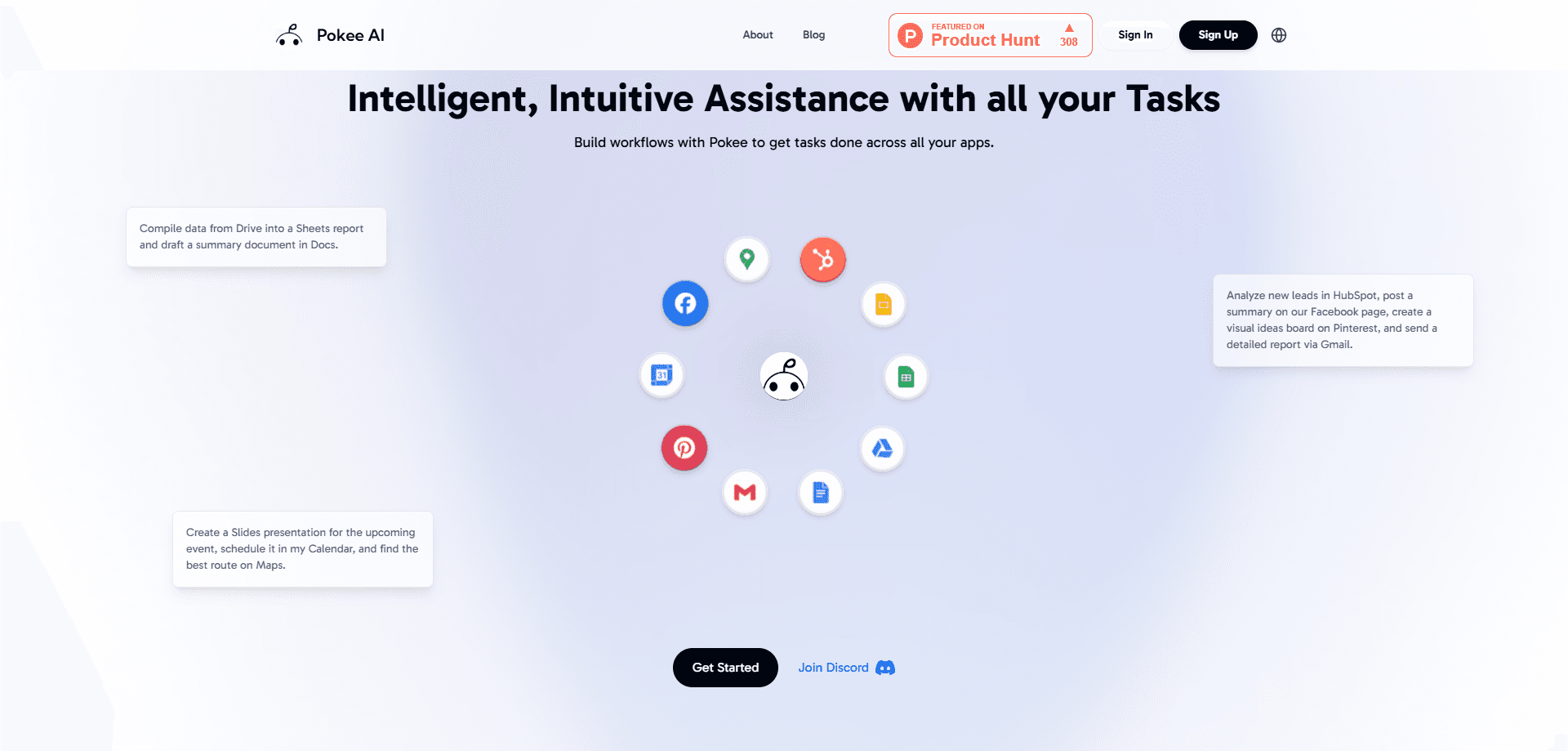
About Pokee AI
What Is Pokee AI
Pokee AI is an AI agent platform that acts as an AI workflow assistant, automating complex digital work across many apps at once. You describe the outcome you want, and the system breaks it into steps, picks the right tools, runs them, and checks the result against your sources. It's less a chatbot and more a workflow assistant that can touch your actual systems. That distinction matters. Advice is cheap. Actually doing the task is the hard part.
The company behind it, Pokee AI, was founded in 2024 and is based in Bellevue, Washington. It's backed by investors including Point72 Ventures, Qualcomm Ventures, and Samsung NEXT Ventures, and it's a Google Cloud Select Technology Partner. The platform's own model, Pokee-Isaac, is paired with a tool-use runtime that plans, acts, verifies, and cites, and it's trained with reinforcement learning across nine enterprise verticals.
The most important limitation is who it's for. This is an enterprise product, not a casual consumer app. The self-serve plans start free, but private deployment inside your own VPC or on-premise still means talking to a sales team. If you're a solo user who just wants a cheap AI helper, you'll be paying for infrastructure and compliance features you don't need. That's not a knock on the product. It's just the wrong fit.
Getting Started
- Create an account at pokee.ai and start on the free plan, which includes 500 credits per month.
- Connect the tools you want the agent to reach, such as documents, code repositories, or your existing SaaS catalog.
- Describe the goal in plain language, for example "pull last week's promo numbers and draft a summary."
- Review the plan the agent proposes, then let it run the steps and check its cited sources.
- For private deployment, request an enterprise demo and have Pokee scope a dedicated tenant, VPC, or on-premise build.
Product Information
A quick look at Pokee AI's pricing, supported platforms, and performance.
Best for
The users, tasks, and scenarios where this tool fits best.
Users
- Enterprise operations teams
- Finance and legal analysts
- IT and security leads
Tasks
- Cross-app reporting
- Document research at scale
- Contract drafting and redlining
Scenarios
- Weekly promo performance reports
- Amazon product research
- Clinical drafting and prior-authorization
Key features
Long-Context Reasoning Core
The engine behind Pokee AI, called Pokee-Isaac, works with a native context window of several million tokens. In practice that means it can hold an entire case archive, a full codebase, or a year of reports in view at once instead of losing the thread after a few pages. For legal and research work, that's the difference between answering a question and answering it with the right context. Big deal for anyone drowning in documents.
Tool-Use Runtime With Verification
Pokee's agent engine runs a plan, act, verify, and cite loop. It doesn't just produce an answer, it executes steps across your connected tools and then checks the output against your sources. Citations are part of the output, which matters when a wrong number can cost real money. How much do you trust an agent that won't show its work? The runtime is trained with reinforcement learning across nine enterprise verticals, so it's tuned to specific industries rather than being a generic chat agent.
Deployment Inside Your Own Boundary
You can run the same agents in a Pokee-managed tenant, inside your AWS, GCP, or Azure account, on your own hardware, or in a fully air-gapped setup with no internet egress. Data never touches another tenant. For regulated industries, this is usually the feature that decides whether a tool is even allowed in the door. No private AI deployment, in many cases, means no deal.
90+ Tool Integrations From One Instruction
A single natural-language request can span more than 90 SaaS tools, so the agent moves between your CRM, catalog, documents, and messaging without a human relaying data. That's what makes it a workflow assistant rather than another single-purpose bot. It's also where the credits go, since heavy cross-tool runs cost more than simple prompts. Plan accordingly.
Vertical-Tuned Custom Builds
Beyond the self-serve product, Pokee builds custom deployments for finance, healthcare, e-commerce, law, education, and manufacturing. Those builds wire the agent to your APIs, your data shape, and your compliance posture, and they're delivered by a Pokee solutions team end to end. The result is supposed to be useful from day one instead of after months of prompt tuning.
Pros and cons
Pros
- Runs agents inside your own cloud, VPC, or on-premise hardware, which clears a common blocker for regulated teams.
- Long-context core handles multi-million token inputs, so whole archives stay in view.
- Verified, cited output suits finance and legal work where sources have to be checkable.
- Free tier with 500 credits a month lets you test real workflows before paying.
Cons
- Private deployment means contacting sales; there's no fully self-serve path to a VPC or on-premise setup.
- Credits, not seats, drive cost, so heavy cross-tool automation can climb quickly past the listed plan prices.
- The product is built for enterprises, so individuals and small teams pay for infrastructure and compliance features they likely won't use.
- Public, non-enterprise details are thin, and some capabilities are documented only for specific verticals.
Frequently asked questions
It's an AI agent platform that executes multi-step tasks across your connected apps from one plain-language instruction. Think of it as a workflow assistant that plans, acts, and verifies rather than a chat window that only gives advice.
Related content
Explore related tools, skills, and articles for Pokee AI.
Pokee AI Alternatives
BinkBink
BinkBink · OtherBinkBink is a free online game platform and AI game maker that lets anyone turn a short text description into a playable browser game. You can jump into hundreds of community-made games. Or describe your own idea and play it in seconds, then share it with friends. Want to create your own game? You don't need to code. No engine setup, no download, no hassle.

Audiogen
Audiogen Inc. · OtherAudiogen is an AI music generator built by Audiogen Inc., a small research team that spent about 2.5 years training its own generative music model and designing a web interface around it. Instead of a plain text box, this AI music tool turns the timeline into a beginner-friendly Generative Audio Workstation, or GAW, where inpainting, extending, remixing and stem editing work more like painting on a canvas. The product is still in beta, so access runs through a waitlist or an invite. Paid plans aren't published yet.

Aiml API
AIMLAPI OÜ · OtherAiml API is a unified AI model API that puts more than 1000 models from OpenAI, Google, Anthropic, and others behind one endpoint and one bill. You write code against a single OpenAI-compatible schema, then switch between chat, image, video, and audio models by changing a model string. It suits developers and small teams who want multi-model access without juggling a dozen separate provider accounts, and it removes the usual billing headache that comes with testing several vendors. One key covers it all.