

PolygrAI
PolygrAI · Other
PolygrAI is an AI interview platform that reviews video answers and flags stress or possible deception from voice, face, and language cues. It's built for hiring, claims, and investigations.
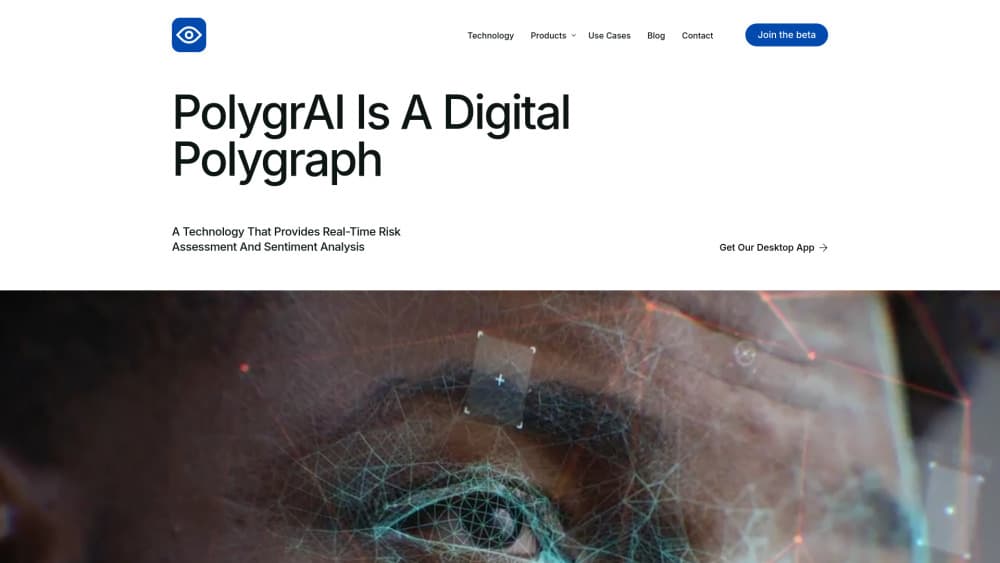
About PolygrAI
What Is PolygrAI
PolygrAI is browser-based deception detection software sold to companies rather than to people. You send someone a video interview link, or upload footage you already have, and the system returns a report: a transcript, per-statement risk scores, emotional signals, and a personality profile. No chest strap, no finger clip, no sensors at all. The camera the candidate already owns does the work.
The pitch is simple. A human interviewer forms an impression in the first minute and then spends the rest of the call confirming it. PolygrAI tries to replace that gut call with a consistent set of measurements applied the same way to every person. It reads facial micro-expressions and eye movement, tracks pitch, pace, and pauses in speech, checks how answers are phrased, and layers a psychometric read on top. The company calls the result an AI polygraph, sometimes an AI lie detector, and it markets the tool to recruiters, insurers, banks, police units, and security teams.
The limits matter more than the features here. PolygrAI says its system will never reach absolute accuracy and shouldn't be treated as a verdict on whether someone lied. The output is a risk indicator, not proof. Using it without the subject's consent is illegal in many places, and courts generally don't accept automated cue analysis as evidence. The company also states the product is under active development, so scores should sit alongside interviews, references, and documents rather than replace them.
Getting Started
- Create an account on polygr.ai and pick a plan. The free tier gives you 30 minutes a month, which is enough to run one or two short interviews and see how the reports read.
- Build the interview in the dashboard, either by writing questions yourself or by letting the AI interview builder draft them from a role description or a case brief.
- Send invitations by email or SMS, or upload a recording you already have to the Analyzer. Consent capture is part of the invitation flow.
- Open the finished report to read the transcript, statement-level risk scores, sentiment shifts, and the psychometric summary, then export or share it with whoever makes the decision.
Product Information
A quick look at PolygrAI's pricing, supported platforms, and performance.
Best for
The users, tasks, and scenarios where this tool fits best.
Users
- Recruiters filling sensitive roles
- Claims investigators at insurers and lenders
- Small legal and compliance teams
Tasks
- High-volume first-round screening
- Reviewing recorded statements
- Second-pass review of a written claim
Scenarios
- A recruitment agency screening 80 candidates across four countries in one week, using the 90 plus language support to keep the interview in each person's first language.
- An insurer handling a suspicious accident claim where the only material is a phone video taken by the claimant.
- An internal HR investigation into a harassment report, where two employees give conflicting accounts and the team needs a structured read before deciding on next steps.
Key features
Four Cue Streams in One Report
Most tools pick one signal. PolygrAI runs visual, vocal, linguistic, and psychological analysis on the same clip and shows them together. Visual analysis covers micro-expressions, gaze, posture, and gesture changes. Voice analysis measures pitch, tone, rhythm, volume shifts, and pauses. Linguistic analysis looks at how answers are structured and phrased. The psychological layer turns all of it into trait estimates. Reading four streams side by side is more useful than any single number, because a flat voice plus a steady face plus evasive wording tells a different story than any one of those alone.
Integrity Assessment With Statement-Level Scores
This is the core deception detection software product. Instead of one overall verdict, PolygrAI scores individual statements inside the transcript and raises a flag where the risk looks highest. That granularity is what makes the report usable in a conversation: you can point at a specific answer and ask a follow-up, rather than telling someone the algorithm thinks they're dishonest. Deception alerts are framed as potential, and the report includes the cue breakdown behind each score. Deepfake detection runs on the same pass, so a synthetic face or a cloned voice gets flagged before the cues are read.
An Interview Builder That Writes the Questions
The interview generator drafts question sets from a job description, a scenario, or a case type, drawing on behavioral science patterns rather than generic prompts. You can edit anything before sending. For teams that run the same interview every week, this removes the most tedious part of the job and makes sure every candidate in a batch gets a comparable experience. Skills evaluation runs on the same transcripts and lists the competencies a candidate actually demonstrated.
Psychometric Profiles
Beyond truth scoring, PolygrAI produces a psychometric profiling report covering motivation, risk appetite, and decision style. Recruiters use it to check culture fit and to spot candidates who interview well but might struggle in the role. Underwriters and investor teams use it in the same way for counterparties. Treat it as a structured hypothesis, not a diagnosis. Personality instruments built on short video samples don't carry the validation of a proctored psychometric test, and the company doesn't claim they do.
Analyzer for Footage You Already Have
The Analyzer takes uploads, so you're not limited to interviews PolygrAI hosted. Drop in a recorded session, a press statement, or a call recording with video, and the video interview analysis produces the same transcript and cue report. The library lets you search across past reports by transcript text, which turns a folder of old interviews into something you can actually query. Analytics then rolls multiple reports into one view, useful when you need to see patterns across a hiring cohort or a set of claims.
Campaigns, 90 Plus Languages, and Enterprise APIs
Campaigns push one interview to an unlimited list of recipients and track completion. The platform handles over 90 languages, including non-English interviews analyzed in the original language, and the participant side works in a mobile browser with no app install. For platforms that want the analysis inside their own product, PolygrAI offers an Analysis API for bulk on-demand jobs, an Interviews API for automated workflows, and embedded interviews for apps and marketplaces. The APIs sit in the enterprise tier and require a sales conversation.
Pros and cons
Pros
- Nothing to ship and nothing to wear. Candidates use a browser and a webcam, so a study can start the same day.
- Statement-level scoring and transcript search make the report something an investigator can act on, not just a dashboard score.
- The free tier gives 30 minutes a month, enough to test the workflow on real interviews before committing to a plan.
- Broad language coverage and a mobile-friendly participant experience fit global hiring and remote claims work.
- Consent capture, encryption, and a stated GDPR and SOC 2 posture address the compliance questions that kill most tools in this category.
Cons
- PolygrAI is explicit that accuracy is not absolute and the output isn't a determination of truth, which limits how far any single report can carry a decision.
- Pricing runs on interview minutes. Above your allowance, overage sits between $0.36 and $0.44 per minute, and a 40 minute interview costs real money at volume.
- Consent and legality are on you. Workplace emotion recognition is banned in the EU outside medical and safety uses, and several US states restrict lie detector style testing of employees.
- There's no published, peer-reviewed accuracy benchmark. Buyers are trusting vendor claims and their own pilots, which is thin ground for a tool used in hiring and claims.
Frequently asked questions
No. A polygraph measures breathing, pulse, sweat, and blood pressure with sensors strapped to the body. PolygrAI works from video and audio only, and it markets itself as an AI polygraph in the looser sense of reading behavioral cues. Treat it as a risk screening tool, not a lie detector test.
Related content
Explore related tools, skills, and articles for PolygrAI.
PolygrAI Alternatives

Odyssey 3
Odyssey · OtherOdyssey-3 is Odyssey's foundation world model. It simulates physics in real time, turns a prompt into an interactive environment, and adapts to robots, cars and games.

JarvisCore
Prescott Data · Coding · Productivity · OtherJarvisCore is an open source Python runtime where AI agents work as equal peers on an agent mesh, claim tasks from a shared ledger, and reach external services through a zero-trust broker.
Clef
Cloudflare · Business · OtherClef is Cloudflare's open-source decision model for Workers AI. It returns calibrated probabilities for typed questions, not generated text, so agents can classify, route, and act fast.