

Polylane
Coreplane Labs · Coding · Business
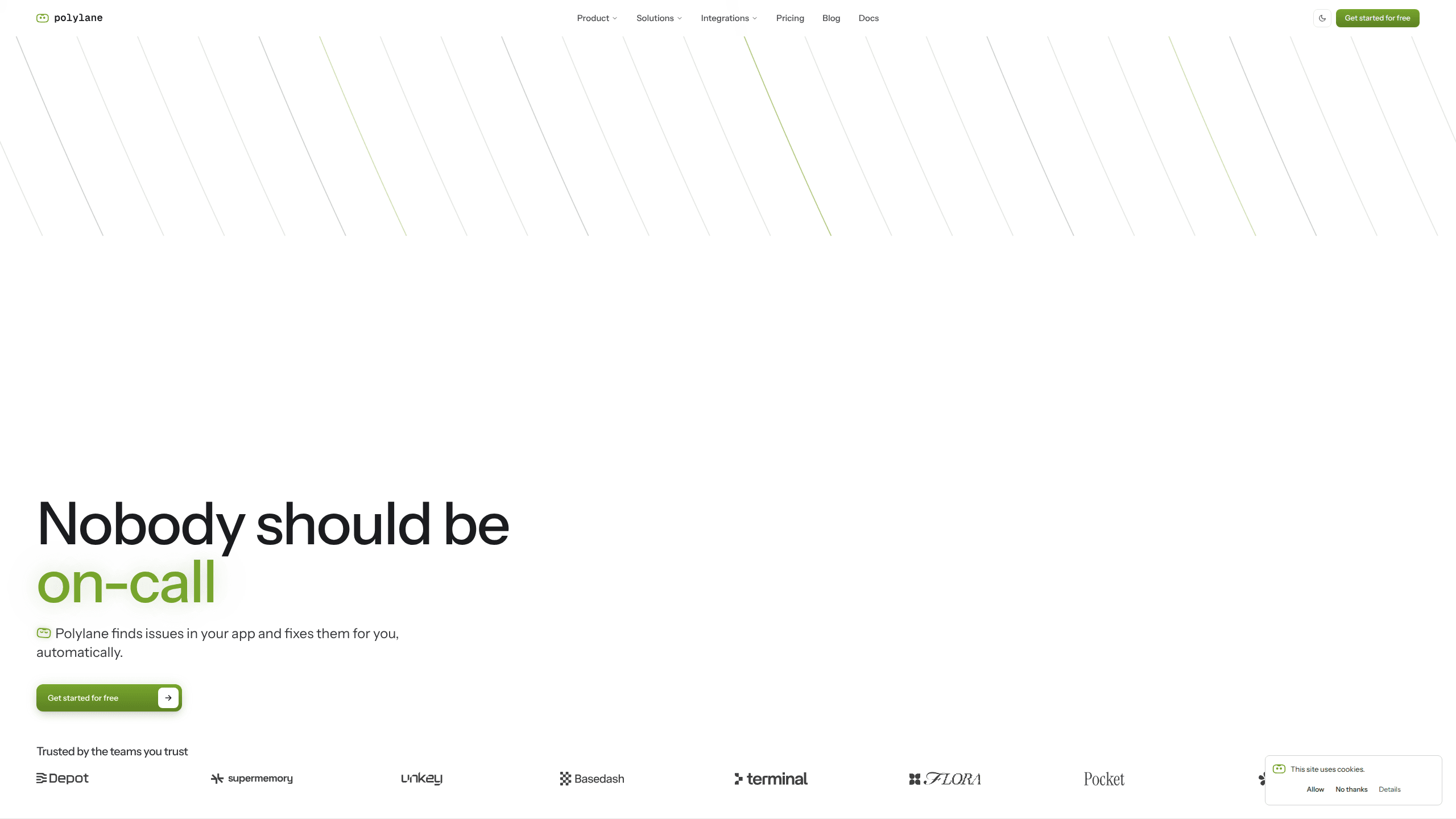
Polylane is an AI SRE platform that watches your logs, metrics and traces, investigates production issues with cited evidence, and opens pull requests with fixes your team can review and merge.
About Polylane
What Is Polylane
Polylane is an AI operations platform from Coreplane Labs, a San Francisco company founded by Boris Tane. It runs one loop over production software: keep a live picture of what you deploy, notice when something drifts, work out why, and hand back a fix as a pull request. Nothing needs a new SDK on each host. The agents read the telemetry you already send to AWS, Cloudflare, Vercel, Datadog, Sentry or whichever providers your team pays for.
The gap it aims at is the space between a chart and a decision. A dashboard can show that checkout latency tripled at 18:00. Polylane tries to say which deploy, config change or code path did it, then writes the change that restores the previous behavior. On-call automation is the pitch, but a person still approves every merge.
Two limits shape how you'd use it. Polylane does not store your metrics and does not replace an observability vendor, so thin logs produce thin investigations. It also never touches production by itself. A fix lands as a branch and a pull request, with your CI and reviewers in the path.
Getting Started
- Run
curl -fsSL https://polylane.com/setup | bashon macOS or Linux. The script installs the CLI, connects coding agents on the machine and creates your account. - Connect cloud accounts and telemetry providers from the console. Start with the two or three services that carry your most important traffic.
- Connect GitHub or GitLab so agents can read repositories and open pull requests against them.
- Let the agents watch for a few days. Review the first issues, read the investigations, and decide whether the autofix pull requests are good enough to keep.
Product Information
A quick look at Polylane's pricing, supported platforms, and performance.
Best for
The users, tasks, and scenarios where this tool fits best.
Users
- Platform and SRE teams
- Small engineering teams without a dedicated on-call rotation
- Teams running Claude Code, Cursor or Codex
Tasks
- Incident triage
- Pull request impact review
- CI failure fixes
- Bug ticket investigation
Scenarios
- Overnight incidents
- Launch weeks
- Migrations and re-platforming
Key features
Context graph
Polylane builds a live map of resources, dependencies and code across your cloud accounts and observability providers. Each node carries its recent changes and open issues, so an investigation starts from real topology rather than a search through five consoles. The same graph is what your coding agent queries over MCP.
Issue detection without thresholds
Agents read the metric, log and trace series on a cadence and compare them with how each resource normally behaves. There is no threshold to tune and no rule to write. Anything your team already charts becomes a check, which is why a drop in tracked events or a queue that never drains can surface without a custom alert.
Investigations with evidence
An investigation walks the problem one step at a time and shows the query, log line or change record behind each claim. When a step has no support, the agent says so instead of filling the gap. Runs are transcripts you can watch, interrupt and share with the team.
Autofix pull requests
Once the cause is proven, Polylane writes the fix on a branch, tests it against the signal that raised the issue, and opens a pull request. Each fix covers one logical change, so unrelated repairs arrive separately. Your review and CI still gate the merge, and a failed fix is reported by email and Slack rather than retried silently.
Production impact review
Polylane reviews pull requests against the infrastructure they deploy to, whether an engineer or a coding agent opened them. It walks from the repository to the resources behind it, reads their criticality, recent changes and open issues, then leaves one comment. A failing verdict has to prove how a line in the diff breaks production, so passing is the default. Teams can turn on a blocking check that holds the merge until a later push clears it.
Slack agent and MCP access
Questions like who owns this service or what changed in the last hour can be asked in any Slack channel, and the answer cites the underlying query or change. Coding agents get the same data through one MCP endpoint with browser sign-in and OAuth handled for you. Reads are allowed by default, writes sit behind a default-deny policy, and nothing merges without a person.
Pros and cons
Pros
- Detection runs on telemetry you already collect, so setup is mostly connecting accounts rather than instrumenting every service again.
- Investigations carry links to the evidence, which cuts down the usual argument about whether a deploy or a database was at fault.
- Fixes arrive as reviewable pull requests with tests and a stated cause, not as changes pushed straight to production.
- The MCP endpoint gives Claude Code, Cursor, Codex and ChatGPT production context that those tools otherwise lack.
- The free plan is usable, with two cloud accounts, two seats and a monthly credit pool that resets.
Cons
- Results track the quality of your telemetry. Sparse logs or missing traces produce investigations that stop early, and the fix quality drops with them.
- Credits are usage-based, so a heavy incident month costs more than the sticker price. Overage is capped, but the cap is the part you have to configure.
- Agents never merge and never change production, so the promise of no on-call is only partial. Someone still reviews pull requests at some point.
- Most integrations rely on API keys and hosted services. Air-gapped or heavily restricted environments need work before the agents can read anything.
Frequently asked questions
It watches production, explains what broke and opens a pull request with a fix. The work spans detection, investigation, code review and on-call questions, all on top of telemetry you already send to your cloud and observability providers.
Related content
Explore related tools, skills, and articles for Polylane.
Polylane Alternatives

Base Code
Base44 (Wix) · Coding · ProductivityBase Code is a shared cloud development environment from Base44. Teammates describe changes to an existing GitHub codebase in chat, preview them live and send them back as pull requests.

Google EmbeddingGemma 2
Google DeepMind · Writing · Image · CodingGoogle EmbeddingGemma 2 is a 740M-parameter open model that turns text, code, images, audio, and video frames into vectors in one 768-dimension space, running on phones and laptops.

GitGlow
GitGlow · Coding · ProductivityGitGlow is a local-first desktop Git client that lets independent developers review their own code and their AI agents' changes in one place before shipping.