

Prava
Prava · Business
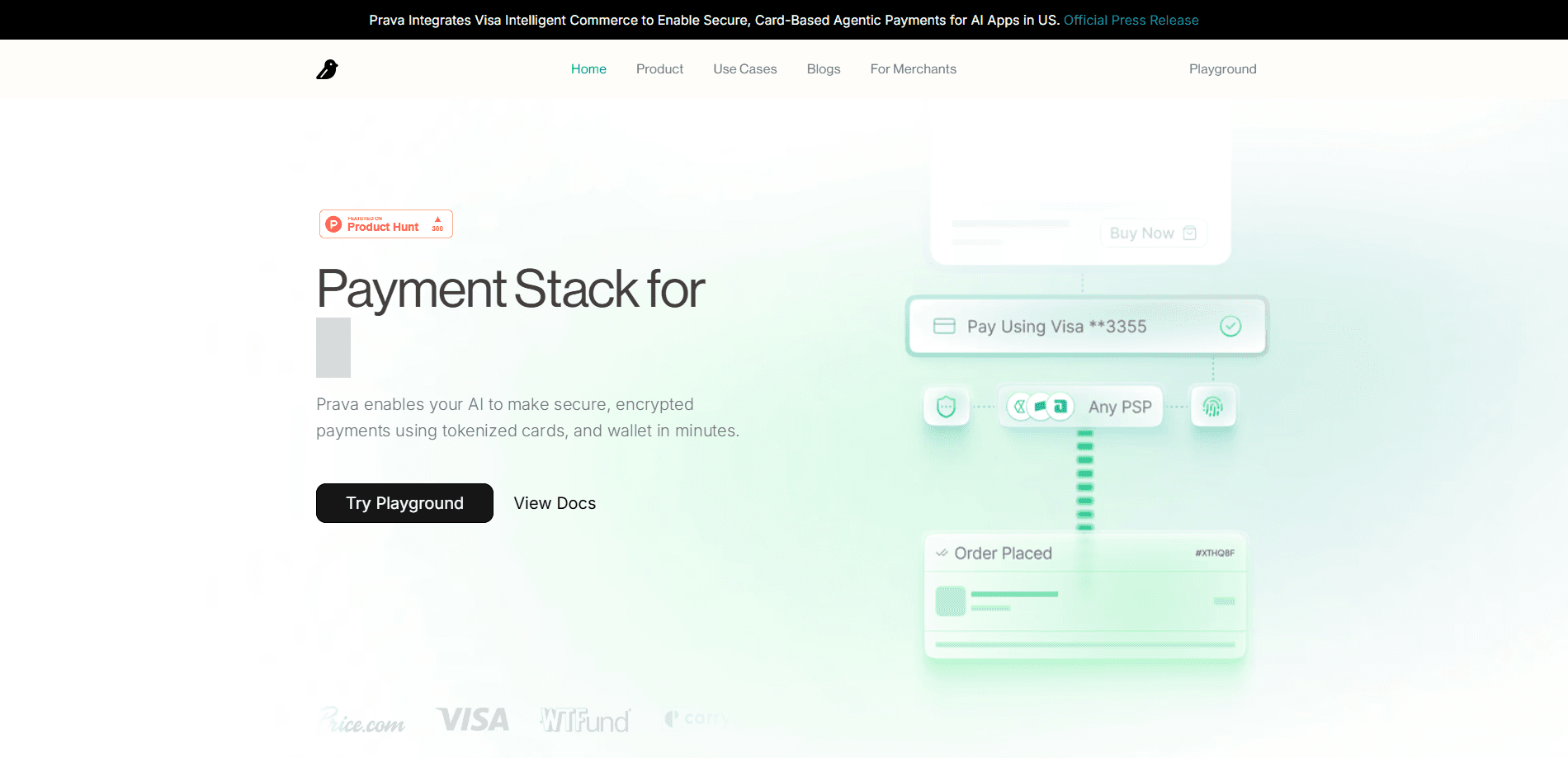
Prava is payment infrastructure for AI agent payments, letting AI applications complete purchases without sending users off to a merchant site. It trades a user's passkey approval for a one-time, merchant-scoped card credential, so an AI agent can check out while never seeing raw card numbers. Developers integrate the payment API for AI apps in a few lines of code through an API, SDK, or MCP connection.
About Prava
What Is Prava
Today's AI apps are good at finding things and bad at buying them. ChatGPT, Perplexity, and AI styling assistants can recommend a product, then hand the user a redirect link that drops them out of the conversation. Prava closes that gap. It's a payments orchestrator for AI agents, built around tokenization and passkey approval rather than raw card data.
The core idea is a programmable payment proxy. Instead of your agent holding card numbers, it holds permissions to spend. The agent asks for a specific merchant and amount, the user approves with Face ID or a fingerprint, and Prava exchanges that approval with the card network for an ephemeral credential. The result is a system where the agent's ability to buy is decoupled from the user's sensitive financial data.
Compliance is part of the pitch. Prava is PCI DSS Level 2 certified and works with Skyflow, a PCI DSS Level 1 vaulting provider. Tokenized cards stay hidden from Prava itself, from the AI app, and from the language model behind it. That's what PCI DSS compliant payments look like in practice. One limit to keep in mind: the platform is focused on US and Southeast Asia markets, so merchants and users outside those regions may find coverage thin.
Getting Started
- Sign up on the developer dashboard and grab your sandbox keys.
- Choose an integration path: REST API, the embedded SDK, or Prava Pay via MCP for an existing AI agent.
- Collect the user's card through Prava's secure iframe or hosted page, then have them create a passkey.
- Trigger a purchase from your app, which generates a scoped token for that merchant and amount.
- Complete checkout and read the order confirmation back into your app.
Want to see it move before you build? The interactive playground runs a live demo with no setup.
Product Information
A quick look at Prava's pricing, supported platforms, and performance.
Best for
The users, tasks, and scenarios where this tool fits best.
Users
- AI app developers
- E-commerce and marketplace product teams
- Founders adding commerce to an AI assistant
Tasks
- Agentic checkout
- In-app buying
- Invoice reconciliation
Scenarios
- An AI stylist recommends sneakers and the user taps Buy without visiting the store site.
- A travel assistant books a hotel room mid-conversation, with the user approving payment on their phone.
- A shopping assistant in Southeast Asia pays a local merchant that runs on a different payment service provider.
Key features
One-Time Scoped Credentials
Every payment generates a credential tied to a single merchant, an exact amount, and a short expiry. That narrow scope is the point. If a token leaks, it can't be reused somewhere else or for a bigger charge, which cuts the fraud surface compared with storing a full card number. Short-lived, single-use access is the whole design.
Passkey Approval
Users approve each purchase with Face ID, a fingerprint, or a security key instead of typing card details at checkout. It keeps the user in control of what the agent is allowed to spend, and it keeps the flow inside the app they're already using. No passkey, no purchase.
Zero PCI Scope for Your App
Prava handles tokenization and vaulting, and the company says card data never touches Prava, the AI app, or the LLM. For a developer, that means you don't take on the compliance burden of storing payment data yourself.
Works Across Payment Providers
Prava isn't locked to one processor. A generated one-time card can be spent on any payment service provider, which matters for apps that sell across many merchants rather than a single store. One card, any processor.
Multiple Integration Paths
You can build with the REST API, embed the SDK for hosted card collection, or connect an existing agent through MCP or the CLI. The MCP route in particular needs no card data and no code, which suits teams already running an agent like OpenClaw or Hermes.
Built-In Financial Guardrails
Limits and expiry windows live on the token itself, so an agent can't drift past what the user approved. Users set the ceiling once and the agent works within it. Approval is required every time.
Pros and cons
Pros
- Keeps users inside the AI app instead of bouncing them to a merchant site, which helps conversion.
- Passkey-based approval gives users a clear moment of consent before any money moves.
- Zero PCI scope for the app means less compliance work for developers.
- One integration covers multiple payment service providers, useful for broad merchant coverage.
- Backed by a Visa Intelligent Commerce integration for card-based agentic payments in the US.
Cons
- Focused on US and Southeast Asia, so merchant coverage elsewhere may be limited.
- No public self-serve pricing; costs are tied to transactions and you'll likely need to talk to sales.
- The value depends on your app already having a checkout flow worth automating, so it does little for simpler tools.
Frequently asked questions
Prava is payment infrastructure for AI applications. It lets an AI agent complete a purchase for a user by turning the user's passkey approval into a one-time, merchant-scoped card credential, so the transaction finishes without a redirect.
Related content
Explore related tools, skills, and articles for Prava.
Prava Alternatives

Knocket
Knocket (Tencent RTC team) · Productivity · Business · ChatbotKnocket is a free live chat and contact page tool that lets visitors message you from your website, app, or a shareable link, with every reply handled from Telegram or one inbox.

shippedit.me
Krawlup · Marketing · Businessshippedit.me now redirects to Krawlup, a web platform that audits SEO, AEO and page speed every week, then hands the fixes to AI coding agents over MCP.

Ayven
Alknoma · Productivity · BusinessAyven is an AI control centre by Alknoma that turns a plain-language goal into a dated plan, hands the work to your people and AI agents, and asks for your approval only when the call is yours.