

Predibase
Predibase (acquired by Rubrik in 2025) · Coding
Predibase was an enterprise platform for fine-tuning and serving custom language models. Rubrik acquired the company in 2025, so the standalone cloud product is no longer sold to new customers.
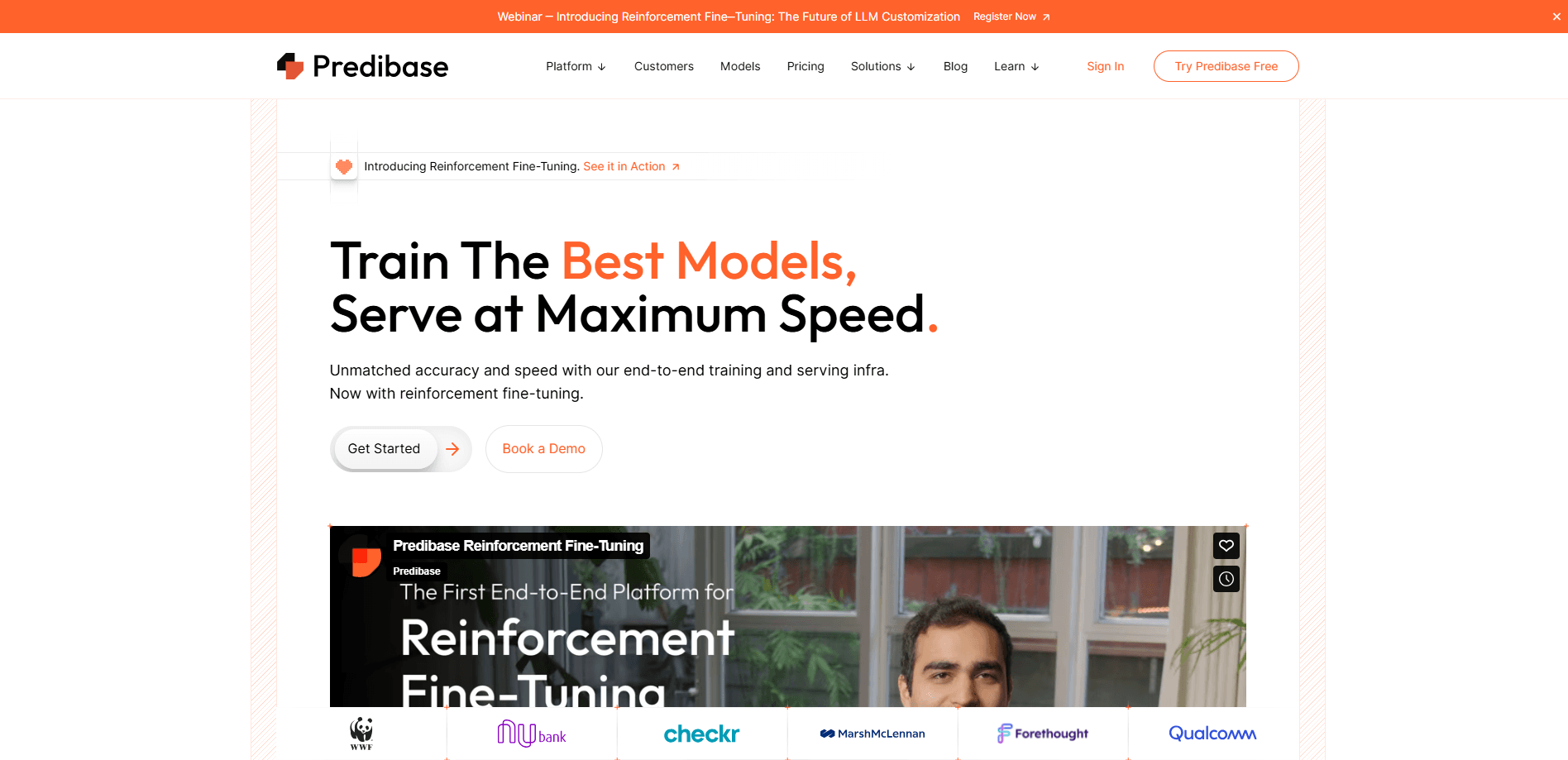
About Predibase
What Is Predibase
Predibase was a platform built for teams that wanted to train, fine-tune, and deploy their own AI models instead of relying only on general-purpose ones. It was an enterprise model fine-tuning platform that grew out of two open source projects the company created and maintained: Ludwig, a low-code framework for training models from a simple config file, and LoRAX, a serving engine that runs thousands of fine-tuned models on a single GPU.
The company targeted a specific problem. General-purpose models are often slow and expensive for narrow tasks, and building a custom model usually means fighting with infra for months. Predibase focused on making that path shorter by handling the training and serving work for you. In March 2025 it added an end-to-end platform for reinforcement fine-tuning, which improves a model on a task using real-time feedback rather than labeled data alone.
The biggest limitation today is availability. Rubrik announced in July 2025 that Predibase was joining the company, and predibase.com now redirects to Rubrik's site. If you're looking for the old self-serve fine-tuning cloud, it isn't something you can sign up for anymore. The open source pieces live on, and Rubrik folded the team's work into its own agent-focused data platform.
Getting Started
- There's no signup flow for the original Predibase cloud today. New users can't create a workspace the way they could before the acquisition.
- For the open source route, pull Ludwig from its GitHub repository and start with a YAML config that describes your data and task.
- Train or fine-tune a model locally or on your own cloud, using the parameters Ludwig exposes for LoRA and quantized training.
- Serve the result through LoRAX if you need many adapters on shared hardware.
- If you want an enterprise deployment, reach out to Rubrik directly, since that's where the product team now sits.
Product Information
A quick look at Predibase's pricing, supported platforms, and performance.
Best for
The users, tasks, and scenarios where this tool fits best.
Users
- Machine learning engineers
- Data science teams at larger companies
- Solo developers and researchers
Tasks
- Fine-tuning open models on private data
- Serving many small models cheaply
- Improving a model with feedback
Scenarios
- Evaluating a fine-tuning stack before committing
- Replacing a deprecated vendor tool
- Researching enterprise AI acquisitions
Key features
Low-code model training with Ludwig
Ludwig lets you describe a model, its inputs, and its training setup in a single YAML file, then run it from the command line. It supports multi-task and multi-modal setups and picks sensible defaults for things like batch size. For teams that don't want to write a training script from scratch, it shortens the setup work.
Multi-LoRA serving with LoRAX
LoRAX is a serving engine that loads many fine-tuned adapters onto one GPU and swaps between them per request. Rather than running a separate deployment per model, you host a pool of adapters on shared hardware. That design cuts the cost of serving a large set of specialized models.
Reinforcement fine-tuning
In March 2025 the company shipped an end-to-end platform for reinforcement fine-tuning, which tunes a model using feedback on its outputs. The approach is meant to raise quality on tasks where labeled examples are scarce. Predibase published results showing it could lift coding accuracy on a small model.
Parameter-efficient training options
Ludwig supports methods like LoRA and quantized training, which change a small slice of a model's weights instead of retraining all of them. That lowers the memory and compute a fine-tuning run needs. For teams with limited GPUs, this is often the difference between a run that fits and one that doesn't.
Serverless-style deployment
Before the acquisition, the hosted platform let you fine-tune and deploy a model without managing servers, and you paid based on usage. It targeted the gap between a quick prototype and a production endpoint. That managed experience is no longer offered to new customers.
Open source under a foundation
Ludwig became a project hosted by the Linux Foundation's AI and Data group, with Predibase staff and outside contributors maintaining it. That keeps the training framework independent of any single vendor. It also means the code outlives the commercial product.
Pros and cons
Pros
- Ludwig and LoRAX are openly available, so teams can keep using the core technology after the acquisition.
- LoRAX's multi-adapter serving lowers the cost of running many specialized models on shared GPUs.
- The low-code approach in Ludwig reduces the setup work for a first fine-tuning run.
- Ludwig's governance under the Linux Foundation gives it a neutral home rather than a single company's control.
Cons
- The standalone Predibase cloud is gone, so new users can't sign up for the hosted fine-tuning service.
- No public pricing applies anymore, which makes budgeting against the old product impossible.
- Anyone running the open source tools now owns deployment, scaling, and maintenance themselves.
- Details about the current enterprise offering sit inside Rubrik's platform, so you have to contact them to learn what's available.
Frequently asked questions
Rubrik acquired Predibase in 2025, and the company announced the move in July of that year. The standalone fine-tuning cloud is no longer sold, and predibase.com now redirects to Rubrik's website.
Related content
Explore related tools, skills, and articles for Predibase.
Predibase Alternatives

Base Code
Base44 (Wix) · Coding · ProductivityBase Code is a shared cloud development environment from Base44. Teammates describe changes to an existing GitHub codebase in chat, preview them live and send them back as pull requests.

Google EmbeddingGemma 2
Google DeepMind · Writing · Image · CodingGoogle EmbeddingGemma 2 is a 740M-parameter open model that turns text, code, images, audio, and video frames into vectors in one 768-dimension space, running on phones and laptops.

GitGlow
GitGlow · Coding · ProductivityGitGlow is a local-first desktop Git client that lets independent developers review their own code and their AI agents' changes in one place before shipping.