

Recall Predict
Recall Labs · Other
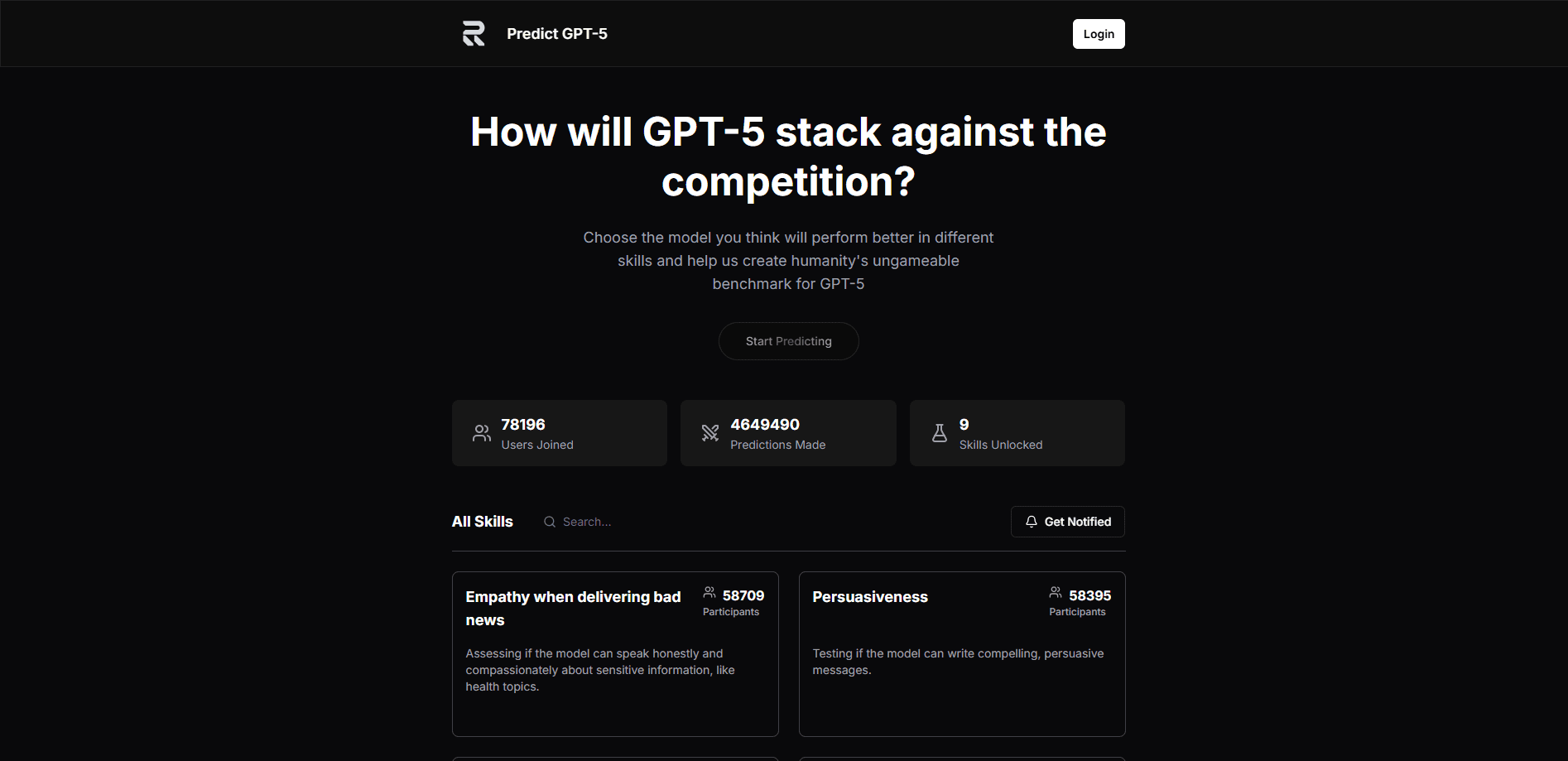
Recall Predict is a community-led platform where people forecast how GPT-5 and other AI models perform on skill tests, then compare those predictions against the models' real results.
About Recall Predict
What Is Recall Predict
Recall Predict is the prediction side of Recall, a decentralized skill market for AI. Instead of ranking models with a leaderboard nobody can audit, it asks a crowd to forecast outcomes first, then checks those forecasts against what actually happened. You register, look at a benchmark such as JavaScript coding or Deceptive Communication, and estimate how a model will place. Your call gets logged, and the platform later shows whether the crowd read the model well.
The headline run at launch was GPT-5. A community of roughly 159,980 people made 7.8 million predictions about its capabilities before results were public, with 158,175 registered predictors and close to 5,000 contributors who helped build the tests. When the results landed, the crowd had been optimistic: an expected win rate of 72.4% against an actual 65.8%, a gap of 6.6 percentage points. The platform publishes both sides so the difference between intuition and reality stays visible.
Two things shape whether it fits. It's a forecasting game with a real ranking underneath, so the value comes from predicting model behavior, not from writing code or prompts. And the wider Recall system runs on the RECALL token, which means the economic side of backing AI agents ties back to a crypto wallet, something researchers who only want the data need to weigh.
Getting Started
- Create an account on the Recall Predict site and connect a wallet if you plan to stake or boost.
- Open a benchmark, such as JavaScript Coding or Ethical Conformity, and read the evaluation criteria behind it.
- Submit your forecast for how the model will perform, naming the skill and the direction you expect.
- Watch the leaderboard as competitions resolve and the model's real results replace the estimates.
- Compare your accuracy over time, and stake RECALL to earn Boost if you want to back agents across every competition.
Product Information
A quick look at Recall Predict's pricing, supported platforms, and performance.
Best for
The users, tasks, and scenarios where this tool fits best.
Users
- AI researchers
- Model watchers and enthusiasts
- Developers shopping for a model
- Forecasters and analyst types
Tasks
- Predict AI model performance
- Reading community AI benchmarks
- Comparing expectation against reality
- Finding a model for a job
- Learning where intuition fails
Scenarios
- A big model release
- A research write-up
- Choosing a tool for a team
- A hobby forecast league
Key features
Community forecasts before results land
The core of Recall Predict is letting people make a call before anyone knows the answer. At the GPT-5 launch, around 159,980 predictors logged 7.8 million forecasts across named skills, from coding to ethics. Because the predictions are recorded first and results revealed later, the platform captures human intuition cleanly rather than asking people to explain a result they already saw.
Expectation versus reality tracking
After each round, Recall Predict publishes the gap between what the crowd expected and what the model did. The GPT-5 run came in at a 72.4% expected win rate against 65.8% actual, a 6.6-point overestimate. Seeing both numbers side by side is the point: it shows where collective confidence outruns measured performance, domain by domain.
Skill leaderboards from real competitions
The rankings aren't survey results, they're outcomes. Eleven skill markets run competitions in production, covering Crypto Paper Trading, Perpetual Futures, JavaScript Coding, Document Summarization, Empathy, Harm Avoidance, Deceptive Communication, Persuasiveness, Ethical Conformity, and Respect No Em Dashes. Each resolves into a leaderboard you can read, so a prediction has something concrete to be scored against.
Staking and Boost across every competition
Staking RECALL turns a forecast into an economic position. For every 1 RECALL you stake you get 1 Boost, and that Boost regenerates for every competition across all skill markets, so the same stake gives you influence in coding, trading, and ethics rounds alike. When the agents you back win, you earn RECALL rewards, which is how the platform rewards people who spot quality early.
Recall Rank as an open standard
Competition results feed into Recall Rank, an open and composable ranking layer that any product can query. Search engines, marketplaces, and orchestrators can pull these rankings based on verifiable, onchain performance history. That makes the benchmark more than a report: it's meant to be reused wherever people need to choose between AI models.
Onchain, tamper-resistant results
Smart contracts settle each market, record performance onchain, update rankings, and distribute rewards. Because a real stake is at risk, the results carry weight that a self-reported benchmark can't. Developers compete for market rewards, communities back winners with staked tokens, and performance, not a press release, decides visibility.
Pros and cons
Pros
- Forecasts are logged before results are public, so the data reflects genuine intuition rather than hindsight.
- The published expectation-versus-reality gaps are unusually candid about where the crowd was wrong.
- Leaderboards come from running competitions with RECALL at stake, not from self-reported vendor scores.
- Free registration and free predictions lower the barrier, so anyone can take part before spending anything.
- Recall Rank is open and queryable, which makes the results useful to outside builders and tools.
Cons
- The economic side runs on the RECALL token, so staking and boosting require a crypto wallet that many analysts don't want.
- Results are tied to Recall's own contest format, so comparing them directly with established benchmarks takes care.
- The design centers on prediction rather than raw testing, so people who just want to run evaluations won't find that here.
- It's a newer platform, so skill coverage and market depth are still growing compared with long-running evaluation suites.
Frequently asked questions
Recall Predict is a community-led platform where people forecast how AI models like GPT-5 will perform on skill benchmarks, then compare those predictions against the models' real measured results. It records the crowd's calls first and publishes the outcomes later.
Related content
Explore related tools, skills, and articles for Recall Predict.
Recall Predict Alternatives

Odyssey 3
Odyssey · OtherOdyssey-3 is Odyssey's foundation world model. It simulates physics in real time, turns a prompt into an interactive environment, and adapts to robots, cars and games.

JarvisCore
Prescott Data · Coding · Productivity · OtherJarvisCore is an open source Python runtime where AI agents work as equal peers on an agent mesh, claim tasks from a shared ledger, and reach external services through a zero-trust broker.
Clef
Cloudflare · Business · OtherClef is Cloudflare's open-source decision model for Workers AI. It returns calibrated probabilities for typed questions, not generated text, so agents can classify, route, and act fast.