

Prefactor
Prefactor · Coding
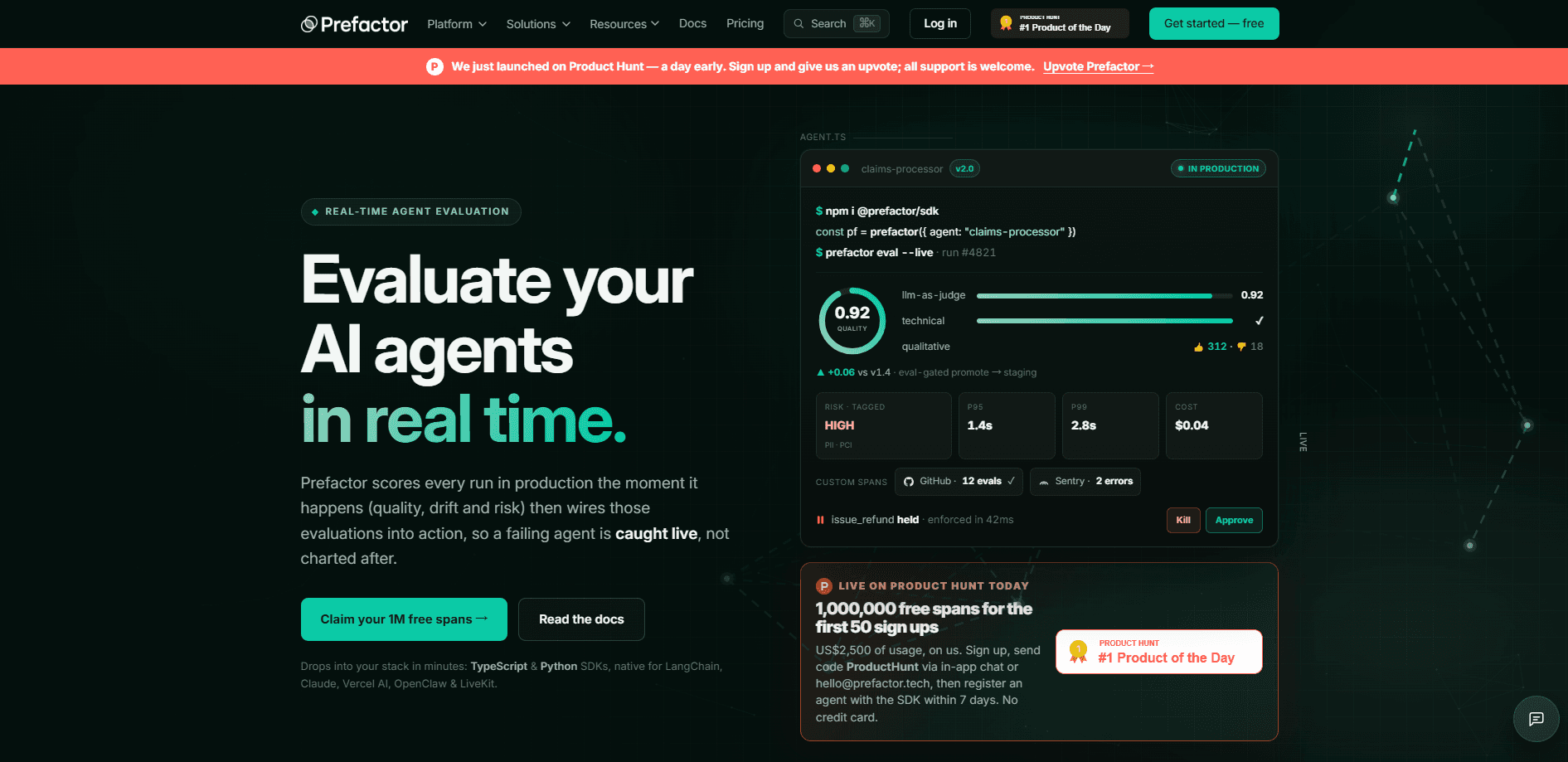
Prefactor is a runtime evaluation platform for AI agents. It's also agent performance monitoring with teeth. It records every step an agent takes as a trace, scores that step for quality, drift, and data risk, and then enforces an action when something crosses a line. Teams use it to hold a risky run for human approval, block an action outright, or keep watching with full visibility instead of finding out about the mistake from a customer email at 1am. Scoring is continuous. So is the enforcement.
About Prefactor
What Is Prefactor
Most monitoring tools draw you a chart and hand the problem back. By the time you have read the dashboard, the agent already acted. That gap between seeing and stopping is the whole reason Prefactor exists.
So what does Prefactor do about it? It sits at the agent runtime layer. Lightweight SDKs in TypeScript and Python capture each model call, tool call, and decision as a span, then run your evaluations and risk checks on that span as the agent works. When a run trips a rule you set, Prefactor intervenes through the same SDK or API, so the policy holds whether or not the agent cooperates.
The tradeoff is scope. Prefactor is built for teams shipping agents to real users, not for someone poking at a single chatbot over a weekend. The free tier caps you at three agents with seven days of data retention. Past that, you pay.
Getting Started
- Install the Prefactor CLI and sign in to connect your workspace; it discovers agents across your runtimes with no migration.
- Drop the TypeScript or Python SDK into your agent code. Native integrations exist for LangChain, Claude, Vercel AI, OpenClaw, and LiveKit.
- Run your agent and watch runs stream in as traces, with cost and data risk attached to each step.
- Define the evaluations you care about: LLM-as-judge, technical checks, qualitative metrics, or a custom business rule.
- Set the enforcement action for each rule, then let Prefactor hold, approve, or block at runtime.
Product Information
A quick look at Prefactor's pricing, supported platforms, and performance.
Best for
The users, tasks, and scenarios where this tool fits best.
Users
- Platform and ML engineering teams
- Security and compliance leads
- Solo builders on the free tier
Tasks
- Catching a high-risk action before it runs
- Scoring output quality on every step
- Proving what an agent did
- Rolling back an agent version
Scenarios
- Customer support agents handling refunds and account changes
- Teams running several frameworks side by side
- Enterprises with shadow agents nobody owns
- Shipping an agent to production for the first time
Key features
Runtime enforcement, not just alerts
This is the feature that separates Prefactor from a dashboard. Evaluations and agent risk scoring wire straight into action, so a run can be paused for approval, throttled, or blocked the moment it crosses a line. Every enforcement decision is logged, which matters when you have to explain later why an agent was stopped.
Tracing every call, tool, and decision
Each model call, tool invocation, and message turn becomes a span inside a trace, and nested or custom business spans are supported on every plan. Cost and data risk attach to each step. So you can see not only what the agent did but what it cost and whether it touched sensitive data. Full traces stream in live rather than showing up after the run ends.
Evaluations you define yourself
Prefactor runs the evals you write on every step: LLM-as-judge, technical checks, and qualitative metrics, with optional bring-your-own LLM for evaluations. There's no per-check cost, and human review feeds back into the loop. Deterministic scoring plus risk and pattern checks run across 100% of your activity. Nothing slips through.
Framework-agnostic integration
One plane covers Claude, Copilot, LangChain, N8N, and whatever your team builds next. The SDK adds under a millisecond of overhead per call according to Prefactor. That's the number that matters for latency-sensitive agents. Native support exists for LiveKit and OpenClaw alongside the general TypeScript and Python libraries. No proxies and no network-level interception, just code that ships with your agents.
Versioning and environments
Agents can be versioned with instant rollback, and separate dev, staging, and production environments are supported, with eval gates in the promotion path. That combination lets you test a change against real traffic patterns before it reaches users. If it misbehaves, you undo it fast. No waiting for a hotfix.
Data retention tiers
Retention scales with plan: seven days on Dev, three months on Startup, twelve months on Scaleup and Enterprise. For teams under audit pressure, that span is often the difference between quoting a log and admitting you can't reconstruct what happened. Retention tiers matter more than they sound.
Pros and cons
Pros
- Enforcement at runtime is the real differentiator; most tools stop at observation and scoring.
- Under 1ms SDK overhead per call, so instrumentation doesn't become the bottleneck.
- Framework-agnostic, which fits teams that have already picked their own stack and don't want to migrate.
- Unlimited seats on every plan, including the free Dev tier.
- PII checks run inside the reliability loop at no per-check cost.
Cons
- The free Dev plan caps you at three agents and keeps only seven days of data, so real production use starts at the $49/mo tier.
- Pricing is usage-based on spans, which can be hard to forecast; the estimator shows 1,000,000 spans a month costing roughly $2,449 on Scaleup.
- It's aimed at teams with engineering staff. If you have no one who can write evals or read traces, the platform will sit idle.
- No Google Play or mobile app; this is a developer tool, used through the CLI, SDK, and web app.
- Self-hosted deployment and SSO are reserved for the Enterprise tier, which means a sales call.
Frequently asked questions
It records every step an AI agent takes, scores each step for quality and risk, and then acts on that score by holding, approving, or blocking a run at runtime. This is AI agent evaluation wired directly to enforcement. In short, it closes the loop between seeing a problem and stopping it.
Related content
Explore related tools, skills, and articles for Prefactor.
Prefactor Alternatives
Forefront
Forefront · CodingForefront is a web platform for building with open-source AI. It lets you fine-tune leading open-source language models on your own data, evaluate how they perform, and run them through an API or export them to host yourself. Developers who want the convenience of a closed-source platform but insist on owning their models and data are the target audience here.

Startkit
StartKit.AI · CodingStartkit is a boilerplate for building AI SaaS and AI wrapper products. Think of it as an AI startup boilerplate with the boring parts already wired up: authentication, Stripe and Lemon Squeezy payments, usage limits, transactional email, and an AI API starter that talks to OpenAI, Anthropic, Groq, or Llama. You clone the repo, set your price, and start on the part of your product that people actually pay for. It's Next.js under React and Tailwind, so most of the boilerplate code already feels familiar.
Testim
Tricentis · CodingTestim is an AI-powered test automation platform for building and running end-to-end tests across web, mobile, and Salesforce applications. It leans on machine learning to keep tests stable when an interface changes, so teams spend less time fixing broken selectors. Not bad for an automated testing tool you can start using today. You create tests by recording actions in a browser, then optionally add JavaScript when you need more control. It's a solid pick for busy QA teams.