

Prefer
Kocoa Technologies Private Limited · Marketing · Business
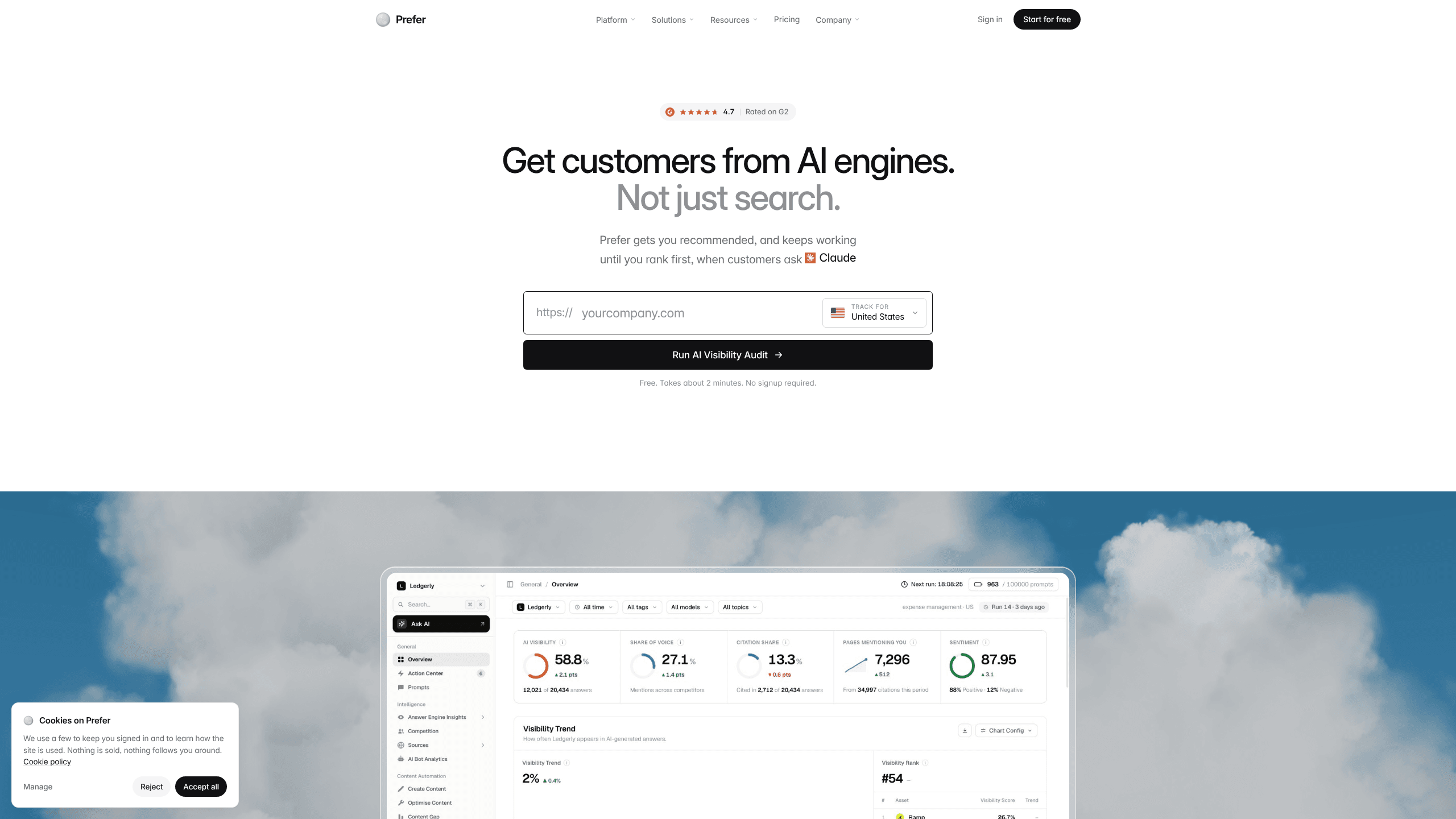
Prefer is an AI visibility platform that tracks how ChatGPT, Gemini, Google AI Overviews and Perplexity describe your brand, then turns each missed citation into a ranked task an agent helps you ship.
About Prefer
What Is Prefer
Prefer is an answer engine optimization platform from Kocoa Technologies, a company founded in 2025 and based in Mumbai. You give it your brand, your competitors, and the questions your buyers type into a chatbot. It runs those prompts across five engines, records who gets named, and turns the gap into work. The company sells the category as answer engine optimization, with generative engine optimization (GEO) and classic AI SEO folded into the same plan.
The product is built around one claim: a report is not a fix. Most AI search visibility tools stop at a dashboard that shows your share of voice sliding while a competitor takes the citation. Prefer keeps the dashboard and adds an Action Center. Each gap becomes a task with an impact score, an owner, the evidence behind it, and a place to mark it done.
That execution layer is the reason the pricing is unusual. Prefer sells software plus agent labor, and the higher tier hands the work to a strategist team. It also means the product's value depends on your team approving changes quickly. Nothing ships without sign-off, so a slow review cycle slows the results too.
The engines covered are ChatGPT, Gemini, Google AI Overviews, Google AI Mode, and Perplexity. Claude, Copilot, and Grok are not tracked, which matters if your buyers live in those tools. There is no permanent free tier either, just a 7-day trial without a card.
Getting Started
- Sign up at app.tryprefer.com with a work email. The trial runs for 7 days and asks for no credit card.
- Add your brand, the competitors you want to beat, and the buyer questions you care about. Prefer suggests prompts from your category if you need a starting list.
- Let it run those prompts across the five engines. The first pass builds a baseline for mentions, share of voice, and average position.
- Open the Action Center and sort by impact. Approve the fix you want first, and the agent drafts either the page or the technical change for review.
- Connect your CMS and Search Console account so approved work goes live. The next crawl shows whether the answer changed.
Product Information
A quick look at Prefer's pricing, supported platforms, and performance.
Best for
The users, tasks, and scenarios where this tool fits best.
Users
- Marketing leads at B2B SaaS companies
- SEO consultants and small agencies
- Founders checking their own category
Tasks
- Diagnosing a lost citation
- Fixing AI crawler access
- Writing for a specific buyer question
- Reporting AI search visibility to leadership
Scenarios
- A crowded software category where models already name a shortlist
- A launch or repositioning
- Paid acquisition that has become too expensive
Key features
Prompt Tracking Across Five Answer Engines
Prefer asks the questions your buyers ask, then records whether your brand appears in the reply, which competitors appear beside it, and where you rank in the list. The dashboard splits results by persona and region, so an answer that works for budget-conscious buyers can be checked separately from one aimed at enterprise teams. Each prompt keeps a history, which is how you tell a real gain from a model having a bad day.
Action Center With Ranked Fixes
Every gap becomes a task, scored on the visibility at stake, the odds the fix wins the citation, and the effort involved. Prefer shows the working behind each score, which makes it possible to argue with the ranking instead of accepting it. Tasks carry an owner label: agent can do, agent-assisted, or your team. The queue only closes when a later crawl confirms the prompt moved.
An Agent That Ships the Work
The agent handles the technical side first, since blocked crawlers and missing schema are cheap to fix and often explain a whole category of misses. It edits robots.txt, adds structured data, and drafts the pages that the engines are looking for. You review one change at a time and approve it. The claim that this saves engineering time held up for at least one customer quoted on the site, a founding marketer who said she no longer needs to pull in engineers for on-page work.
Content Drafting and CMS Publishing
Content starts from the prompt rather than from a keyword. Prefer drafts the article or comparison page, scores it against the prompts it should win, and publishes to your CMS once approved. Drafts cite the sources the models already trust, which is a practical shortcut: a page that agrees with the sources an engine reads is easier for that engine to quote.
AI Crawler and Site Health Audits
The audit covers what an answer engine needs before it can cite you: crawl access for each bot, indexable pages, working schema, and internal links that pass the right context. Prefer labels the damage in plain terms, such as twelve money pages invisible to two crawlers. You see the expected lift before you spend time on the fix, which helps when a developer asks why the change matters.
MCP Server, API, and Search Data Integrations
Prefer runs an MCP server, so Claude or Cursor can pull this week's top actions or explain why a prompt dropped without opening the app. The API pushes visibility data into your own dashboards, and Looker Studio and CSV export cover the reporting tools most teams already use. On the measurement side, Search Console, Google Analytics, Bing Webmaster Tools, DataForSEO, Cloudflare, and Vercel connect to the same workspace.
Pros and cons
Pros
- The Action Center turns tracking into a queue with owners and deadlines, which is the part most AI visibility tools leave out.
- Impact scores show their inputs, so you can reorder the list when you disagree instead of trusting a black box.
- Content and technical fixes are drafted inside the same tool that found the gap, which removes a handoff between the SEO team and whoever writes.
- The $99 entry price includes 150 prompts, 30 articles a month, and unlimited team seats, so adding a colleague costs nothing.
- The MCP server and open API let analysts work from Claude, Cursor, or their own BI stack rather than a browser tab.
Cons
- Five engines is a narrower net than several rivals offer. If your buyers ask Claude or Copilot, those answers stay invisible to the tool.
- Nothing publishes without a human approval step, so the promised speed depends on how fast your team reviews drafts.
- There is no free plan beyond the 7-day trial, and the $1,499 Managed tier is the only route if you want Prefer's own team to do the work.
- Prices are quoted in dollars and monthly billing only for Managed, which complicates budgeting for teams outside the US.
Frequently asked questions
Prefer tracks how AI answer engines describe your brand and then helps you change those answers. It measures mentions and share of voice across ChatGPT, Gemini, Google AI Overviews, Google AI Mode, and Perplexity, ranks the gaps it finds, and drafts the content or technical fix that closes each one.
Related content
Explore related tools, skills, and articles for Prefer.
Prefer Alternatives

ngram 2.0
ngram · Video · Marketingngram 2.0 is an AI video generator for teams. It turns a prompt, a screen recording, or a product URL into a narrated explainer, product demo, or AI avatar video, and every scene stays editable.

shippedit.me
Krawlup · Marketing · Businessshippedit.me now redirects to Krawlup, a web platform that audits SEO, AEO and page speed every week, then hands the fixes to AI coding agents over MCP.

MePersona
MePersona, Inc. · Writing · Productivity · MarketingMePersona is an AI unified inbox for creators. It learns your voice, drafts replies to fan messages from 12 platforms, and sends only what you approve.