

Prelint
Prelint · Coding
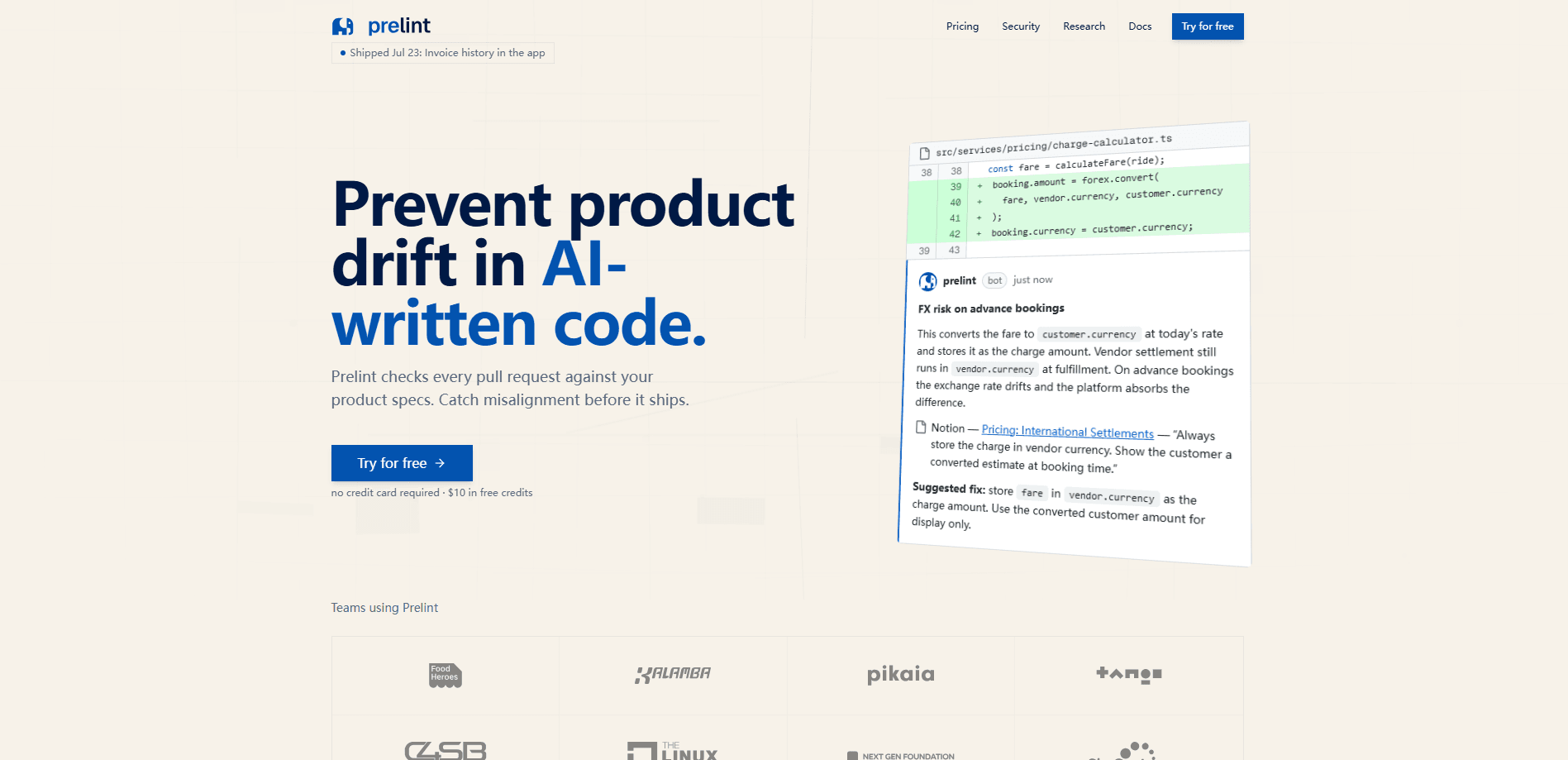
Prelint is an AI code review tool that checks each pull request against the specs and decisions your team already agreed on. Instead of hunting for bugs or style issues, it flags where code drifts from your pricing rules, architecture decisions, or compliance constraints before the change ships. It runs as a GitHub App, posts inline findings on the exact lines that triggered them, and keeps a searchable record of every product decision your code encodes.
About Prelint
What Is Prelint
Prelint sits next to your existing code review and looks at a layer most tools ignore: whether the code matches what the team actually agreed to build. It reads markdown specs, architecture decision records, and product requirement docs stored in your repo, then turns them into review criteria. When a PR contradicts one of those decisions, Prelint says so.
The problem it targets is specific. AI coding agents write clean, passing, well-structured code that still breaks your product rules. A pricing page that quotes 60-day terms when billing policy says 30, or a signup flow that adds a GDPR consent step for US-only customers. Your linter won't catch that. Your human reviewer might, if they have time and remember the policy. So what fills the gap when neither does?
The biggest limit is scope by design. Prelint doesn't replace your linter, type checker, or security scanner, and it won't fix the code for you. It reads context within a character budget and depends on the quality of the docs you feed it. Garbage specs in, garbage findings out.
Getting Started
- Install the GitHub App and pick which repositories Prelint should review. No CI changes and no YAML are needed.
- Add context to the repo by dropping product specs, decision logs, or architecture docs into it. Markdown files get indexed automatically.
- Open a pull request. Prelint reviews it within seconds and posts findings as inline comments pinned to the lines that triggered them.
- Read the decision ledger to see who decided what, when, and whether a person or an AI made the call. Approved decisions become context your agents reuse next time.
Product Information
A quick look at Prelint's pricing, supported platforms, and performance.
Best for
The users, tasks, and scenarios where this tool fits best.
Users
- Engineering teams running 25 to 50 pull requests a day
- Startups using AI coding agents like Claude Code or Cursor
- Open-source maintainers
Tasks
- Catching roadmap and pricing drift in a pull request
- Onboarding new engineers
- Building audit evidence
Scenarios
- A pull request quietly changes invoice terms from 30 to 60 days
- A team ships AI-generated code that passes every test but adds an unplanned consent step
- A developer wants to know why a checkout rule exists
Key features
Product-Intent Review on Every Pull Request
Prelint reviews the product layer of a PR rather than code style or bugs. It checks spec violations, architecture decision compliance, business logic correctness, and scope drift. Findings show up as inline comments on the exact lines that triggered them, so reviewers see the problem in context instead of in a separate report.
Specs Become Review Criteria
Any markdown you keep in the repo can act as a rule. Architecture decision records, product requirements, API contracts, and compliance policies all get read and enforced. Context is assembled within an 80K character budget, prioritized from project-level specs down to general documentation.
The Decision Ledger
Every review records the product decisions embedded in your code, along with who made them, when, where they came from, and whether a person or an AI decided. Duplicates get resolved automatically, and a contradiction lowers the confidence of a decision so agents ask before building on it.
Two-Minute Setup
Setup is a GitHub App install plus a few markdown files. There's no CI change, no YAML, and no build step. The first review can run within a couple of minutes of adding the app, which keeps the adoption cost low for teams that want to test it.
Pay-Per-Review Pricing
Pricing is metered at $1 per completed review, not per seat. You buy prepaid credits from $10 up to $1,000, and credits never expire. Failed, cancelled, and timed-out reviews are free, and CI bot commits from tools like Dependabot or Renovate never trigger a charge.
Free Reviews for Open Source
Reviews on public repositories are free with no setup required. That makes Prelint usable for maintainers who want a second pass on incoming PRs without paying for a subscription or seat.
Pros and cons
Pros
- Catches a real gap: code that passes tests but violates product specs, pricing rules, or compliance constraints.
- Inline findings land on the exact lines that triggered them, so review stays in the existing GitHub workflow.
- Pricing is honest for small teams, at $1 per completed review with no seats and no subscription.
- Open-source reviews are free, and failed or bot-triggered reviews cost nothing.
- The decision ledger gives new engineers and auditors a way to see why a rule exists.
Cons
- It won't fix anything for you. Prelint only reports findings, so a human still has to make the change.
- Output quality depends entirely on your specs and docs being accurate and current. Stale docs mean noisy or missing findings.
- It doesn't replace your linter, type checker, or security scanner, so it adds another tool to the stack rather than consolidating one.
Frequently asked questions
It reviews the product layer of a pull request: spec violations, architecture decision compliance, business logic correctness, and scope drift. It deliberately leaves code style, formatting, bug detection, and security scanning to your existing tools.
Related content
Explore related tools, skills, and articles for Prelint.
Prelint Alternatives
Forefront
Forefront · CodingForefront is a web platform for building with open-source AI. It lets you fine-tune leading open-source language models on your own data, evaluate how they perform, and run them through an API or export them to host yourself. Developers who want the convenience of a closed-source platform but insist on owning their models and data are the target audience here.

Startkit
StartKit.AI · CodingStartkit is a boilerplate for building AI SaaS and AI wrapper products. Think of it as an AI startup boilerplate with the boring parts already wired up: authentication, Stripe and Lemon Squeezy payments, usage limits, transactional email, and an AI API starter that talks to OpenAI, Anthropic, Groq, or Llama. You clone the repo, set your price, and start on the part of your product that people actually pay for. It's Next.js under React and Tailwind, so most of the boilerplate code already feels familiar.
Testim
Tricentis · CodingTestim is an AI-powered test automation platform for building and running end-to-end tests across web, mobile, and Salesforce applications. It leans on machine learning to keep tests stable when an interface changes, so teams spend less time fixing broken selectors. Not bad for an automated testing tool you can start using today. You create tests by recording actions in a browser, then optionally add JavaScript when you need more control. It's a solid pick for busy QA teams.