

Prem AI
Prem AI · Coding
Prem AI is a Swiss confidential AI platform. It runs open models on encrypted GPUs, keeps private AI inference unreadable to the host, and hands back hardware proof of every run.
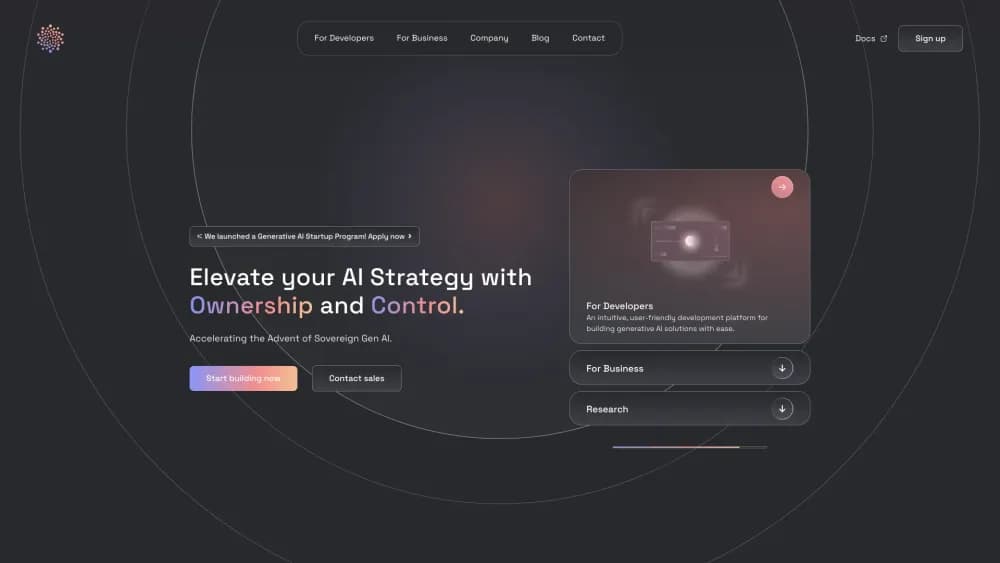
About Prem AI
What Is Prem AI
Prem AI is a platform for running AI models without handing the plaintext of your prompts to an infrastructure provider. Requests are encrypted on your side before they leave, and on supported routes they're decrypted only inside a confidential computing environment, a Trusted Execution Environment (TEE) built on Intel TDX, AMD SEV, and NVIDIA Confidential Computing. The gateway passes along ciphertext and billing metadata. It doesn't get to read the message.
What the platform sells is less trust required. Teams in healthcare, finance, legal, and government usually can't put patient records or contract text through a standard AI API, because the provider processes the content in the clear. Prem gives those teams an inference route they can describe to a compliance reviewer, plus attestation evidence that names the hardware that ran the job.
The honest limit is that TEE attestation isn't the same as full proof. Prem's own platform page lists gaps: reference measurements aren't pinned by default, Zero Data Retention traffic runs on partner agreements rather than hardware-isolated machines, and route assurance doesn't yet bind an approved image to the exact model backend. If your threat model needs those guarantees today, read the status page before you commit.
Getting Started
- Sign up at dashboard.prem.io and create an API key in the API section.
- Pick an inference mode. Confidential inference needs the TypeScript SDK and a client key you generate and keep. Zero Data Retention works with any OpenAI client and a base URL swap.
- Install the SDK with npm install @premai/api-sdk, or start the bundled confidential proxy if you'd rather keep using the OpenAI SDK.
- Send a chat or audio request. Store your key encryption key (KEK) in a secret manager and reuse it, since regenerating it breaks decryption of earlier sessions.
- Check the model catalog with GET /rvenc/models or GET /openai/models, because the list differs by API key and by mode.
Product Information
A quick look at Prem AI's pricing, supported platforms, and performance.
Best for
The users, tasks, and scenarios where this tool fits best.
Users
- Compliance and security teams at hospitals, banks, and law firms
- Developers building on open models
- Companies with sensitive source code or internal documents
- European teams under data residency rules
Tasks
- Clinical notes and patient records
- Financial document analysis
- Coding assistance on private repos
- Regulated voice workflows
Scenarios
- Passing a security review before an AI pilot
- Running an evaluation with no code change
- Keeping inference inside a jurisdiction
- Building on owned hardware
Key features
Client-Side Encryption
This is the base layer of the encrypted AI API: your application encrypts the request body before any network call. The gateway handles ciphertext plus operational metadata such as model name, size, timing, and billing. Only the processing runtime decrypts the payload to run inference. The practical effect is that a compromised gateway log or a curious operator doesn't surface your prompt text, and a local proxy variant gives the same protection to clients that only speak OpenAI's format. Prem never receives the key encryption key.
Hardware Attestation You Can Check
Each protected request can return attestation evidence: signed claims from the CPU and GPU, nonces to prove freshness, and policy results that say whether the measurement matched an approved reference. Prem publishes the verification code on GitHub, so a security team can run the check itself instead of trusting a dashboard badge. The evidence covers AMD SEV-SNP, Intel TDX, and NVIDIA confidential computing, including multi-GPU clusters where every GPU claim gets verified.
Two Inference Modes
Confidential inference puts the whole path through encryption and a protected runtime, aimed at sensitive data and production workloads. Zero Data Retention is a plain OpenAI-compatible API endpoint that needs no key management and no proxy, where Prem routes the request to a partner under a no-retention contract. That second mode is the cheap way to test models, prototypes, and public data. Both modes expose different catalogs, and the API rejects a model sent to the wrong one with a clear 400 error.
Open Model Catalog With Transparent Pricing
The catalog leans on current open-weight models: Qwen 3.8, DeepSeek V4 and V4.1 variants, GLM 5.2 and 5.3, Kimi K3, and DiffusionGemma for decision tasks. Prices are per million tokens and published for both input and output, with cached prompt tokens billed at a discount. Confidential chat starts around $0.30 to $0.35 per million input tokens on the cheapest models, and audio transcription runs $0.05 per minute. You see the rate before you send anything.
Multi-Modal Routes
Chat covers text, image, and video input depending on the model. A voice transcription route handles audio and returns Deepgram-compatible transcriptions. A decisions endpoint answers typed questions with probabilities, which suits classification and scoring jobs where you want a number rather than prose. One API key and one base URL reach all of them, which cuts down on the glue code a regulated pipeline usually needs.
Swiss Hosting and Deployment Options
The managed service runs in Swiss data centers with an uptime commitment near 99.98% and renewable power. For teams that can't use a hosted API, the Enclave hypervisor installs on existing GPU clusters, whether on-premises, in a public cloud account, or in a private cloud, and Prem says it can't read data processed there. Enterprise deployments go further: dedicated instances, custom model choices, and air-gapped setups.
Adjacent Products in the Same Accounts
Prem's broader pitch is sovereign AI: data, compute, and models that stay under your control, sold as three products around one account. Fluso is a no-code agent builder for teams that want to deploy agents against internal procedures without writing code. Prem Studio fine-tunes and compresses models on your own data, with exported weights you can self-host. Neither replaces the API, but they matter if you'd rather own a smaller model than rent a large one.
Pros and cons
Pros
- Client-side encryption means prompt text never reaches the gateway in readable form, which is a real difference from a standard model API.
- Attestation evidence you can verify with published code gives security reviewers something to check rather than a policy document.
- OpenAI and Anthropic compatible interfaces keep migration short, often a base URL and a key.
- Prem pricing is per token with published input and output rates, so budgeting is straightforward and cached prompts cut repeat costs.
- Swiss hosting plus SOC 2 Type I, ISO 27001, and FADP coverage answers residency questions that stall AI rollouts in Europe.
Cons
- The confidential catalog is small. If your workflow depends on a specific closed model, the route won't exist for it.
- Key management is on you. Lose the KEK and earlier encrypted sessions can't be decrypted, so it belongs in a secret manager with backups.
- Attestation has documented gaps: reference measurements are unpinned by default and route assurance doesn't yet bind the served model, so a pass doesn't prove the full claim.
- Zero Data Retention leans on partner contracts rather than hardware isolation, and there's no free plan, so evaluation costs money from the first call.
Frequently asked questions
Prem AI runs AI models for teams that can't send plaintext prompts to a cloud provider. It encrypts requests on the client side, processes supported routes inside confidential computing hardware, and returns attestation evidence. It also sells a licensed hypervisor for running that same setup on your own GPUs.
Related content
Explore related tools, skills, and articles for Prem AI.
Prem AI Alternatives

Base Code
Base44 (Wix) · Coding · ProductivityBase Code is a shared cloud development environment from Base44. Teammates describe changes to an existing GitHub codebase in chat, preview them live and send them back as pull requests.

Google EmbeddingGemma 2
Google DeepMind · Writing · Image · CodingGoogle EmbeddingGemma 2 is a 740M-parameter open model that turns text, code, images, audio, and video frames into vectors in one 768-dimension space, running on phones and laptops.

GitGlow
GitGlow · Coding · ProductivityGitGlow is a local-first desktop Git client that lets independent developers review their own code and their AI agents' changes in one place before shipping.