

Prime AI Technologies
Prime AI Technologies · Coding · Business
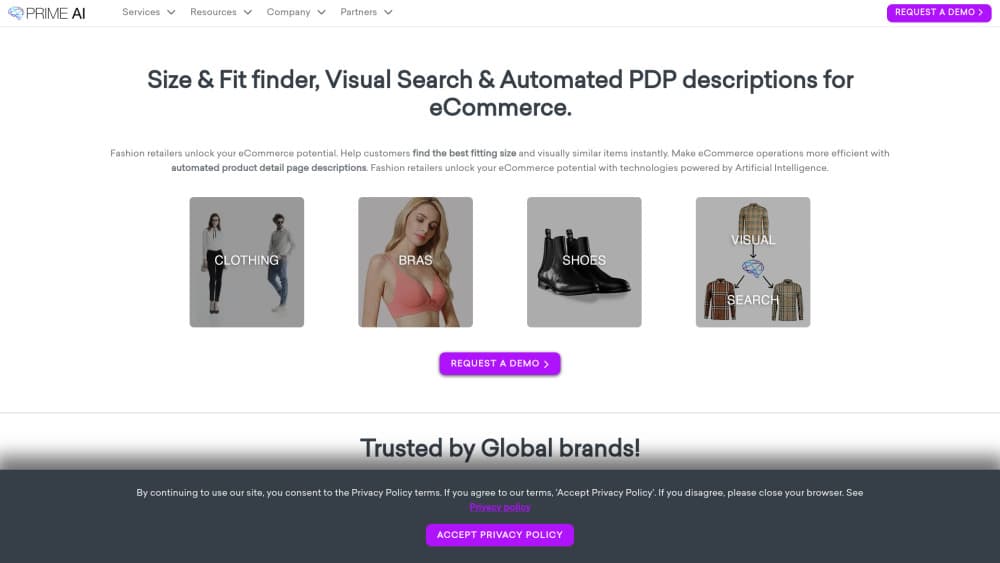
Prime AI Technologies is an AI size and fit platform for fashion retailers. It predicts clothing, shoe and bra sizes from a store's own sales and returns data, plus an API and virtual try on.
About Prime AI Technologies
What Is Prime AI Technologies
Prime AI Technologies is a UK company that builds AI decision tools for online commerce. The flagship product is a fit finder for fashion retailers, an AI clothing size finder that shows a recommended size on the product page instead of leaving the shopper to guess between two sizes and send one back.
The pitch is narrow and measurable. Prime AI reports a 35% lower return rate for shoppers who ordered exactly the size it recommended, compared with shoppers who ignored the advice, and at least a 3% lift in overall conversion. Those numbers come from the vendor, not from an independent study. Fashion brands including Tommy Hilfiger, Calvin Klein, Hugo Boss and Mango appear as case studies on its site.
The same sizing engine feeds a shoe size finder, a bra size finder, a virtual try on widget and a developer API. That range matters if you sell more than one category, because a single vendor covers apparel, footwear and lingerie rather than forcing you to stitch three tools together.
The main limit is data. Pro plans start with a handover of up to 24 months of sales and refund records, and predictions get better with volume. A brand new store with no order history has little for the models to work from, and Pro pricing is quoted per project rather than published.
Getting Started
- Book a demo and describe your catalogue, platform and return problem.
- Send sales and refund history by product and colour ID. Prime AI ingests up to 24 months, and less history still works.
- Install the widget on your product pages. Shopify stores can start with the free Lite app in about 10 minutes.
- Known shoppers get an instant size from their user ID. New shoppers answer a short one-time quiz about body shape and fit preference.
- Watch the size-demand dashboard for uptake, return rates and conversion changes, then adjust fit messaging with your account manager.
Product Information
A quick look at Prime AI Technologies's pricing, supported platforms, and performance.
Best for
The users, tasks, and scenarios where this tool fits best.
Users
- Ecommerce managers at apparel brands with a painful return rate
- Shopify store owners who can't justify a paid tool yet
- Marketplaces, virtual fitting room providers and multi-brand retailers
Tasks
- Cutting size-related refunds on a large catalogue
- Sizing a new collection before it has any sales history
- Sizing footwear and lingerie
- Adding sizing to your own app or platform
Scenarios
- Peak season, when bracketing spikes
- Launching in a new country with unfamiliar size conventions
- Made-to-order and tailoring
Key features
Zero-Input Sizing from Your Own Sales Data
Returning shoppers get a size the moment they land on a product page, with no quiz, because your site passes their user ID and Prime AI reads their past purchases. New shoppers answer one short quiz about body shape and fit preference, then they're remembered. This is the feature that separates Pro from a static size chart: nobody has to measure themselves twice.
Predictive Models Down to Product and Colour
Instead of one size model for the whole store, the models learn how each garment actually fits from purchases, returns and browsing behaviour. A slim-cut shirt and a relaxed one in the same label get different advice. That granularity is what makes the size recommendation software useful on mixed catalogues where fit varies by style.
LLM Review Analysis and Fit Messaging
Large language models read your product reviews and pull out fit signals such as tight sleeves or fabric that stretches, without anyone tagging them by hand. Those signals turn into short messages on the product page telling shoppers to size up, size down or stay put. It puts customer language to work before checkout, which is where the size decision gets made.
Size-Demand Dashboard
The dashboard shows size uptake, return rates, conversion lift and true size demand, including revenue lost to stock-outs in popular sizes. Buyers get a clearer picture of which sizes to order next season. Most competing tools report that a shopper used the widget, not whether the advice changed the outcome.
Shoe and Bra Size Finders
Footwear sizing runs in the shopper's browser: they photograph one foot next to an A4 or US Letter sheet, and the tool measures length and width to about half a shoe size, then matches the result to real SKUs. When the right size is out of stock, it suggests similar in-stock shoes. Lingerie works differently and needs no photo at all, which matters for a category where shoppers avoid webcams and tape measures.
Clothing Size Finder API and Virtual Try On
The API drops recommendations into a marketplace, a headless storefront or a fitting room provider's app, with product measurement sync and analytics included. Virtual try on sits on top as an optional add on, rendering the garment on the shopper's own photo with attention to drape and shadows. Both are sold as modules around the same sizing engine, so you don't need separate vendors for advice and previews.
Pros and cons
Pros
- Recommendations come from your own orders and refunds, so they reflect how your garments fit rather than a generic brand chart.
- Returning customers skip the quiz entirely, which removes the biggest drop-off point in most sizing widgets.
- One vendor covers clothing, footwear, lingerie and try-on, so a multi-category catalogue stays on one contract.
- The dashboard reports whether shoppers followed the advice and what happened to returns, so the case for renewal is measurable.
- Free Lite app and a documented API mean a small store can start today and a platform team can integrate properly later.
Cons
- Pro pricing is quote based. You can't compare it to a fixed monthly tool without talking to sales, and budgets are hard to set in advance.
- Launch depends on a data handover of up to 24 months, so you need clean order and refund records before the models can do much.
- The free Lite version has no predictive AI and no return analysis, which leaves small catalogues on a single size model.
- Results track shopper adoption. If the widget sits low on the page or the quiz feels long, return-rate gains shrink even when the predictions are good.
Frequently asked questions
It builds AI sizing and fit tools for online fashion retailers. The core product recommends a clothing size per shopper, and the same engine covers shoes, bras, virtual try on and a developer API.
Related content
Explore related tools, skills, and articles for Prime AI Technologies.
Prime AI Technologies Alternatives

Base Code
Base44 (Wix) · Coding · ProductivityBase Code is a shared cloud development environment from Base44. Teammates describe changes to an existing GitHub codebase in chat, preview them live and send them back as pull requests.

Google EmbeddingGemma 2
Google DeepMind · Writing · Image · CodingGoogle EmbeddingGemma 2 is a 740M-parameter open model that turns text, code, images, audio, and video frames into vectors in one 768-dimension space, running on phones and laptops.

GitGlow
GitGlow · Coding · ProductivityGitGlow is a local-first desktop Git client that lets independent developers review their own code and their AI agents' changes in one place before shipping.