
ProdMoh AI
ProdMoh · Writing · Image · Productivity · Marketing · Leaning · AI Assistant · Other
ProdMoh is an AI product management platform that turns customer feedback into PRDs, user stories, and guardrails, then carries that context into MCP-ready coding tools and a release gate.
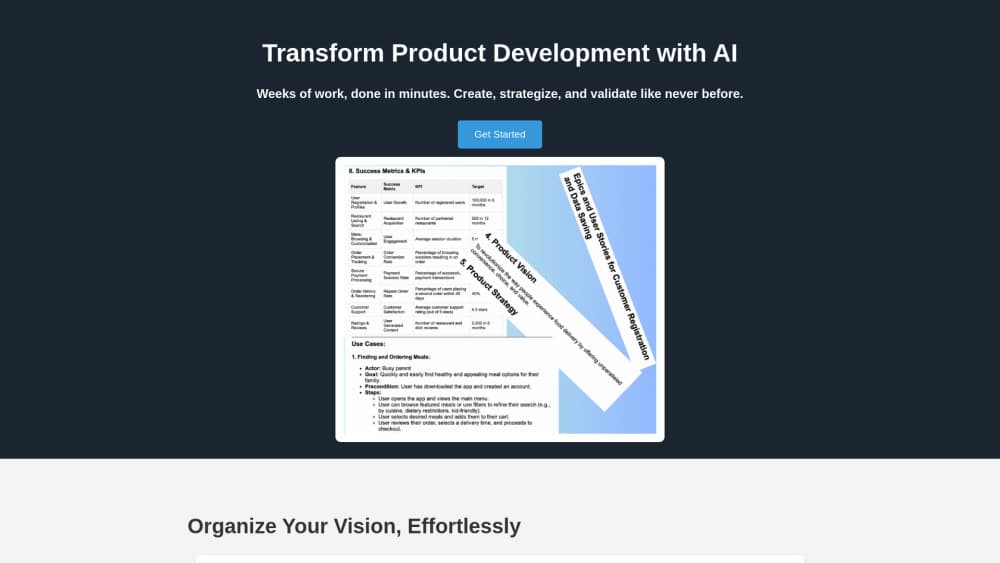
About ProdMoh AI
What Is ProdMoh
ProdMoh is a workspace for product teams that ship with AI coding assistants. It sits between the customer signal and the release decision: feedback comes in, a spec goes out, and the release only clears when someone can point at evidence.
The problem it targets is context loss. A support ticket says invites never arrive, a PM rewrites that as a ticket, a developer guesses at the edge cases in Cursor, and the release gets approved by whoever is least tired. ProdMoh keeps one version of the requirement and passes it down the line. It also scores ideas before anyone commits sprint time, and it keeps a portfolio view for the people paying for the work.
The limits matter more than the feature list. ProdMoh runs on credits, not seats, so heavy Customer Pulse use burns budget fast. It doesn't host your code or replace Jira, and the quality of every generated PRD depends on how clean your feedback data is. Teams that skip review will get polished specs for the wrong feature.
Getting Started
- Create a free account with an email address. New accounts start with 200 credits, no card required.
- Paste a feature idea or a customer problem into the preview box, or import a PRD you already wrote.
- Read the decision preview: the likely call, why it matters now, the evidence you're missing, and the next move.
- Turn the preview into a full PRD with user stories, acceptance criteria, and guardrails, then edit anything that reads wrong.
- Connect the MCP client for Cursor, Claude, or Windsurf so your coding tool can pull the saved scope, or work the release through Release Gate in the browser.
Product Information
A quick look at ProdMoh AI's pricing, supported platforms, and performance.
Best for
The users, tasks, and scenarios where this tool fits best.
Users
- Product managers at teams of three to ten
- Solo founders and indie builders
- Engineering leads at companies adopting AI coding tools
Tasks
- Turning a pile of support tickets into a scoped PRD
- Handing requirements to an AI coding assistant without copy-paste
- Preparing a release decision with evidence attached
Scenarios
- A backlog of feature requests nobody has triaged
- A team that just started using Cursor
- A quarterly roadmap review where everything looks equally urgent
Key features
Customer Pulse
Customer Pulse reads support tickets, CSV exports, and plain text notes and pulls out recurring themes instead of one-off complaints. Each theme becomes a candidate opportunity with the source feedback attached, so a PM can argue for a fix with the actual rows in hand. Credits are charged per feedback item, which makes a large import a visible cost.
PRD and User Story Generation
Feed in a sentence, a ticket dump, or an existing PRD and ProdMoh writes the structured version: user stories, acceptance criteria, constraints, and open questions. The output is meant to be edited, not accepted as-is. This is the part that saves the most time for a team that already knows what it wants to build and dreads the writing.
ProdMoh Score
ProdMoh Score rates an idea on strategic fit, market signal, and execution readiness, then shows where the evidence is thin. It's a product roadmap tool argument, not a verdict: the score gives a PM something to point at when two ideas both sound reasonable and the room needs a reason to pick one.
MCP Connector for Coding Tools
The MCP integration pushes saved PRDs, stories, and guardrails into Cursor, Claude, Windsurf, and other compatible clients. Developers stop rebuilding context from Slack threads, and the assistant works against the same acceptance criteria the PM wrote. MCP calls cost 10 credits each, so a chatty session adds up.
Code X-Ray and Release Gate
Code X-Ray reviews a diff for risk before anyone approves it. Release Gate then tracks each test scenario, whether evidence has been uploaded, and which items still need proof. The release owner gets a clear approve, block, or defer path rather than a green build and a shrug. A full X-Ray report costs 400 credits, and the fix pull request with an evaluation run costs 500.
Product Canvas and Launch Generator
Product Canvas lays initiatives across acquisition, retention, monetization, trust, and efficiency so leadership can see where the roadmap is crowded. The Launch Generator drafts release notes, go-to-market outlines, sales enablement copy, and training material from the approved scope, which saves the usual scramble after ship day.
Pros and cons
Pros
- The workflow covers signal, spec, build context, and release evidence in one place, so a small team doesn't need four separate tools to keep a requirement intact.
- Free tier is genuinely usable: 200 credits and no credit card let you run a real PRD before paying anything.
- Credit packs are one-time purchases, and the Pro pack never expires, which suits teams with uneven monthly workload better than a subscription.
- MCP support for Cursor, Claude, and Windsurf means the spec reaches the coding assistant without manual handoffs.
- Release Gate forces a named decision with evidence, which is more useful than a build that merely passes CI.
Cons
- Credit pricing is hard to forecast. A large Customer Pulse import plus a few X-Ray reports can consume a pack faster than a subscription budget would suggest.
- There's no permanent free plan beyond the starter credits, so evaluation ends once the 200 credits run out.
- Generated PRDs still need a human editor. Vague feedback produces a confident sounding spec for the wrong problem.
- The platform assumes a process. Teams without a release checklist or a feedback source will find half the workflow unused.
Frequently asked questions
It turns customer feedback and rough ideas into product specs with acceptance criteria and guardrails, then connects those specs to AI coding tools through MCP and tracks release evidence against them. Think of it as the layer between a support inbox and a shipped feature.
Related content
Explore related tools, skills, and articles for ProdMoh AI.
ProdMoh AI Alternatives

Google EmbeddingGemma 2
Google DeepMind · Writing · Image · CodingGoogle EmbeddingGemma 2 is a 740M-parameter open model that turns text, code, images, audio, and video frames into vectors in one 768-dimension space, running on phones and laptops.

MePersona
MePersona, Inc. · Writing · Productivity · MarketingMePersona is an AI unified inbox for creators. It learns your voice, drafts replies to fan messages from 12 platforms, and sends only what you approve.

Fluence
Yay Software (Yannick Huchard) · Writing · Voice & Language · ProductivityFluence is an Android app that reads PDFs, EPUBs, Word files and web articles aloud, follows each sentence as it speaks, and answers questions about the text on the phone itself.