

Promptius AI
Promptius AI · Coding
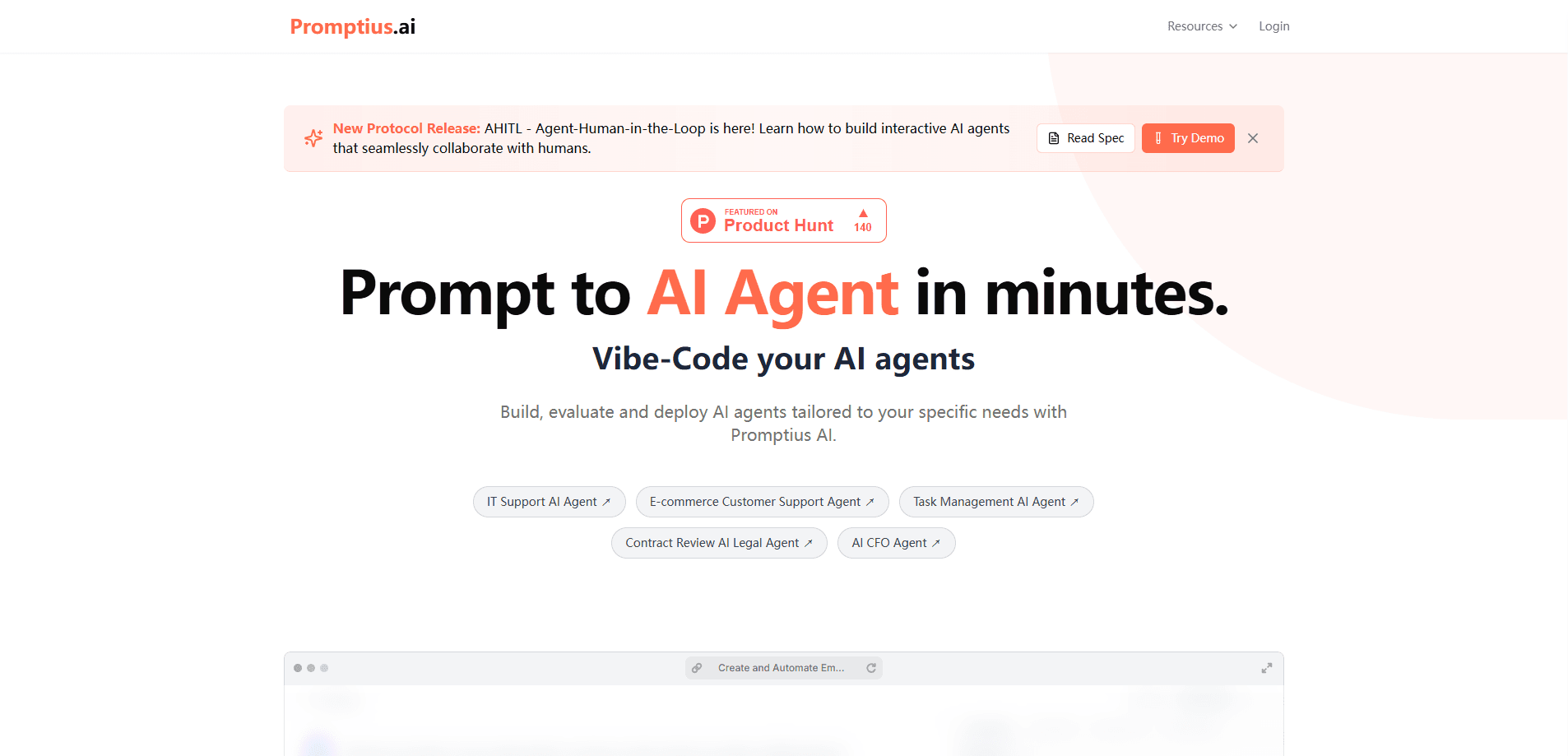
Promptius AI is an AI-powered development environment for building and deploying autonomous AI agents. It's an AI agent builder for people who want working agents without a heavy engineering project, covering workflow automation, data analysis, and customer-facing tasks. You describe the behavior you want, connect the tools the agent should reach, and ship it to run on its own. No coding required.
About Promptius AI
What Is Promptius AI
Promptius AI is an agent development platform for autonomous AI agents. Instead of writing the orchestration layer yourself, you use its interface to define an agent's role, the tools it can call, and the conditions that trigger its work. The claim is that you can go from an idea to a running agent in minutes rather than weeks.
The problems it addresses are familiar to anyone who has tried to automate real work. Simple scripts break the moment a task needs judgment, and full agent frameworks demand time most teams don't have. Promptius AI sits in the middle. It handles the plumbing, the scheduling, and the tool connections, so you focus on what the agent should actually do.
The limits matter as much as the features. Because the product is young, public documentation, pricing pages, and independent reviews are thin. Its site loads as a single-page app, so check the official pages directly before you commit a budget or a workflow to it. Treat vendor claims about speed and reliability as vendor claims until you've tested them on your own tasks. Speed claims are cheap. Proof isn't.
Getting Started
- Create an account on the official Promptius AI site and open the agent builder.
- Describe the agent's role in plain language, then pick the tools, data sources, or APIs it should reach.
- Set the trigger that starts the agent, whether that's a schedule, an event, or a manual run.
- Test the agent on a small sample, check its outputs, and tighten the instructions where it drifts.
- Deploy the agent and monitor its runs, adjusting as real data comes in.
Product Information
A quick look at Promptius AI's pricing, supported platforms, and performance.
Best for
The users, tasks, and scenarios where this tool fits best.
Users
- Non-technical operators who need working automation without writing code
- Small product teams without a dedicated ML engineer
- Developers who want a faster first draft
Tasks
- Workflow automation
- Data analysis
- Customer interactions
Scenarios
- Cleaning up daily repetitive work
- Early project research
- Internal tooling on a budget
Key features
Agent Builder
The builder is where you define what an agent does. You set its role, the tools it can reach, and the rules it follows, using natural language rather than a diagramming language, which lowers the entry barrier for someone who understands the task but not the code behind it. No drag-and-drop blueprint. Just plain instructions. That's the whole idea.
Workflow Automation
Agents connect to external tools and APIs, so they can trigger actions instead of just returning text. A support agent can log a ticket. A research agent can pull from a data source. A sales agent can update a record. The value is in closing the loop between deciding and doing, which is exactly where scripted automation tends to fall apart.
Deployment and Scheduling
Deployment and scheduling is where the platform earns its keep. You push agents to run on a schedule, an event, or a manual trigger, without standing up your own infrastructure. That's real AI agent deployment. An agent you built on Monday can run unattended by Friday. It's the difference between a demo and something that saves time.
Data Analysis Agents
Agents can read data, summarize it, and surface anomalies. This suits teams that need a daily snapshot without building a BI pipeline. Point an agent at the data, define what "notable" means, and let it report. That's it. No dashboard to maintain.
Natural-Language Configuration
Instructions are written in plain language, which keeps the learning curve shallow. You describe intent, the platform translates it into agent behavior, and you adjust wording when the output drifts, which is a workflow that rewards clear thinking more than technical skill. The trade-off is real. Fine-grained control can be harder to reach than with code.
Pros and cons
Pros
- Low entry barrier: you can describe an agent's role in everyday language instead of writing orchestration code.
- Covers the whole path from idea to a deployed, scheduled agent without extra infrastructure work.
- Fits several job types at once, including workflow automation, data analysis, and customer interactions.
- Lets developers prototype agent behavior quickly before committing to a heavier framework.
Cons
- Public documentation and independent reviews are scarce, so it's hard to verify performance claims before signing up.
- No published API details means you can't confirm how well it fits an existing codebase or data stack.
- A natural-language builder trades fine control for ease, which can frustrate teams that need precise, custom logic.
Frequently asked questions
Promptius AI is used to build and deploy autonomous AI agents. Typical work includes automating multi-step workflows, analyzing data, and handling customer interactions. It's a no-code AI agent builder on the surface. You describe the behavior rather than code it, then run the agent on a schedule or trigger.
Related content
Explore related tools, skills, and articles for Promptius AI.
Promptius AI Alternatives
Forefront
Forefront · CodingForefront is a web platform for building with open-source AI. It lets you fine-tune leading open-source language models on your own data, evaluate how they perform, and run them through an API or export them to host yourself. Developers who want the convenience of a closed-source platform but insist on owning their models and data are the target audience here.

Startkit
StartKit.AI · CodingStartkit is a boilerplate for building AI SaaS and AI wrapper products. Think of it as an AI startup boilerplate with the boring parts already wired up: authentication, Stripe and Lemon Squeezy payments, usage limits, transactional email, and an AI API starter that talks to OpenAI, Anthropic, Groq, or Llama. You clone the repo, set your price, and start on the part of your product that people actually pay for. It's Next.js under React and Tailwind, so most of the boilerplate code already feels familiar.
Testim
Tricentis · CodingTestim is an AI-powered test automation platform for building and running end-to-end tests across web, mobile, and Salesforce applications. It leans on machine learning to keep tests stable when an interface changes, so teams spend less time fixing broken selectors. Not bad for an automated testing tool you can start using today. You create tests by recording actions in a browser, then optionally add JavaScript when you need more control. It's a solid pick for busy QA teams.