

PromptQL
Hasura · Coding
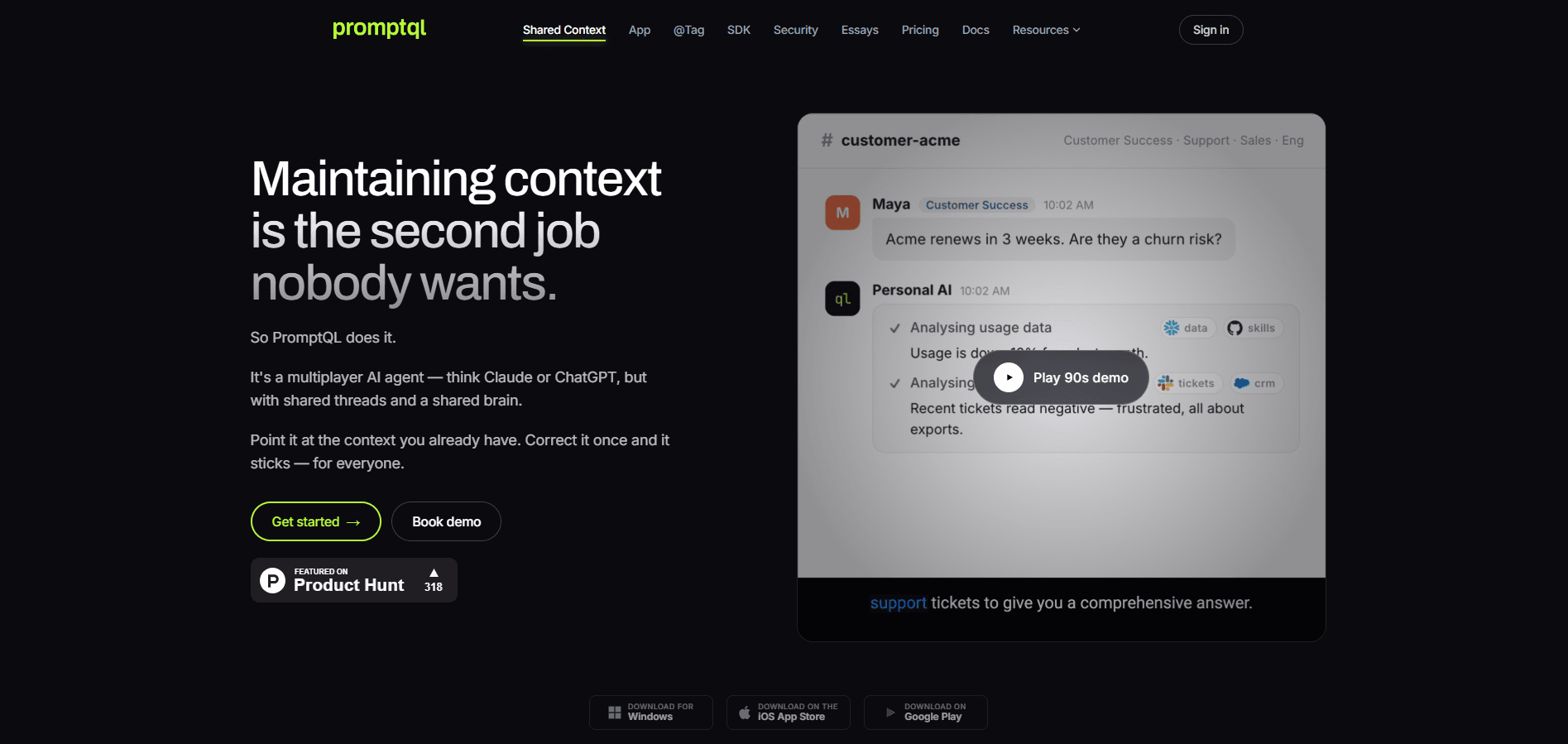
PromptQL is a multiplayer AI agent built by Hasura that connects to your business data and systems and answers real questions by writing code. Instead of one person chatting with a bot in isolation, teams share threads, a shared context brain, and automations that keep improving as more people correct and refine the work. It's aimed at organizations that need grounded, traceable answers rather than confident guesses.
About PromptQL
What Is PromptQL
PromptQL is a data agent platform from Hasura, the company behind the Hasura GraphQL Engine and Data Delivery Network. The core idea is that AI is only as accurate as the context it's given, and the context that matters usually lives in people's heads, not in a schema. PromptQL connects to warehouses, databases, SaaS apps, and APIs as they already exist, then lets teams capture that tribal knowledge in the flow of work.
The product is positioned around two problems Hasura spent years working on. Both are hard. The first is shared context: rather than extracting context once and handing it to AI, PromptQL keeps a flywheel going where people and AI work together and correct each other. Correct the agent once, and the fix sticks for everyone. The second is security. PromptQL enforces permissions deterministically at the data layer, so each person's agent works with exactly the access they have and nothing more. That's the gate. Without it, teams can't hand over work that matters.
The main limitation is scope. PromptQL is an enterprise-focused tool, not a consumer chatbot. It's an AI analytics tool first, and Team pricing starts at $40 per user per month. Features like single-tenant deployment or bring-your-own-model setups sit behind Enterprise and Custom contracts. If you just want a free assistant for personal tasks, this isn't built for that.
Getting Started
- Create a workspace at prompt.ql.app and sign in to the Playground, which is free.
- Connect a data source. PromptQL introspects schemas from your warehouse, database, or SaaS app to build a unified data graph without moving your data.
- Invite a few coworkers so threads and context are shared from the start.
- Ask a real business question in a shared thread and let the agent write code to answer it.
- Correct anything it gets wrong at the source so the fix persists for the whole team.
Product Information
A quick look at PromptQL's pricing, supported platforms, and performance.
Best for
The users, tasks, and scenarios where this tool fits best.
Users
- Data and analytics teams
- Operations managers
- Enterprise IT and security leads
Tasks
- Investigating metric spikes
- Fixing month-end exports
- Answering recurring business questions
Scenarios
- A growth team trying to explain why a metric jumped on a specific afternoon
- Finance reconciling regional numbers that land in different systems
- A security-conscious organization rolling out AI internally
Key features
Multiplayer Shared Threads
PromptQL runs on shared threads rather than private chats, so a conversation about a metric lives where the whole team can see and build on it. When someone corrects the agent, that correction applies for everyone using the same thread. It's the feature that separates PromptQL from single-user AI assistants. That's the whole pitch.
Shared Context Brain
The shared context layer holds the definitions, exceptions, and tribal knowledge that never make it into a schema. It covers knowledge, skills, and a semantic layer that the agent draws on when answering. Because context is captured just-in-time during real work, it stays current instead of decaying the moment it's written down.
Connect Any Data With No Prep
PromptQL connects to your warehouse, databases, SaaS apps, and APIs as they exist today. It introspects the schemas to build a unified data graph without moving or reshaping your data. Practically, that means you can go from data to questions in minutes rather than a long migration project.
Code answers, not canned reports.
Rather than retrieving canned reports, the agent writes code to answer the question in front of it. In the product's own examples, it connects to several systems, tests each theory against a spike, and adds a panel with the answer. That approach lets it handle questions nobody anticipated in advance.
Deterministic Security Guardrails
Permissions are enforced at the data layer, for every user, every source, and every query. Each person's agent works with exactly the access they have and nothing more, which matters when a single organization runs data across many systems with different policies. Guardrails aren't bolted on after the fact. They're built in.
Model Choice Per Bot
PromptQL measures usage in normalized units called OLUs and lets you pick different models for different bots, or even mid-thread. Open-weight options like DeepSeek, Qwen, and GLM cost a fraction of frontier models, so teams can trade cost against capability per task.
Pros and cons
Pros
- Shared threads and a shared context brain mean corrections stick for the whole team, not just one user.
- Connects to existing warehouses, databases, SaaS apps, and APIs without moving or reshaping data.
- Permissions are enforced deterministically at the data layer, which suits security-conscious enterprises.
- Backed by Hasura, whose GraphQL Engine and Data Delivery Network run inside large enterprises.
- Teams can swap models per bot or mid-thread to control cost against accuracy.
Cons
- The free Playground only covers building multiplayer bots, so real production use needs a paid plan.
- Team pricing starts at $40 per user per month and is billed weekly in increments, which adds up for larger groups.
- Single-tenant deployment and bring-your-own-model setups need an Enterprise or Custom contract, so smaller teams can't easily get them.
- API availability isn't documented publicly, which makes it hard to plan automated integrations up front.
Frequently asked questions
It connects to your business data and systems and answers real questions by writing code, then keeps improving as your team corrects it. The focus is grounded, traceable analysis and automation rather than generic chat.
Related content
Explore related tools, skills, and articles for PromptQL.
PromptQL Alternatives
Forefront
Forefront · CodingForefront is a web platform for building with open-source AI. It lets you fine-tune leading open-source language models on your own data, evaluate how they perform, and run them through an API or export them to host yourself. Developers who want the convenience of a closed-source platform but insist on owning their models and data are the target audience here.

Startkit
StartKit.AI · CodingStartkit is a boilerplate for building AI SaaS and AI wrapper products. Think of it as an AI startup boilerplate with the boring parts already wired up: authentication, Stripe and Lemon Squeezy payments, usage limits, transactional email, and an AI API starter that talks to OpenAI, Anthropic, Groq, or Llama. You clone the repo, set your price, and start on the part of your product that people actually pay for. It's Next.js under React and Tailwind, so most of the boilerplate code already feels familiar.
Testim
Tricentis · CodingTestim is an AI-powered test automation platform for building and running end-to-end tests across web, mobile, and Salesforce applications. It leans on machine learning to keep tests stable when an interface changes, so teams spend less time fixing broken selectors. Not bad for an automated testing tool you can start using today. You create tests by recording actions in a browser, then optionally add JavaScript when you need more control. It's a solid pick for busy QA teams.