

Prosed
Prosed · Writing
Prosed is an AI book assembly tool that turns content you've already written into a structured, publish-ready nonfiction manuscript. It connects to ChatGPT, Claude, Cursor, or any other assistant that speaks MCP, loads your full archive from Substack, a blog, or a podcast, and reads all of it. The platform then runs that material through an editorial pipeline called The Inkwell and hands back chapters built from your own sentences. You get a manuscript you can export as PDF or DOCX, plus a private portal where you shape every chapter before it's done.
About Prosed
What Is Prosed
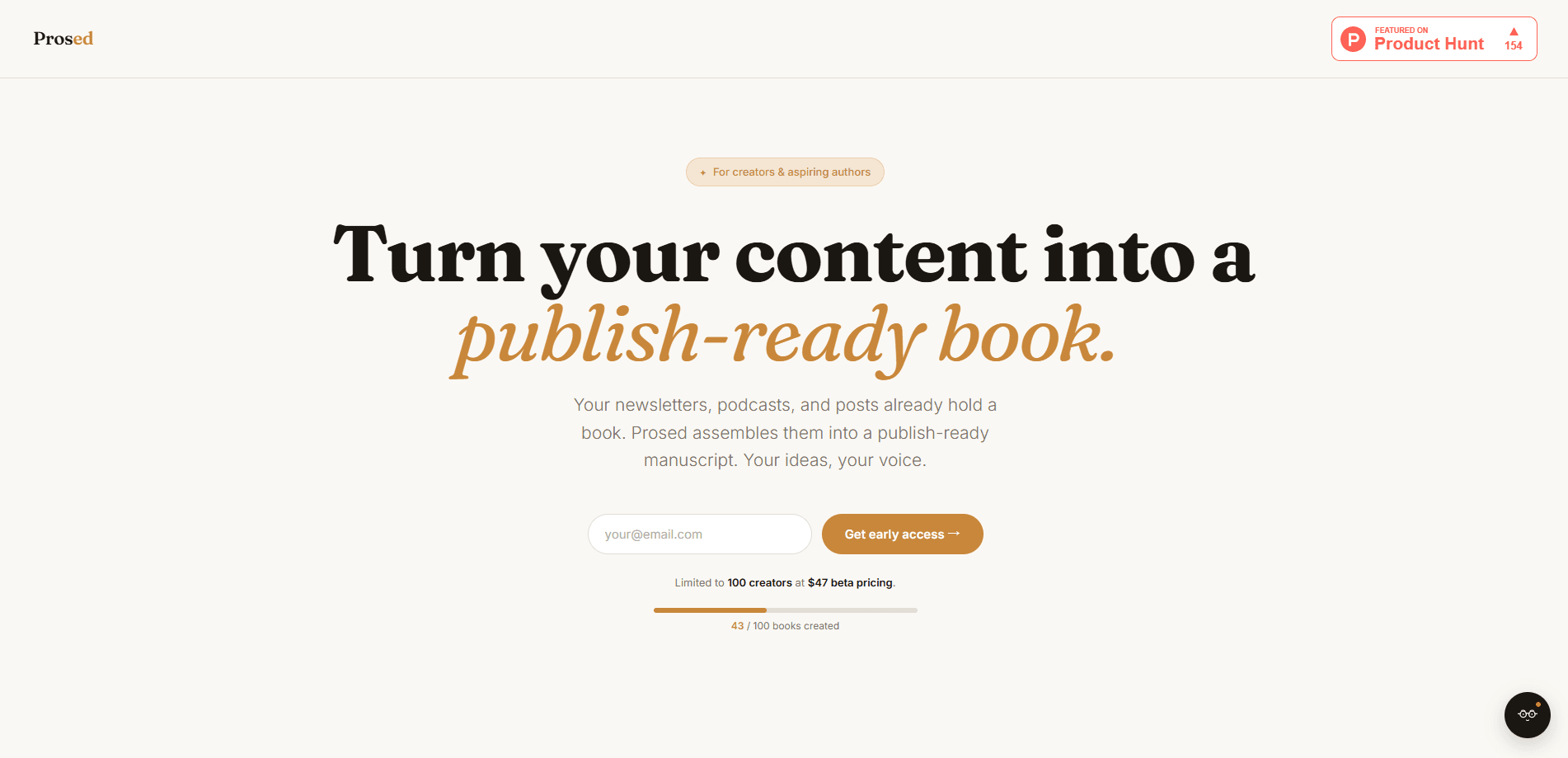
Prosed is a book assembly service for people who already have a body of work but no finished book. Feed it a newsletter archive, a run of podcast transcripts, a folder of notes, or years of blog posts, and it finds the manuscript hiding in there. The pitch is blunt: you don't write new words. It assembles what you've got. Nothing gets invented.
The product sits inside your existing writing setup rather than replacing it. You paste a single address into an MCP-capable assistant, sign in once inside that conversation, and everything after that happens in the chat. That design choice matters. It's the main reason Prosed feels different from dropping your drafts into a chatbot.
The platform runs on three parts. The Inkwell is a multi-stage editing pipeline built from patterns the team pulled out of more than 150 bestselling nonfiction books. Typo is an AI reviewer that checks grammar, voice, flow, and cohesion, and links every note to the exact passage it's about. The private portal gives each chapter a clean reader where you can comment, accept or reject suggestions, and request revisions.
The biggest limit is worth stating plainly. Prosed doesn't write your book from scratch. It needs source material, and it works best when that material is substantial. Where two of your ideas need a bridge sentence, the pipeline writes one, but it also shows you exactly where it did that. If you're starting from nothing, this isn't the tool for you yet.
Getting Started
- Connect Prosed to an MCP-capable assistant by pasting its address into ChatGPT, Claude, or Cursor. You sign in once inside the conversation.
- Tell it where your content lives, such as a Substack URL, a blog, or podcast transcripts. Prosed loads the whole archive rather than a sample.
- Ask what book is in your archive. Prosed answers honestly and will tell you if there isn't enough material yet.
- Shape the outline by talking it through. Move chapters, cut them, or rename them, and this part stays free.
- Let Prosed assemble the chapters from your own sentences, then review each one in the portal and export a PDF or DOCX.
Product Information
A quick look at Prosed's pricing, supported platforms, and performance.
Best for
The users, tasks, and scenarios where this tool fits best.
Users
- Newsletter writers
- Podcasters
- Aspiring nonfiction authors
Tasks
- Turning a newsletter archive into a manuscript
- Drafting a book outline from scattered posts
- Editing for voice and flow
- Exporting a finished draft
Scenarios
- You've published for years and want to see what a book version looks like
- You want a manuscript you can still legally call your own
- You already write inside an AI assistant daily
Key features
The Inkwell Editing Pipeline
The Inkwell is the multi-stage engine underneath Prosed, built from patterns the team observed across 150-plus bestselling nonfiction books. It edits, restructures, and writes the connective tissue that turns separate posts into chapters. The important detail is where those connecting sentences come from. The pipeline writes a bridge between two of your ideas when one is needed, and it always flags the spot. You see the seams instead of being told there aren't any.
Typo, the Editorial Reviewer
Typo acts as a dedicated manuscript editor and AI editor rather than a spell-checker. It looks at grammar, voice, flow, and cohesion across a chapter, and every note it leaves links to the exact passage it refers to. That link matters more than it sounds. Vague feedback like "tighten this section" is useless in a 300-page draft. Typo pins its suggestions to real text, so you can act on them.
The Private Chapter Portal
Every chapter gets a distraction-free reader inside your private portal. From there you comment, accept or reject Typo's suggestions, and request revisions chapter by chapter. Working one chapter at a time keeps the editing job small enough to actually finish, which is the part most book projects fall apart on. That's the whole point.
MCP Connection to Your Assistant
Prosed runs through MCP, so it lives inside ChatGPT, Claude, Cursor, or any other assistant that supports the protocol. You paste one address, sign in once, and then load archives, ask questions, and shape outlines without leaving the conversation. For people who already write in these tools, the setup is closer to enabling a feature than adopting new software.
Archive Loading From Real Sources
You point Prosed at a Substack, a blog, a podcast, or a set of transcripts and notes, and it reads everything rather than a sample. In one example on the company's site, loading a Substack returned 148 posts and 214,000 words going back to 2019. That thoroughness makes the "is there a book in here" question answerable instead of a guess.
Voice Control and Source Mapping
You tell Prosed how you talk, which phrases you love, and which ones you never want to see again. Those instructions hold across the manuscript, so a hated word stays out and a signature phrase lands where it belongs. Every sentence in the finished book comes from your own writing, and the source map shows which lines are yours and where the pipeline bridged between them.
PDF and DOCX Export
When a draft is ready, you take it away as a PDF and a DOCX. The DOCX matters if you plan to keep editing in a word processor or hand the file to a traditional editor, and the PDF gives you a clean version to read start to finish. Read it, revise it as often as you like, then export again. No lock-in either.
Pros and cons
Pros
- Reads your entire archive, not a sample, so nothing gets missed.
- Builds chapters only from sentences you already wrote, which keeps the voice authentically yours.
- The source map shows where the pipeline bridged between your ideas, so the seams stay visible.
- Typo's feedback links to the exact passage, which makes long drafts actually editable.
- Setup and outline shaping are free, so you learn whether you have a book before spending money.
Cons
- You need a substantial body of existing work going in, and a thin archive may not yield a full book.
- The connecting sentences the pipeline writes are new text, so purists who want zero new words will notice them.
- Pricing isn't published as a simple number on the site, so you have to go through setup to learn what generation costs.
- It runs through MCP inside another assistant, which means anyone unfamiliar with that setup has a learning step first.
Frequently asked questions
Prosed turns content you've already produced, such as newsletters, podcasts, posts, and notes, into a structured nonfiction manuscript. It reads your whole archive, finds the book within it, and assembles chapters from your own sentences. If you want to turn a newsletter into a book, that archive is the raw material.
Related content
Explore related tools, skills, and articles for Prosed.
Prosed Alternatives

Google EmbeddingGemma 2
Google DeepMind · Writing · Image · CodingGoogle EmbeddingGemma 2 is a 740M-parameter open model that turns text, code, images, audio, and video frames into vectors in one 768-dimension space, running on phones and laptops.

MePersona
MePersona, Inc. · Writing · Productivity · MarketingMePersona is an AI unified inbox for creators. It learns your voice, drafts replies to fan messages from 12 platforms, and sends only what you approve.

Fluence
Yay Software (Yannick Huchard) · Writing · Voice & Language · ProductivityFluence is an Android app that reads PDFs, EPUBs, Word files and web articles aloud, follows each sentence as it speaks, and answers questions about the text on the phone itself.