

Protoclone
Clone Robotics · Other
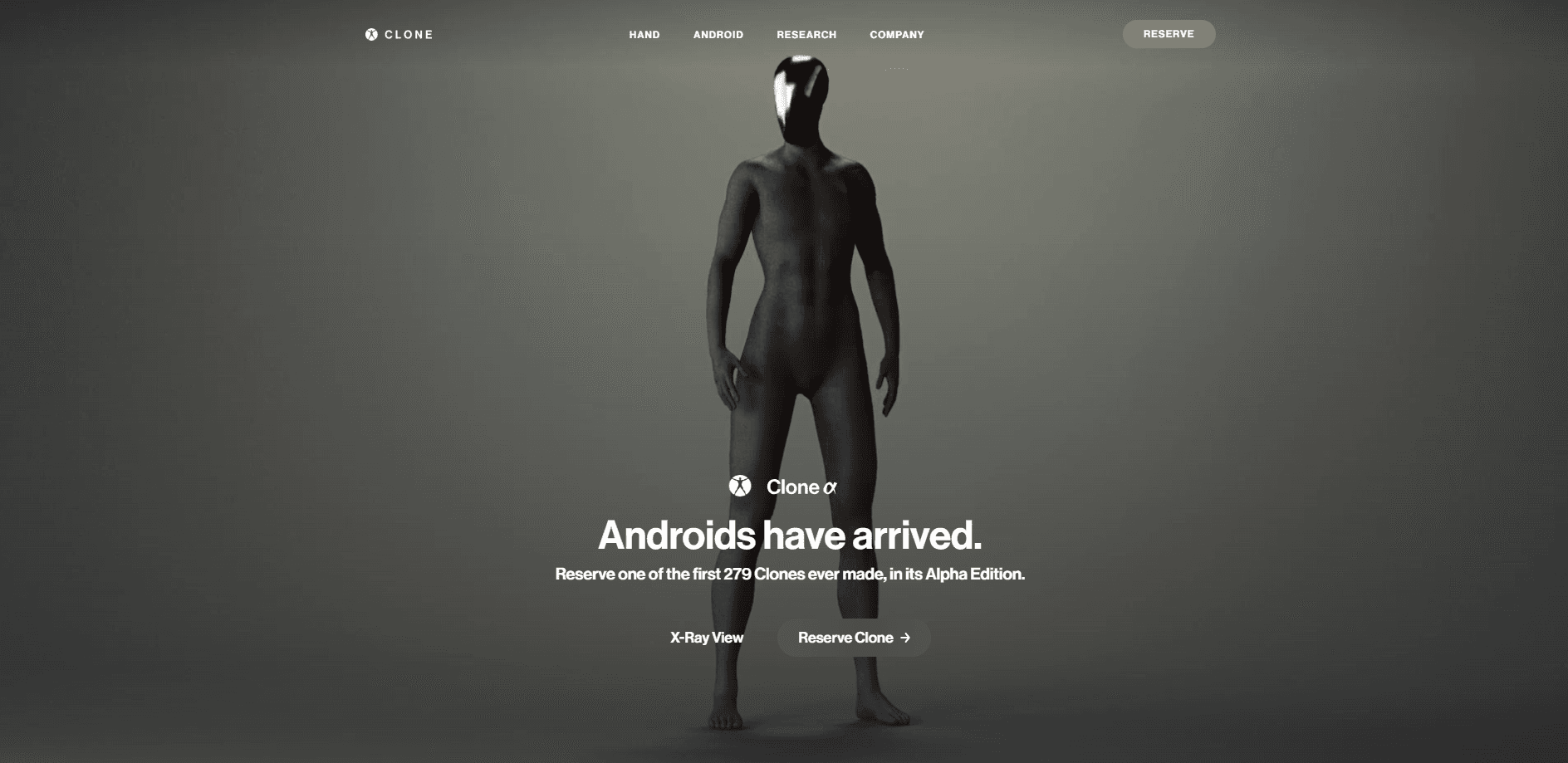
Protoclone is Clone Robotics' bipedal, muscle-driven android prototype. It pairs a 206-bone polymer skeleton with over 1,000 Myofiber artificial muscles and 500 sensors to move like a person.
About Protoclone
What Is Protoclone
Protoclone is a musculoskeletal android built by Clone Robotics, a Polish startup founded in 2021. Instead of motors and metal joints, it copies human anatomy: a 3D-printed polymer skeleton, artificial ligaments, synthetic muscle, and a vascular-like fluid system inside.
The first full-body version, Protoclone V1, appeared in early 2025 and drew millions of views. Full Protoclone V1 specs list a 206-bone frame, 1,000 muscles, and 500 sensors, which is why people call it a synthetic human robot rather than a standard bipedal humanoid robot. Most people remembered the look, a faceless frame with a black mask twitching on a workshop rig. The engineering underneath is the real story. Clone wants a robot that moves in human spaces without redrawing every doorway and stair for it.
The prototype doesn't walk on its own yet, and that gap matters for anyone expecting a finished home helper. Current units hang from a support rig and run on compressed air. Clone says a closed-loop water hydraulic system comes next.
Getting Started
- Read the technical pages on clonerobotics.com to understand the musculoskeletal design.
- Join the pre-order waitlist if you want one of the limited Alpha Edition units.
- Wait for Clone to confirm final pricing, delivery windows, and regional availability.
- When a unit ships, run it through the Telekinesis training platform to teach it new skills.
Product Information
A quick look at Protoclone's pricing, supported platforms, and performance.
Best for
The users, tasks, and scenarios where this tool fits best.
Users
- Robotics researchers
- Hardware and biomechanics engineers
- Early adopters and collectors
Tasks
- Household chore research
- Manipulation and grasping studies
- Natural-language interaction research
Scenarios
- Lab and university demos
- Manufacturing and hospitality pilots
- Home service prototypes
Key features
Myofiber Artificial Muscles
More than 1,000 Myofiber units drive Protoclone. Each synthetic muscle-tendon strand weighs about 3 grams, contracts in under 50 milliseconds, and pulls with roughly 1 kilogram of force. That speed and density let the robot mimic human motion instead of the stiff, gear-driven movement of many humanoids.
206-Bone Polymer Skeleton
The frame reproduces all 206 human bones in 3D-printed polymer, tied together with artificial ligaments and connective tissue. Joints follow human directions, so a shoulder moves along 20 separate axes while a knee bends and straightens. This keeps the robot compatible with furniture and tools already shaped for people.
Dense Sensor Feedback
Over 500 sensors track joint angles, muscle force, and local torque, and the data feeds NVIDIA Jetson processors. The result is fast, closed-loop control that keeps movement smooth and limits the chance of a grip crushing something delicate.
Water-Based Cooling Loop
Sweating isn't a gimmick here. Protoclone runs a biomimetic cooling system that releases water to keep its motor units from overheating, and future models use water inside a closed hydraulic loop. The company says water also drives higher force output than air alone.
Natural-Language Interface
A spoken interface lets users talk to Protoclone in plain speech. Combined with an on-device GPU, it turns the android into a walking computer you can instruct by talking, which Clone frames as the next step in human-computer interaction.
Telekinesis Training Platform
The Alpha Edition ships with the Telekinesis training platform. Owners can teach new skills instead of waiting for firmware drops. It also ships with pre-installed abilities like folding laundry, loading a dishwasher, pouring drinks, and making sandwiches.
Pros and cons
Pros
- Muscle-driven design moves closer to human motion than motor-and-gear humanoids.
- Lightweight polymer build and soft muscles lower the risk of damage to floors and furniture.
- Dense sensing and edge GPU support smooth, closed-loop control.
- The Telekinesis platform lets owners add skills rather than wait for updates.
- Pre-installed skills cover common household chores out of the box.
Cons
- Early units are tethered to a support rig, so the robot can't walk freely on its own yet.
- The Alpha Edition is capped at 279 units with no confirmed public price.
- Real autonomy stays limited, so buyers shouldn't expect a finished household assistant.
Frequently asked questions
Protoclone is a bipedal, musculoskeletal android from Clone Robotics. It copies human anatomy with a 206-bone polymer skeleton and more than 1,000 Myofiber artificial muscles, and it's the prototype that the upcoming Clone Alpha is built on.
Related content
Explore related tools, skills, and articles for Protoclone.
Protoclone Alternatives

Odyssey 3
Odyssey · OtherOdyssey-3 is Odyssey's foundation world model. It simulates physics in real time, turns a prompt into an interactive environment, and adapts to robots, cars and games.

JarvisCore
Prescott Data · Coding · Productivity · OtherJarvisCore is an open source Python runtime where AI agents work as equal peers on an agent mesh, claim tasks from a shared ledger, and reach external services through a zero-trust broker.
Clef
Cloudflare · Business · OtherClef is Cloudflare's open-source decision model for Workers AI. It returns calibrated probabilities for typed questions, not generated text, so agents can classify, route, and act fast.