

Psyke
Psyke (built by the Upflowy team) · Marketing · AI Detection
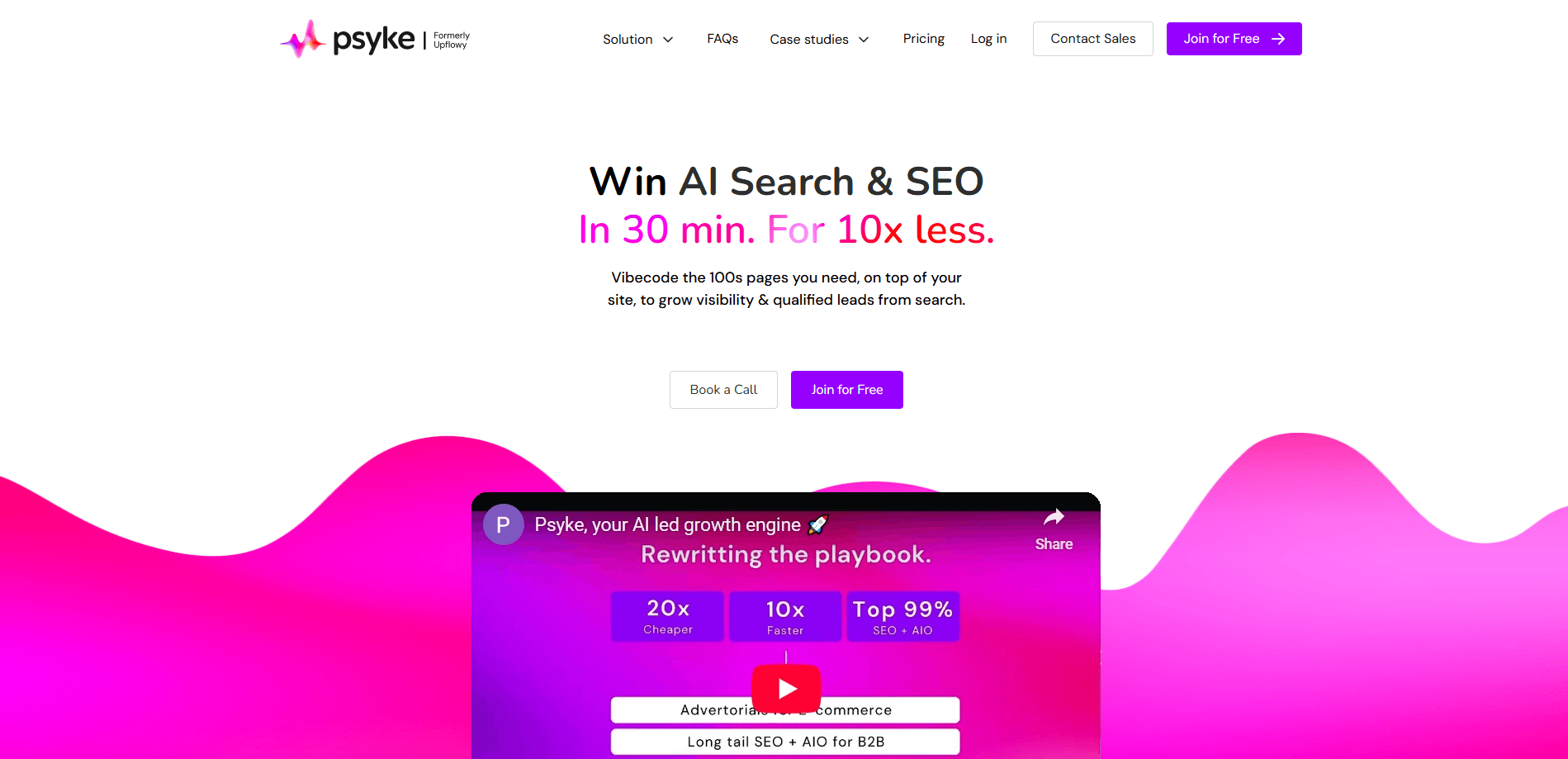
Psyke is an AI SEO platform that turns a website into a structured knowledge layer which AI search engines can read, cite, and recommend. Its AI content generation and agentic organic marketing workflows map buyer intents, produce on-brand content variants, and publish them to your existing content management system. Think of it as generative engine optimization with an execution layer. Marketing teams at small and mid-sized companies use it to show up inside ChatGPT, Claude, Perplexity, and Google AI answers, not just in classic search results.
About Psyke
What Is Psyke
Psyke is an AI SEO platform built around a simple claim: the way buyers find businesses has shifted from blue links to AI-generated answers, and most companies are invisible in those answers. Instead of chasing keyword rankings, Psyke builds a structured representation of your business, a knowledge layer that large language models can parse, and deploys content against thousands of buyer intents.
The product comes from the team behind Upflowy, an Australian software company, and is marketed as an operating system for agentic organic marketing. Its pitch is that traditional SEO tools only report on rankings, while Psyke both reports and executes. Does that claim hold up? It depends on how much of your growth you're willing to hand to automation.
Here's the main catch: paid plans are custom-priced. The website doesn't publish a price list, so you have to talk to sales before you know what a plan costs. Small teams that want to test the waters on their own budget may find that friction annoying.
Getting Started
- Sign up for the Starter plan at the Psyke app and connect a website. Starter is free but stamps a Psyke watermark on published pages.
- Approve a blueprint, which is a page template built around one clear buyer intent. There are 26 blueprint types.
- Let the Intent Mapping Engine scan the questions buyers ask across search and AI engines, then review the clusters it scores by opportunity.
- Connect your CMS (Webflow, WordPress, Shopify, Contentful, or Sanity) so Psyke can publish approved variants directly to your domain.
- Track AI citations and refine. The feedback loop keeps running as new models reach meaningful usage.
Product Information
A quick look at Psyke's pricing, supported platforms, and performance.
Best for
The users, tasks, and scenarios where this tool fits best.
Users
- Marketing teams at small and mid-sized companies who want AI search visibility without hiring an agency, provided they can work with custom pricing.
- Content and SEO managers who already publish regularly and want to scale output while keeping one consistent brand voice.
- Agencies managing several client sites, since the Pro plan supports unlimited workspaces from a single account.
Tasks
- Building a knowledge layer so AI engines describe your business accurately, rather than pulling stale or wrong details from elsewhere.
- Generating hundreds of on-brand page variants from one approved blueprint, each mapped to a distinct buyer intent.
- Tracking how often ChatGPT, Claude, and Perplexity cite you, then refining the content that gets ignored.
Scenarios
- A B2B software company that ranks fine on Google but never appears when buyers ask an AI assistant for recommendations.
- A marketing team that wants to publish AI-targeted content without rebuilding its whole site or leaving its current CMS.
- An agency that needs to cover many client domains and prove visibility gains with something more concrete than keyword position reports.
Key features
Intent Mapping Engine
The Intent Mapping Engine identifies the questions buyers actually ask, across both traditional search and major AI engines. It clusters them by commercial and decision-stage intent, then ranks each cluster by revenue opportunity. A fintech example on the site shows over 2,000 tracked prompts sorted into clusters, which gives a sense of the scale the tool works at. That's a lot of ground to cover.
Knowledge Graph Builder
This feature turns your business into an AI-readable web of entities, relationships, and concepts tied to each product, category, and use case. The goal is control over how language models describe you, so their answers reflect what you sell rather than whatever they scraped last. If AI doesn't cite you, as the company puts it, your category is being decided without you.
Blueprint Page System
A blueprint is an approved page template built around one clear search intent. Psyke lists 26 blueprint types, and once you approve one, it scales that template across variables to produce thousands of consistent variants. One template. Infinite variants. This is the mechanism behind the platform's core promise of scale without losing brand consistency.
Native CMS Deployment
Psyke publishes directly into your existing CMS, including Webflow, WordPress, Shopify, Contentful, and Sanity. Marketing teams keep control of what goes live and when, and there's no need to migrate your site to Psyke's hosting. Draft pages don't count toward your plan limit, so you can prepare as many as you like before publishing. No migration. No hosting lock-in.
AI Citation Tracking
The platform tracks which AI models cite your content, then feeds that data back into refinement and redeployment. As new models reach material usage, Psyke adds them to its tracking set. This turns AI search visibility into something you can measure, not just guess at. Not perfect, but useful.
Five-Surface Growth Layer
Psyke organizes its work into five surfaces that run continuously and compound with one another: intent mapping, knowledge structuring, deployment, optimization, and tracking. It's a system, not a report. The company frames this as replacing a piece of the old marketing stack rather than adding another AI search optimization tool.
Pros and cons
Pros
- Targets AI search and classical SEO in one workflow, which matters as more buyers start their research with an AI assistant.
- Replaces parts of a content agency with automation, a cost the company claims is roughly 10x lower.
- Publishes straight into popular CMS platforms, so you don't have to rebuild your site or retrain your team.
- Offers a free Starter tier and a 60-day money-back guarantee on paid plans, which lowers the risk of trying it.
- Handles scale well: blueprints turn into thousands of intent-mapped pages from a single approved template.
Cons
- Pricing is custom and quoted through sales, so you can't compare costs or budget without a conversation first.
- The free Starter plan limits you to 25 pages per campaign and one live campaign, and it adds a Psyke watermark to published pages.
- The heavier done-for-you tier, Psyke For You, is fully managed and priced on scope, which puts it out of reach for solo operators.
- API availability isn't documented on the site, so developers who want to build on top of Psyke will need to ask.
Frequently asked questions
Psyke builds and manages a structured content layer for your website so AI search engines like ChatGPT, Claude, and Perplexity cite your business in their answers. It maps buyer intents, generates on-brand pages, and publishes them to your CMS, then tracks how often AI models reference you.
Related content
Explore related tools, skills, and articles for Psyke.
Psyke Alternatives

Emailwritr
Emailwritr · Writing · MarketingEmailwritr is an AI email copywriting tool built for affiliates, course creators, and online businesses that want more revenue from the list they already own. Instead of blank pages or generic chatbot prompts, this AI email writer generates welcome sequences, launch campaigns, cart recovery emails, and promo series from frameworks modeled on well-known direct-response copywriters. You connect your autoresponder, answer a few questions about your offer, and it writes the copy for you.

Prosp
Prosp · Writing · Voice & Language · MarketingProsp is an AI LinkedIn outreach tool built for agencies and sales teams, and it writes the message and the voice note in your own voice for each prospect so they actually reply. You connect your accounts, find leads, and let the AI draft and send personalized messages at scale, all from one inbox. It's built for people running outbound at volume. That's the whole pitch. Every touchpoint still has to feel human.

On Model
On Model · Image · MarketingOn Model is an AI fashion model tool that places your clothing on virtual models so online stores can get on-model product photos without booking a photoshoot. It runs as a Shopify app, letting you swap the model in an existing image, change backgrounds, and generate faces for cropped or headless shots. The goal is simple: match your product photos to your customers and stand out from competitors using the same supplier images.