

Pure Global MedTech
Pure Global · Other
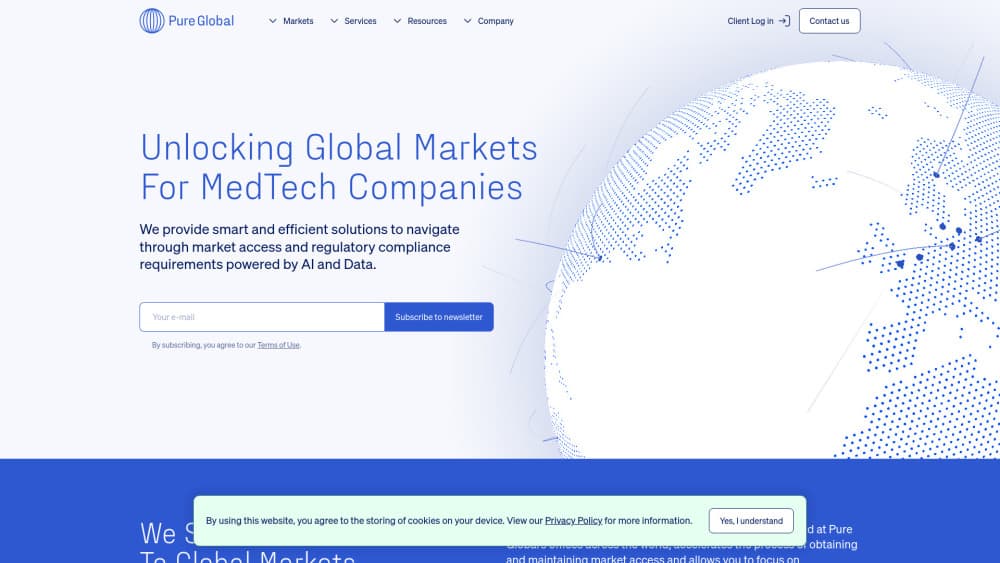
Pure Global MedTech handles medical device registration and in-country representation across 32 markets, with AI-assisted dossiers and one flat annual fee per market.
About Pure Global MedTech
What Is Pure Global MedTech
Pure Global MedTech is a medical device regulatory consulting firm that handles medical device registration for devices, IVDs, and software as a medical device outside the manufacturer's home country. The company pairs local regulatory specialists in more than 15 countries with an AI-assisted dossier system, so a single program can cover several authorities instead of one consultant per market.
The work starts before paperwork. Pure Global classifies the portfolio, maps which approvals you already hold, and sequences market access around your commercial priorities and the evidence you can produce now. From there it compiles a reusable core dossier, submits locally, answers deficiency questions, and keeps registrations current after approval. Clients range from startups with one device to multinationals with a portfolio of hundreds.
What it does not do is act as a law firm or a test lab. Government fees sit outside the quoted price, clinical trials are handled by partners, and the service is built for companies with a device already in development, not for someone testing an idea. Pure Global publishes free databases and AI tools at pureglobal.ai, and the registration service itself is a paid engagement.
Getting Started
- Run the fee calculator on the Pure Global site or send a short brief on your device, target countries, and current approvals.
- Take a scoping call where the team reviews intended use, device class, quality system status, and timing.
- Approve a registration plan that lists markets in sequence, local requirements, and one flat annual fee per market.
- Hand over technical files and evidence so the core dossier can be compiled and translated.
- Track submissions and deficiency responses in one program record, then keep the approvals maintained after launch.
Product Information
A quick look at Pure Global MedTech's pricing, supported platforms, and performance.
Best for
The users, tasks, and scenarios where this tool fits best.
Users
- Regulatory affairs managers at device startups
- Export-focused IVD makers
- Quality managers preparing for audits
Tasks
- Entering three or four Asian markets in one year
- Replacing a distributor who held the local license
- Cleaning up an ISO 13485 system before an MDSAP audit
- Keeping a live approval valid after a design change
Scenarios
- A scaleup with CE marking that needs FDA and Health Canada clearance next
- A manufacturer whose notified body asks for more clinical evidence
- A company entering the Gulf or Southeast Asia without local staff
Key features
Multi-market registration program
One program lead runs the whole sequence, from classification and evidence readiness to local submission and approval. Instead of a country checklist, the team builds a pathway map that shows which markets accept existing approvals and which need new testing. Useful when you're weighing six markets and can only fund three this year.
Reusable core dossier
Administrative, technical, clinical, labeling, risk, software, and quality evidence get organized into one controlled source package. Local versions are traceable copies, so an update to the risk file flows into every market instead of being retyped. This is where most of the time savings come from on a second or third filing.
In-country representation
Pure Global acts as the local regulatory role in markets that require one, including distributor authorization where the law allows it. That means an address, a responsible person, and someone who answers authority questions in the local language. Manufacturers without a subsidiary stop needing to appoint a distributor just to hold a license.
AI-assisted dossier compilation
The company uses AI to draft and assemble dossier sections, then has regulatory specialists review them. In practice, first drafts of administrative forms and instruction-for-use text arrive faster, and the review time goes into the parts that actually vary by authority. The AI does not sign anything, and every submission still carries a named reviewer.
QMS and audit support
ISO 13485 consulting, FDA QMSR readiness, and MDSAP remediation are handled by the same firm that files the registrations. Supplier audits follow a risk-based schedule for qualification, surveillance, and for-cause reviews. Having one team on quality and registration cuts the back-and-forth when an auditor asks how a process links to a submission.
Cybersecurity and connected device review
Connected devices get support for FDA premarket cybersecurity expectations, EU MDR requirements, and IEC 81001-5-1. The team reviews architecture, threat modeling, and lifecycle controls, then lines the documentation up with what each authority wants to see. Relevant for anyone shipping a device with an app, a radio, or a cloud backend.
Free regulatory databases
At pureglobal.ai, Pure Global publishes open databases covering device registrations, clinical trials, regulations, timelines, and government fees across dozens of markets. You can check what a competitor registered and what a filing costs before you talk to sales. The databases are free, which makes them a reasonable first stop even if you never buy the service.
Pros and cons
Pros
- One contract covers registration, in-country representation, translation, and post-market support, so there's no coordinating four vendors per market.
- Pricing is a flat annual fee per market, which makes budgeting for a multi-country launch far easier than hourly consulting.
- The reusable core dossier genuinely shortens later filings, since local versions trace back to one source package.
- Local teams in more than 15 countries mean authority questions get answered in the local language and time zone.
- Free databases and a fee calculator let you scope a market before committing to an engagement.
Cons
- Government fees are excluded, and they can be substantial in markets like Brazil or Japan, so the quoted fee isn't the full cost of entry.
- There's no self-service tier. You can't buy a single submission or run the process yourself through the platform.
- Smaller portfolios may find the annual fee hard to justify against a local one-off consultant, especially for a single low-class device.
- No public API, so registration status has to be pulled from the program record rather than pushed into your own systems.
Frequently asked questions
Yes. Registration work covers medical devices, in vitro diagnostics, and software as a medical device, including the clinical and analytical evidence each authority expects. Combination products and drug-device pairs are scoped case by case.
Related content
Explore related tools, skills, and articles for Pure Global MedTech.
Pure Global MedTech Alternatives

Odyssey 3
Odyssey · OtherOdyssey-3 is Odyssey's foundation world model. It simulates physics in real time, turns a prompt into an interactive environment, and adapts to robots, cars and games.
JarvisCore
Prescott Data · Coding · Productivity · OtherJarvisCore is an open source Python runtime where AI agents work as equal peers on an agent mesh, claim tasks from a shared ledger, and reach external services through a zero-trust broker.
Clef
Cloudflare · Business · OtherClef is Cloudflare's open-source decision model for Workers AI. It returns calibrated probabilities for typed questions, not generated text, so agents can classify, route, and act fast.