

PydanticAI
Pydantic Services Inc. · Coding · Other
PydanticAI is a free, type-safe Python framework for building AI agents that work with any LLM provider.
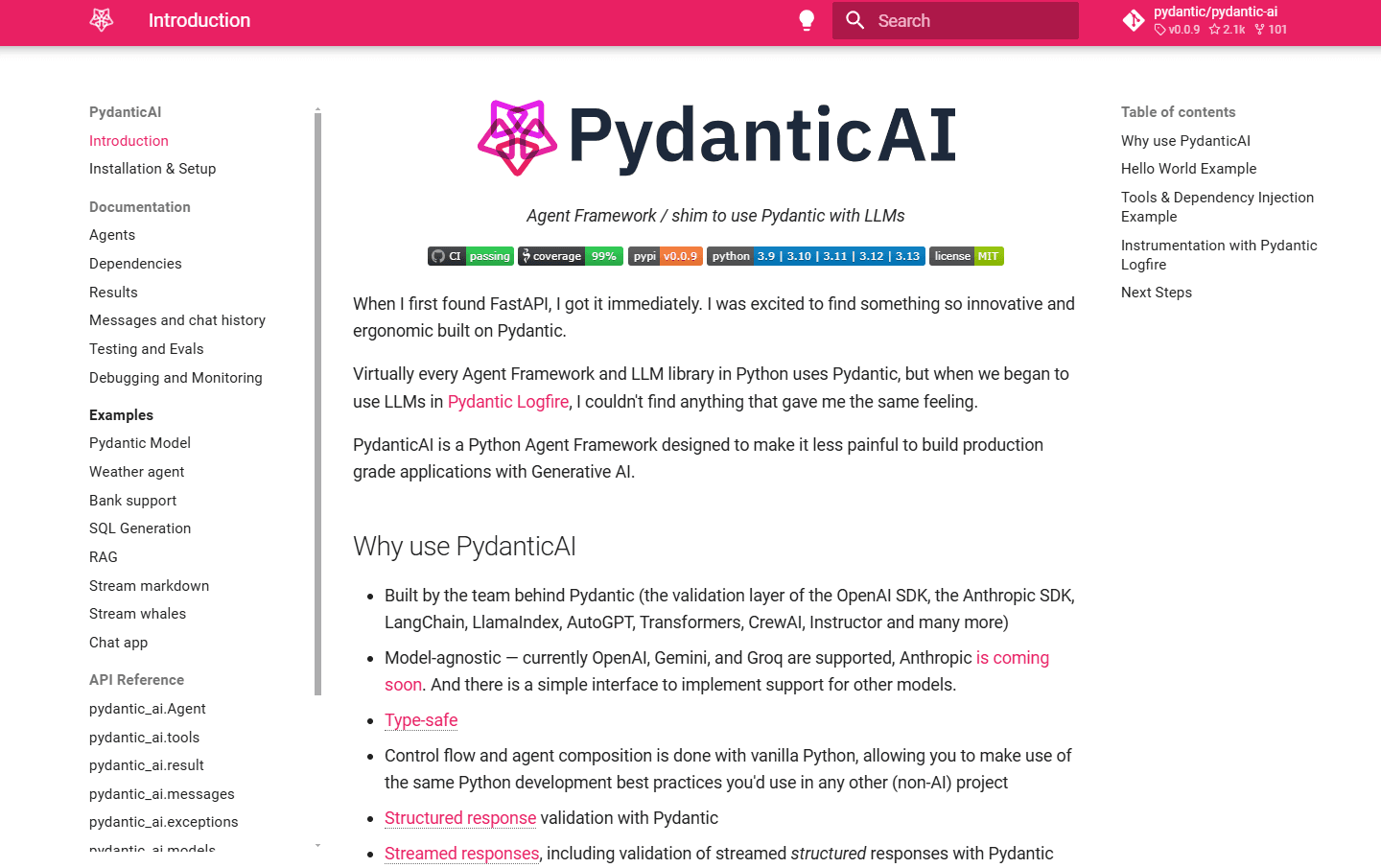
About PydanticAI
What Is PydanticAI
PydanticAI is an open-source Python framework from the team behind Pydantic, the data validation library that already leans quietly under FastAPI, LangChain, and a mountain of other tools. It brings the same validation-first mindset to AI agent development: you declare what an agent should take in and give back as typed models, and the framework enforces that contract at runtime. If a model returns malformed data, you get a clear validation error instead of a silent bug three calls later. The pitch is simple. Most agent frameworks lock you into one provider or force you to parse loose strings and hope for the best. PydanticAI works as a model-agnostic AI SDK, so moving from OpenAI to Anthropic or a local model is mostly a config change. It also ships dependency injection, retries, streaming, and observability hooks out of the box. That matters once a prototype turns into something real users touch every day.
The biggest limitation is who it's for. This is a developer tool, and it assumes you're comfortable with Python, type hints, and async code. There's no drag-and-drop builder or no-code interface. If you can't read a Pydantic model definition, the docs will feel like a wall.
Getting Started
- Install the package with
pip install pydantic-ai(Python 3.9 or newer is required). - Set your provider API key as an environment variable, for example
OPENAI_API_KEYorANTHROPIC_API_KEY. - Define an agent with a model, a system prompt, and an output type so responses come back validated.
- Call
agent.run()with your input and read the typed result, or stream tokens as they arrive. - Register tools with the function-calling decorator so the agent can call your own Python functions.
Product Information
A quick look at PydanticAI's pricing, supported platforms, and performance.
Best for
The users, tasks, and scenarios where this tool fits best.
Users
- Python developers
- Backend engineers
- Data and ML teams
Tasks
- Structured extraction
- Tool calling
- Multi-provider apps
- Agent testing
Scenarios
- Prototyping an internal chatbot
- Adding AI to an existing service
- Migrating away from one provider
- Durable background jobs
Key features
Model-Agnostic by Design
PydanticAI treats the model as a configurable string, not a hard dependency. It's model-agnostic AI SDK design, plain and simple. The same agent can run on OpenAI, Anthropic, Google Gemini, Mistral, Groq, or a locally hosted model, and swapping providers rarely touches your agent logic. For teams worried about vendor lock-in or wild cost spikes when a provider changes its pricing, that flexibility alone can justify the switch.
Type-Safe Structured Outputs
You define the shape of an agent's response as a Pydantic model, and the framework validates every reply against it before your application ever touches the data it contains. This is structured output validation at the framework level. Malformed output triggers a retry or a clear error rather than a downstream crash. It's the feature most developers cite when they explain why they picked PydanticAI over looser alternatives.
Dependency Injection and Tools
Agents can call your Python functions through a decorator, with typed parameters and validated return values. Dependencies like database connections or API clients get injected cleanly. No global state. No hidden plumbing. That keeps tool code testable and easy to reason about.
Streaming and Real-Time Responses
Agents stream tokens, structured output, and tool events as they happen. You can build a chat interface that shows partial results, or a voice pipeline that responds before the full answer is ready. Either way, you don't write your own event plumbing. It's already there.
Built-In Observability
Every run can be traced and logged, and it integrates with Pydantic Logfire for detailed spans and metrics. Something goes wrong in production? You can see exactly which model call, tool invocation, or validation step failed instead of guessing at the cause from vague logs.
Testing With Pydantic Evals
Pydantic Evals, a companion package, lets you define datasets and run them against your agents the way pytest runs against functions. You track scores over time. You catch prompt regressions the moment a model or instruction changes. That's the difference between shipping with confidence and shipping with crossed fingers.
Pros and cons
Pros
- Free and open source under the MIT license, with no paid tiers, seat limits, or usage caps of any kind.
- Type-safe outputs cut down on silent failures.
- Works with most major LLM providers and local models, so switching is low-risk.
- Dependency injection and tool support fit naturally into existing Python code.
- Strong typing means better editor autocomplete and fewer runtime surprises.
Cons
- Requires solid Python and async knowledge, so it isn't usable by non-coders.
- No visual builder or no-code path.
- Being newer, it has a smaller community and fewer tutorials than older frameworks, so you'll sometimes be the first to hit a rough edge that nobody has documented yet.
- Advanced features like durable execution and evals add concepts you'll need to learn.
Frequently asked questions
Yes. PydanticAI is open source under the MIT license, so the framework itself costs nothing. You still pay for whatever LLM provider you connect to. Those API calls are billed by the provider, not by Pydantic.
Related content
Explore related tools, skills, and articles for PydanticAI.
PydanticAI Alternatives

Base Code
Base44 (Wix) · Coding · ProductivityBase Code is a shared cloud development environment from Base44. Teammates describe changes to an existing GitHub codebase in chat, preview them live and send them back as pull requests.

Google EmbeddingGemma 2
Google DeepMind · Writing · Image · CodingGoogle EmbeddingGemma 2 is a 740M-parameter open model that turns text, code, images, audio, and video frames into vectors in one 768-dimension space, running on phones and laptops.

GitGlow
GitGlow · Coding · ProductivityGitGlow is a local-first desktop Git client that lets independent developers review their own code and their AI agents' changes in one place before shipping.