

QAgent
QAgent Inc. · Coding · Business
QAgent is an automated quality assurance platform for AI agents. You point it at your agent's endpoint, define the ground truth it should follow, and it runs test suites that score answer quality, hallucination rate, policy adherence and multi-turn memory on every release. It works as an LLM evaluation tool that anyone can run in minutes. It's built for solo developers and small teams who ship agents without a dedicated QA department.
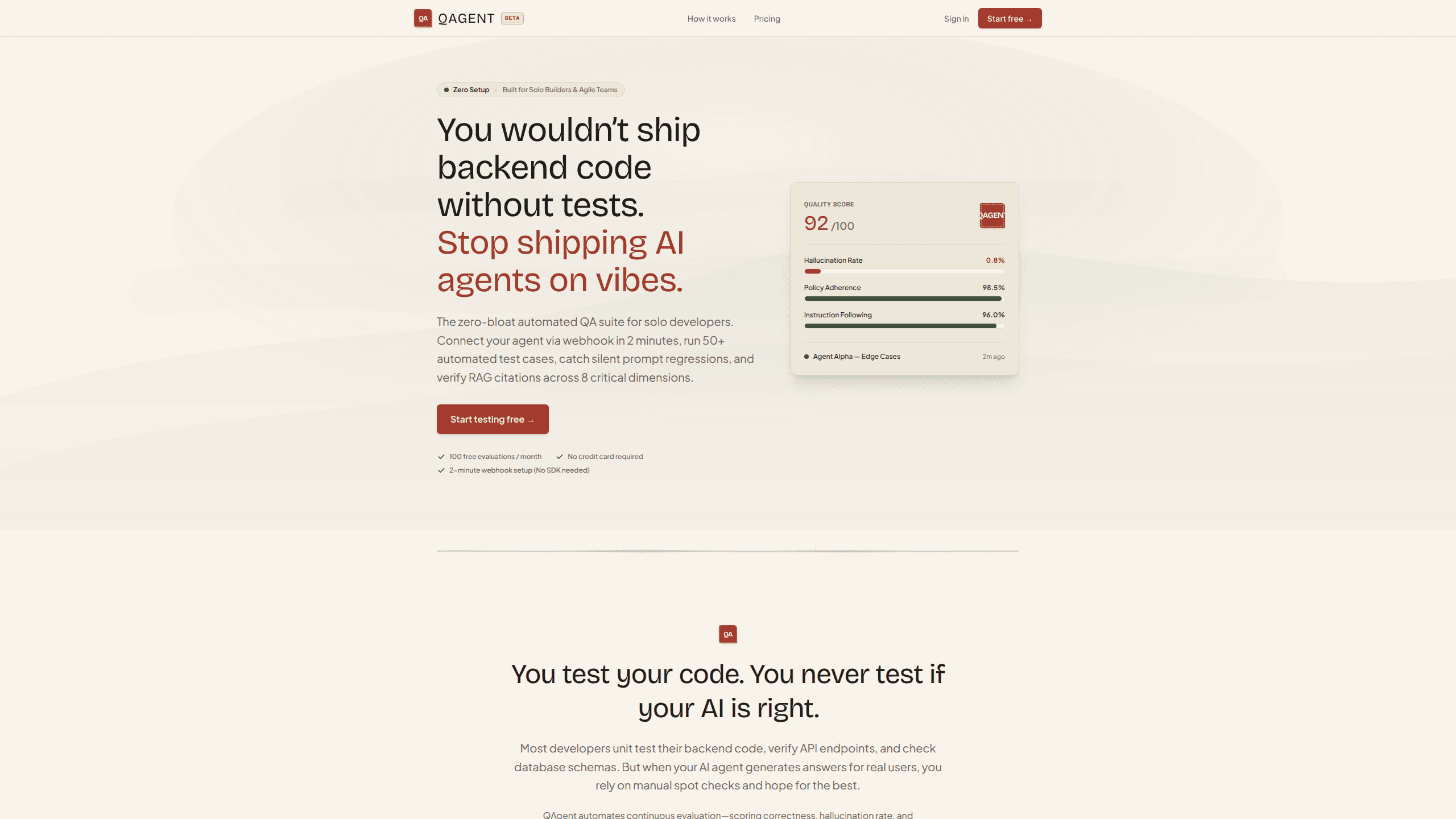
About QAgent
What Is QAgent
QAgent is a web-based testing platform that answers a question most AI builders skip: does your agent actually give correct answers? Instead of reading a few replies in a playground and hoping for the best, you connect your agent and let QAgent run the same battery of checks after every prompt change.
The product targets a specific gap. Developers unit test backend code and verify API endpoints, but the moment an LLM generates an answer for a real user, quality checks turn into manual spot checks. That's a problem. QAgent treats agent output as something testable, scoring it against rules you wrote rather than whatever sounds convincing in the moment.
The main limitation is scope. QAgent evaluates accuracy, safety and consistency. It doesn't fix your prompts for you, and its scoring is only as good as the ground truth you feed it. So write real rules. If your refund policy or pricing tiers aren't defined, the judge has nothing to check against.
Getting Started
- Create a free account and connect your agent through a webhook endpoint, a LangChain workflow, or a plain HTTP POST target.
- Define your ground truth: pricing tiers, refund windows, forbidden topics and any knowledge documents the agent should respect.
- Write test rubrics that pair a prompt with the expected behavior, using clear must and must-not rules.
- Run the suite and review pass or fail ratings, along with step-by-step root causes for each failure.
- Wire the same suite into your release flow so prompt edits get re-scored before deploy.
Product Information
A quick look at QAgent's pricing, supported platforms, and performance.
Best for
The users, tasks, and scenarios where this tool fits best.
Users
- Solo developers
- Small teams without a QA hire
- Freelancers and agencies
Tasks
- Catch hallucinations
- Track prompt regressions
- Verify RAG citations
- Test multi-turn memory
Scenarios
- A late-night prompt tweak to fix one customer's edge case, followed by a full regression run in about a minute.
- Handing an AI chatbot to a client and attaching a scorecard that shows factual groundedness and policy adherence.
- Gating a deployment release on automated evaluation results instead of gut feeling.
- Testing adversarial inputs to confirm the agent escalates to a human instead of promising discounts it can't give.
Key features
Eight Evaluation Dimensions
QAgent scores agents across eight separate metrics rather than a single vague score. These cover answer quality, factual groundedness, policy adherence, escalation correctness, RAG faithfulness, contextual relevancy, context recall and multi-turn memory, and each dimension maps to a real production failure mode. That detail matters. A low number points at a specific problem rather than a general mood.
Deterministic LLM-as-a-Judge Scoring
Rather than matching strings or regex patterns, QAgent cross-examines each response with a calibrated judging model. It runs on Groq LPUs for speed, which matters when you want a full regression suite finished in under a minute. Pass and fail calls come with a confidence level, so you know when a result sits near the line and deserves a closer manual look before you trust it.
Ground Truth and Rubric System
Every test combines three ingredients: your official rules, the test prompt with RFC 2119 style expected behavior, and the agent's live response. The judge checks strictly against the rubric. A polite but wrong answer still fails. That's what separates QAgent from a vibe check in a chat window.
Smart Exemptions for False Positives
The judge knows the difference between a hallucination and normal behavior. Ticket IDs that change per session, live balances and polite greetings aren't flagged as unsupported claims. Nice. If the top retrieved chunk holds the full answer, lower-ranked results don't drag the score down. Jailbreak tests don't penalize the retriever for missing attack docs.
Prompt Regression Tracking
QAgent records score deltas on every prompt iteration. You see instantly whether a change that fixed one case caused a drop elsewhere. That's the whole point. For teams that edit system prompts often, this turns silent degradation into a visible line on a chart.
Quality Audit Reports
The Solo plan exports CSV and print-ready Quality Audit reports. These show groundedness percentages, RAG faithfulness and policy adherence, which is useful when a client wants evidence rather than a promise. Send the file. Reports turn a testing run into something you can attach to a project handover.
Pros and cons
Pros
- Webhook setup takes about two minutes with no SDK to install or boilerplate to write.
- Eight named dimensions give specific feedback instead of one blended score.
- Free tier of 100 evaluations per month makes it easy to try before paying.
- Transparent audit trail shows the query, rubric, response and evaluator findings for each test.
- Flat monthly pricing with no annual lock-in or sales calls.
Cons
- One connected agent endpoint on the free plan, so testing several agents requires the paid tier.
- Scoring depends entirely on the ground truth you provide; vague rules produce vague results.
- The platform is still in beta, so features and limits may shift.
Frequently asked questions
It tests whether your AI agent gives correct, policy-compliant answers. That covers hallucination detection, instruction following, RAG faithfulness, escalation behavior and multi-turn memory, scored across eight dimensions.
Related content
Explore related tools, skills, and articles for QAgent.
QAgent Alternatives
Forefront
Forefront · CodingForefront is a web platform for building with open-source AI. It lets you fine-tune leading open-source language models on your own data, evaluate how they perform, and run them through an API or export them to host yourself. Developers who want the convenience of a closed-source platform but insist on owning their models and data are the target audience here.

Startkit
StartKit.AI · CodingStartkit is a boilerplate for building AI SaaS and AI wrapper products. Think of it as an AI startup boilerplate with the boring parts already wired up: authentication, Stripe and Lemon Squeezy payments, usage limits, transactional email, and an AI API starter that talks to OpenAI, Anthropic, Groq, or Llama. You clone the repo, set your price, and start on the part of your product that people actually pay for. It's Next.js under React and Tailwind, so most of the boilerplate code already feels familiar.
Testim
Tricentis · CodingTestim is an AI-powered test automation platform for building and running end-to-end tests across web, mobile, and Salesforce applications. It leans on machine learning to keep tests stable when an interface changes, so teams spend less time fixing broken selectors. Not bad for an automated testing tool you can start using today. You create tests by recording actions in a browser, then optionally add JavaScript when you need more control. It's a solid pick for busy QA teams.