

Qodex
Qodex.ai · Coding
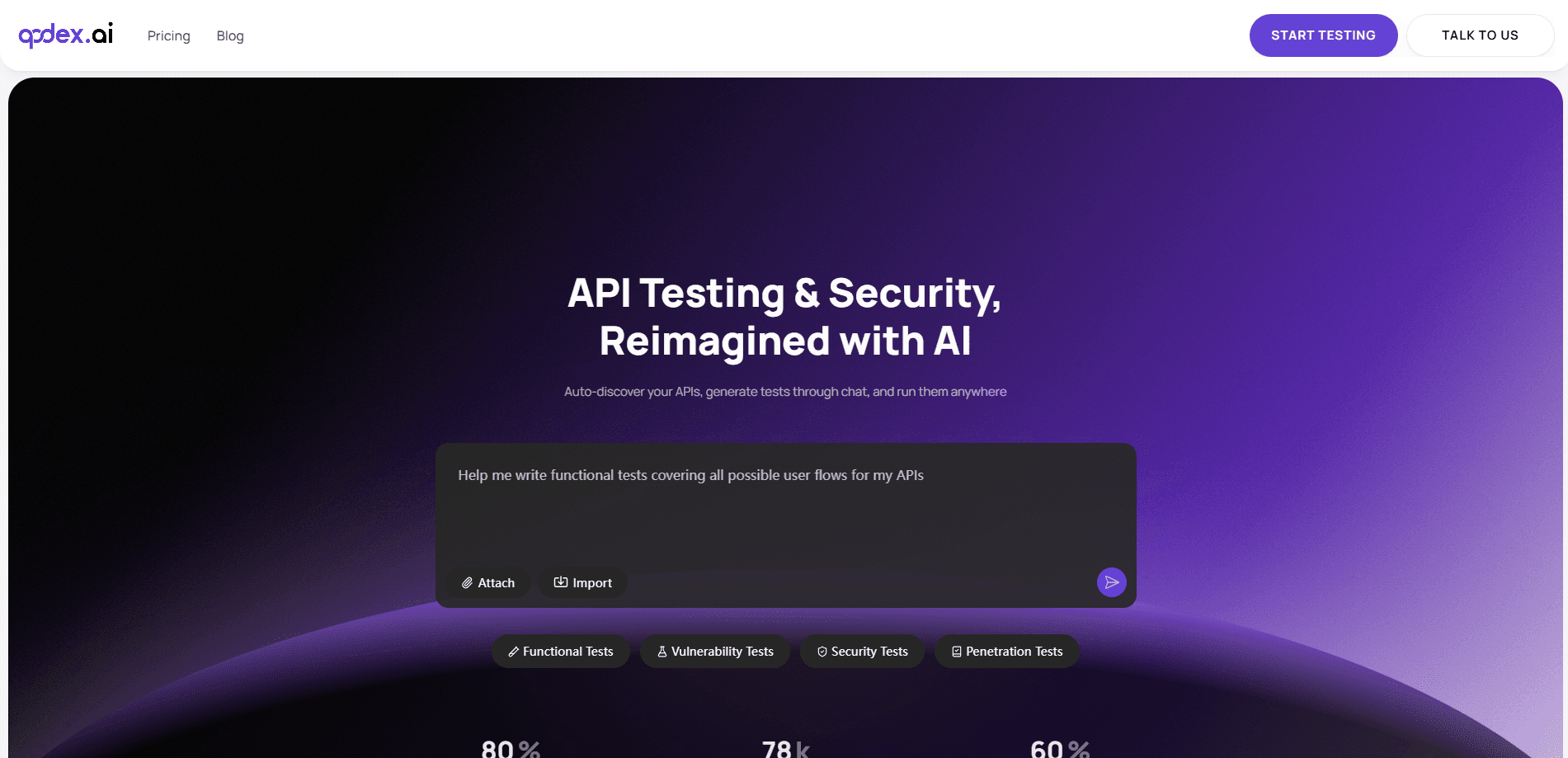
Qodex is an AI testing agent that runs real API, UI, and security tests on every pull request, then reports actual bugs with the failing request and response attached.
About Qodex
What Is Qodex
Qodex is a continuous testing and code review agent for OWASP API testing built by Qodex.ai, a company based in San Francisco. It installs as a GitHub app, watches the pull requests you choose, and runs API, UI, and security scenarios against your running app before anything merges. Instead of reading a diff and guessing, it opens the real application, executes the scenario, and hands back what actually broke.
The problem it targets is the gap between how fast AI writes code and how slowly humans verify it. AI multiplied the number of pull requests, but review, QA, and the test suite didn't multiply with them. Qodex runs the checks automatically on each change, so a team can keep merging without dropping the review that used to catch the bug.
The main limit is scope. Qodex is not a general coding assistant and it doesn't write your application code. It tests it. You also need the app reachable at a URL, whether that's a per-pull-request preview or a shared staging environment, and API scenarios need the API online.
Getting Started
- Install the Qodex GitHub app on the repositories you want covered.
- Point Qodex at a preview or staging URL where your app runs.
- Import scenarios from OpenAPI, Postman, a spreadsheet, or your existing tests, or let the agent generate them.
- Open a pull request and wait for the checks to run against the live app.
- Read the verdict: a real bug arrives with evidence, a stale test arrives as a suggested fix, and an environment problem is flagged separately.
Product Information
A quick look at Qodex's pricing, supported platforms, and performance.
Best for
The users, tasks, and scenarios where this tool fits best.
Users
- Backend and API developers
- QA and test engineers
- Engineering leads and platform teams
- Security-focused teams
Tasks
- Gating pull requests
- Testing API flows end to end
- Turning production bugs into regressions
- Auditing security on every deploy
Scenarios
- Teams shipping on AI speed
- Repos behind SSO or browser auth
- Multi-repo projects on Startup
- Regulated environments on Scale
Key features
Execution-backed review, not diff-only guessing
A code reviewer that only reads the diff gives you an opinion. Qodex runs the scenario against the live app and reports what happened. Each finding carries the failing request, the response, or a screenshot, so you're looking at a fact rather than a hunch. That evidence is what lets a team treat the verdict as a real gate.
One agent for API, UI, and security
The same run covers three layers: HTTP and GraphQL scenarios, browser runs through Playwright, and OWASP-aligned security probes. Security semantics are inverted on purpose, so a pass means the attack was blocked and the agent can't make a failing test go green by loosening an assertion. One agent, one set of scenarios, three kinds of coverage.
Scenarios you own and can export
Everything Qodex writes is standard Playwright and HTTP code you can read, export, and run without the product. If you leave, you keep the suite, and there's no proprietary runtime holding it hostage. You can also import from OpenAPI, Postman, spreadsheets, and existing tests, so adoption doesn't mean starting from zero.
Intelligent generation with free replays
The model writes a scenario once. After that, replays are generated code with no model call, so the suite grows without the bill growing with it. Qodex also offers a bring-your-own-model-key option, and every model call is logged, which keeps cost and privacy predictable.
Failure triage that separates noise from bugs
Every failure is classified before it reaches you. A real bug arrives with evidence; a stale test arrives as a proposed diff you approve; an environment problem is flagged and not counted against the suite. Findings without evidence don't block a merge. That distinction is what keeps the gate trusted instead of muted.
Fits your stack without a rewrite
Qodex installs as a GitHub app in minutes and runs against a URL. Nothing goes into your application, no runner goes into your CI, and no existing test has to be rewritten. It connects to GitLab, a CLI, Slack, Microsoft Teams, Jira, Sentry, Datadog, and webhooks, so alerts land where your team already works.
Pros and cons
Pros
- Findings come with the failing request, response, or screenshot, so a real bug is easy to verify and hard to dismiss.
- Scenarios are standard Playwright and HTTP code you can export and run elsewhere, which avoids lock-in.
- Free replay after the model writes a scenario means the suite can grow without a matching rise in cost.
- Failure triage separates real bugs, stale tests, and environment issues, which keeps the checks trustworthy.
- Setup is light: a GitHub app and a staging URL, with no SDK in your app and no runner in your pipeline.
Cons
- You need the app reachable at a URL, so teams without a preview or staging environment can't use it as intended.
- UI scenarios need the app reachable in a browser, which adds setup if you only test APIs today.
- The free tier is capped at 25 scenarios and 100 runs a month on a single repository, enough to evaluate but not to run a team.
- Startup starts at $1,299 per project per month, which is priced for teams rather than solo developers.
Frequently asked questions
Qodex runs automated API, UI, and security tests on your pull requests and reports what actually broke. It works as a continuous testing and PR review agent: it executes your scenarios against the live app, then posts findings with evidence and a merge recommendation. It tests your code rather than writing it.
Related content
Explore related tools, skills, and articles for Qodex.
Qodex Alternatives

Base Code
Base44 (Wix) · Coding · ProductivityBase Code is a shared cloud development environment from Base44. Teammates describe changes to an existing GitHub codebase in chat, preview them live and send them back as pull requests.

Google EmbeddingGemma 2
Google DeepMind · Writing · Image · CodingGoogle EmbeddingGemma 2 is a 740M-parameter open model that turns text, code, images, audio, and video frames into vectors in one 768-dimension space, running on phones and laptops.

GitGlow
GitGlow · Coding · ProductivityGitGlow is a local-first desktop Git client that lets independent developers review their own code and their AI agents' changes in one place before shipping.