

Quantum Algorithm as a Service (Q3AS)
Aqora Quantum S.A.S. · Other
Quantum Algorithm as a Service (Q3AS) is a cloud platform to build, run and deploy quantum algorithms without managing hardware. It suits developers, researchers and students.
About Quantum Algorithm as a Service (Q3AS)
What Is Quantum Algorithm as a Service (Q3AS)
Quantum Algorithm as a Service (Q3AS) is a cloud platform from Aqora that lets you build, run and ship quantum algorithms from a browser. Instead of installing simulators, wiring up SDKs or paying for access to a physical quantum computer, you sign in and work entirely online. The platform handles execution behind the scenes.
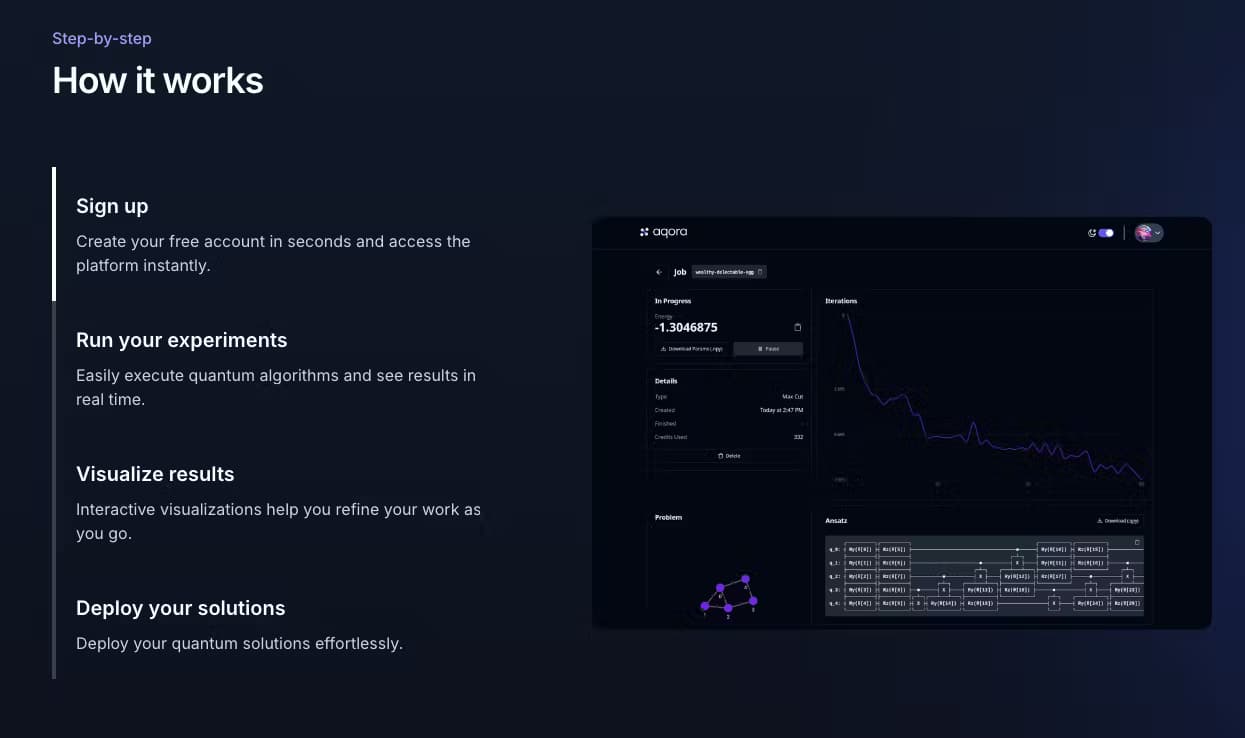
The core pitch is simplicity. You write a quantum algorithm, run it against real or simulated backends, and watch the results update in real time. Deploy the finished solution, and you're done. That flow removes most of the setup work that normally keeps beginners away from quantum computing.
The main limit is scope. Q3AS is built for algorithmic experimentation, not for training large fault-tolerant workloads. Because it leans on managed infrastructure, you get less control over low-level hardware than a self-hosted stack would give you. So who does it fit? Anyone who wants to learn, prototype or run smaller quantum workloads, where that tradeoff rarely matters.
Getting Started
- Sign up for a free account on the Q3AS site to open the platform.
- Create a new project or pick an existing experiment to start from.
- Write or upload your quantum algorithm, then run it against the available backend.
- Watch the interactive visualizations to check your results and refine the run.
- Deploy the finished solution straight from the dashboard.
Product Information
A quick look at Quantum Algorithm as a Service (Q3AS)'s pricing, supported platforms, and performance.
Best for
The users, tasks, and scenarios where this tool fits best.
Users
- Developers new to quantum
- Researchers prototyping ideas
- Students learning quantum computing
- Teams evaluating quantum tooling
Tasks
- Running quantum algorithms online
- Visualizing experiments
- Deploying quantum solutions
- Comparing algorithm runs
Scenarios
- A class assignment where students submit a working quantum algorithm on a deadline.
- An early research sprint where speed of iteration matters more than hardware tuning.
- A hackathon build where a team needs a deployable quantum demo fast.
- A side project exploring whether a quantum approach beats a classical one for a specific problem.
Key features
Execute Without the Technical Complexity
Q3AS runs your quantum algorithms on managed infrastructure. You skip simulator installs, dependency headaches and hardware access requests. You focus on the algorithm itself, which is the part that actually teaches you something about quantum computing, instead of losing a weekend to environment setup that has nothing to do with your idea. For anyone who has stalled out on that setup, it's a real relief.
Real-Time Visualizations
Results update as your experiment runs, with interactive visuals instead of a wall of raw numbers. You watch a run unfold and adjust mid-session. No waiting for a batch job. It's the difference between debugging blind and actually seeing where the circuit misbehaves, and once you've worked with live visual feedback, going back to scanning raw output for a stray state feels like a serious downgrade.
One-Click Deployment
When an algorithm works, deploy quantum solutions straight from the same interface. No separate pipeline to configure. This matters if you need a shareable, running version for a demo, a teammate or a stakeholder review.
Free Trial With Full Feature Access
The platform opens with a free account that covers its features, with no commitment to continue. That's enough to run real experiments and decide whether the workflow fits you before any spend. Close the tab and nothing is owed.
Guided Sign Up To Deploy Flow
The platform lays out a clear path: sign up, run experiments, visualize results, deploy. Each step builds on the last, which keeps new users from getting lost in a tool that could easily have been built for specialists only. If you've never touched a quantum circuit before, that guided path is the whole point.
Pros and cons
Pros
- No local setup, since everything runs in the browser through managed cloud infrastructure.
- Free access lets you test full features before committing.
- Real-time visualizations speed up debugging quantum experiments.
- Deployment happens from the same interface you write and run in.
Cons
- You get far less low-level hardware control than a self-hosted quantum stack would give you, so fine-tuning physical qubit behavior, calibrating a specific device or chasing gate-level optimizations is basically out of reach.
- It's aimed at algorithmic experimentation, which makes it a poor fit for heavy fault-tolerant workloads.
- Pricing beyond the free tier isn't published clearly, so teams need to contact the vendor to plan costs.
- Exact algorithm support depends on the available backends, and that detail isn't fully documented publicly.
Frequently asked questions
It's a cloud platform from Aqora for developing, executing, visualizing and deploying quantum algorithms without managing hardware yourself. You work in a browser and the platform handles execution.
Related content
Explore related tools, skills, and articles for Quantum Algorithm as a Service (Q3AS).
Quantum Algorithm as a Service (Q3AS) Alternatives

Odyssey 3
Odyssey · OtherOdyssey-3 is Odyssey's foundation world model. It simulates physics in real time, turns a prompt into an interactive environment, and adapts to robots, cars and games.

JarvisCore
Prescott Data · Coding · Productivity · OtherJarvisCore is an open source Python runtime where AI agents work as equal peers on an agent mesh, claim tasks from a shared ledger, and reach external services through a zero-trust broker.
Clef
Cloudflare · Business · OtherClef is Cloudflare's open-source decision model for Workers AI. It returns calibrated probabilities for typed questions, not generated text, so agents can classify, route, and act fast.