

Quetext
Quetext · AI Detection · Business
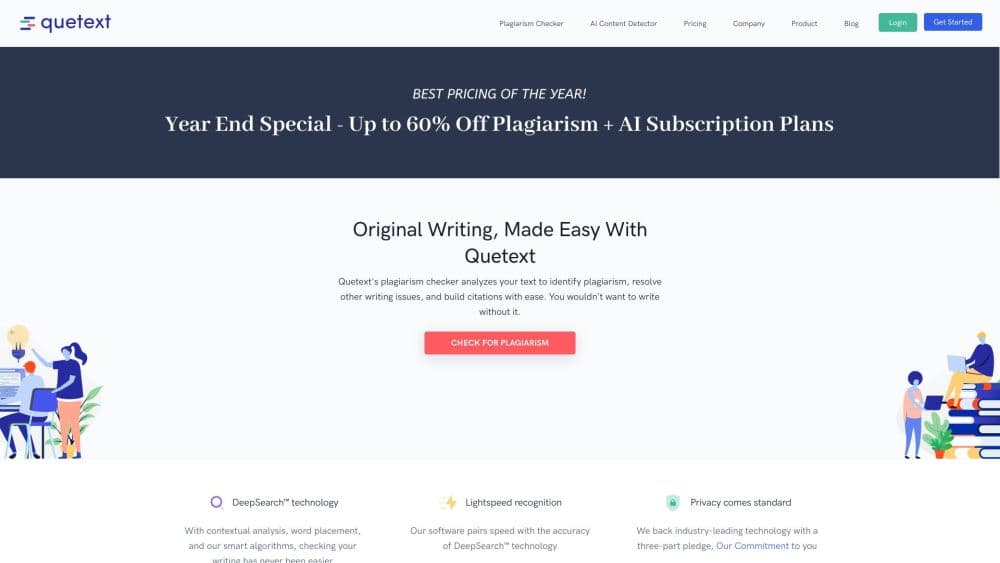
Quetext is a plagiarism checker and AI detector for students, teachers, and writers. It scans text against billions of sources and flags AI text in one pass.
About Quetext
What Is Quetext
Quetext is an online writing-integrity platform built around two core jobs: catching copied text and AI content detection. Run a plagiarism check online and it spots text that reads as machine-written. You paste in a paragraph or upload a document, and it returns a similarity score plus a list of matched sources. The same scan flags sentences that likely came from a chatbot. Beyond detection, the platform bundles a grammar checker, a summarizer, a paraphrasing tool, and a citation generator, so most of a draft's cleanup happens in one account.
The company leans on a homegrown engine it calls DeepSearch. Instead of matching exact strings, it reads context and phrasing, which helps it catch paraphrased copy that basic checkers miss. That matters most for academic work, where quoting a source and rewording it are two different problems.
Two limits shape when it fits. The free tier caps checks at 1,000 words, so long essays and full reports need a paid plan. And the AI detector gives a probability, not proof. Its AI score tells you how likely the text looks generated, which is a signal to review, not a verdict you can lean on alone.
Getting Started
- Create a free account at quetext.com with an email address.
- Paste your text into the checker or upload a file from your device, Google Drive, or OneDrive.
- Run the scan and read the ColorGrade feedback, which shades flagged passages and links each one to its source.
- Fix what's flagged by rephrasing it or adding a citation, then re-run the check to confirm the score dropped.
- Export the report as a PDF if you need to share the result with a teacher, editor, or client.
Product Information
A quick look at Quetext's pricing, supported platforms, and performance.
Best for
The users, tasks, and scenarios where this tool fits best.
Users
- Students
- Teachers and professors
- Content writers and marketers
Tasks
- Checking a paper for plagiarism
- Screening text for AI
- Polishing grammar and clarity
- Building a reference list
- Scanning a batch of documents
Scenarios
- Finishing a term paper the night before the deadline
- Reviewing submissions across a whole class
- Keeping a content pipeline clean
Key features
DeepSearch Plagiarism Checker
DeepSearch is Quetext's contextual engine. It doesn't just look for exact matching strings. It reads word placement and meaning, so it flags near-matches and lightly reworded passages that simpler tools skip. Every scan runs against billions of web pages and academic sources, and each flagged passage links back to the source it resembles. You can also exclude sources you trust, such as your own site, from individual reports or all of them.
AI Content Detector
The AI detector returns a score for how likely a piece of text was machine-written, plus a line-by-line breakdown that marks which sentences look generated. It covers text from common tools including ChatGPT, GPT-3, GPT-4, Bard, and LLaMA. Reports can be exported as PDFs and shared, which helps when you need to document a finding for a teacher or editor. Treat the score as a likelihood rather than a fixed answer.
Grammar Checker and Paraphrasing Tool
The grammar checker catches typos, punctuation slips, and clumsy sentence structure. AITutorMe, the paraphrasing tool, offers three rewritten versions of any sentence you select, so you can rephrase flagged text while keeping its meaning. Both sit alongside the scanner, which means you can fix a passage and re-check it without switching tools.
AI Humanizer and Summarizer
The AI Humanizer rewrites text that reads as robotic or repetitive so it flows more naturally, keeping the original intent. The summarizer condenses a document or article into key points, and it handles uploads in PDF, DOC, and TXT formats. People use the summarizer for study notes and quick digest of long research.
Citation Generator
The citation generator builds references in MLA, APA, and Chicago style. It covers more than webpages, reaching books and journals, which is where a lot of academic writing actually draws from. It saves the manual step of formatting each source by hand and reduces the citation errors that trip up otherwise original work.
Browser Extensions and Developer API
You can run checks from a Chrome, Firefox, or Edge extension across any webpage, Google Docs, WordPress, and plain HTML, so you don't have to copy text into the site. For teams, a RESTful API lets you embed plagiarism checks and AI content detection inside Canvas, Moodle, or your own product. The API bills from a prepaid wallet at $0.10 per 1,000 words, and new accounts start with 5,000 free words.
Pros and cons
Pros
- One account covers plagiarism checks, AI detection, grammar, paraphrasing, summarization, and citations, so you replace several subscriptions.
- DeepSearch catches paraphrased passages that exact-match checkers miss, which matters for edited academic work.
- Bulk upload and admin controls make it usable for teachers handling many submissions at once, not just individuals.
- The Chrome extension plus the API mean it fits both casual checking and automated workflows inside an LMS.
- The free tier and a 5,000-word API trial let you test real output before paying.
Cons
- The free tier stops at 1,000 words, so a long essay or a full report forces a paid plan quickly.
- The AI score is a probability, not proof. On border-line text it can disagree with other detectors, so it can't settle a dispute on its own.
- Word-based limits on paid plans mean heavy users may run out mid-month and need a higher tier.
- Some advanced features, including the grammar checker, are still labeled beta, so the polish isn't guaranteed across every language.
Frequently asked questions
Quetext checks writing for plagiarism and detects AI-generated text. You paste in or upload a document and get a similarity score with matched sources, alongside a score estimating how much of it looks machine-written. It also offers grammar, paraphrasing, summarization, and citation tools.
Related content
Explore related tools, skills, and articles for Quetext.
Quetext Alternatives
Isgen AI
Isgen · AI DetectionIsgen AI is a web-based AI detector that scores text for machine authorship and shows you which sentences and phrases push the number up. It's built for teachers, editors, students, and writers. Their question is simple: did this draft come from ChatGPT, GPT-5, Claude, Gemini, DeepSeek, or another model? You paste or upload content, run a scan, and get a Human, AI, and Mixed breakdown in seconds. There's also a companion editor that scores text while you write it.
Humanizeai Tools
Humanizeai Tools · Writing · AI DetectionHumanizeai Tools is a web-based AI humanizer that rewrites machine-generated text so it sounds like a person wrote it, which is the whole point of the category it belongs to. Paste a draft from ChatGPT, Claude, or Gemini, run it through the tool, and it swaps out the phrases and sentence patterns that AI detectors flag. If your goal is to make AI text sound human before you publish it, this is the kind of tool built for exactly that. It suits students, bloggers, and marketers who need copy that reads naturally and clears tools like GPTZero, Copyleaks, and Winston AI after a single pass.

Hidemyai
Hidemyai · Writing · AI DetectionHidemyai is an AI content humanizer. It rewrites text from ChatGPT, Jasper, and similar tools so the result reads like a person wrote it. You paste your draft, pick a document type and tone, and the service returns a version meant to bypass AI detectors such as Originality.ai, Turnitin, and ZeroGPT. It targets writers, marketers, and students who lean on AI drafts but can't ship copy that sounds robotic. The promise is simple: make AI content undetectable.