

Quick Intel
Quick Intel · Other
Quick Intel is a crypto token security scanner and honeypot checker that reads token contracts for scams and risky code across 60+ chains. Check a token before you trade or build.
About Quick Intel
What Is Quick Intel
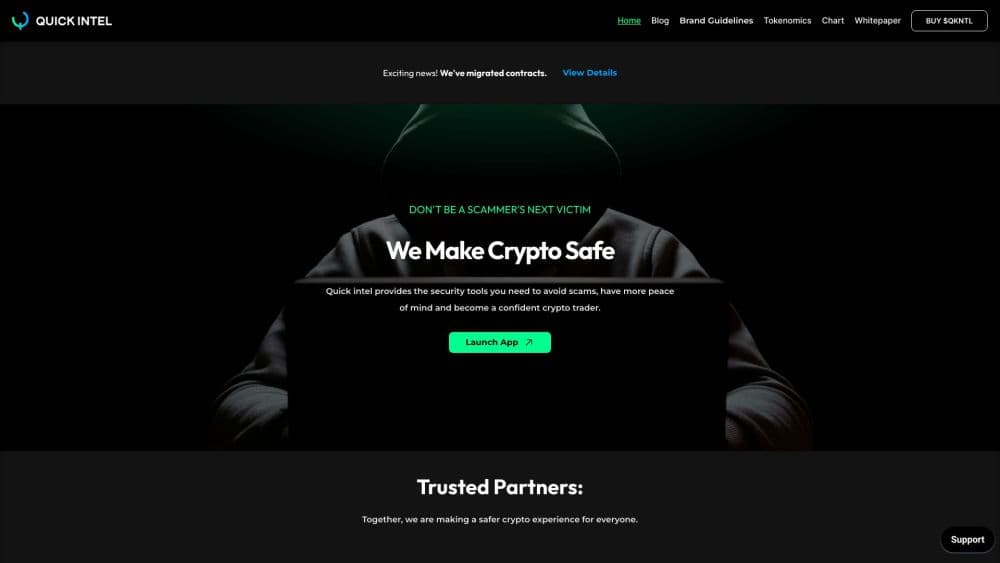
Quick Intel is a security toolkit for anyone who touches tokens. You paste a contract address and it returns a read on the code behind it: whether the owner can still mint new tokens, whether the contract can block your sells, and whether the project matches a known scam pattern. The same engine powers a web scanner, mobile apps, Discord and Telegram bots, and a paid API, so traders and developers run the same checks from wherever they work.
The reason it exists is grim. Scam tokens are cheap to spin up and hard to spot by eye, and the damage adds up fast once someone moves funds. This scam token detector automates the first pass. It flags the contract functions that most often hide a rug pull: mint, blacklist, fee changes, wallet limits, and pause switches. Its ShadowShield AI scores the overall likelihood of a scam and explains what it flagged in plain language.
There are limits worth knowing. A scan tells you about the contract, not the people behind it or the price. A clean result doesn't mean a token will hold value. The API returns the same data tier as the Basic Plus plan, and some deeper features sit behind the higher tiers. Treat it as one input in a decision, not a verdict.
Getting Started
- Open the Quick Intel scanner at app.quickintel.io/scanner and pick the chain the token runs on.
- Paste the token's contract address and start the scan. No account is needed for the basic result.
- Read the flags. The report lists contract functions like mint, blacklist, and fee control, plus ownership status and links baked into the contract.
- Upgrade for detail. Basic Plus adds expanded scan results like suspicious external actions, and All Access unlocks ShadowShield AI and AI code explanations.
- Go API-first if you're building. Sign up on the developer portal, pick a plan, and call the risk endpoint from your wallet, bot, or dashboard.
Product Information
A quick look at Quick Intel's pricing, supported platforms, and performance.
Best for
The users, tasks, and scenarios where this tool fits best.
Users
- Crypto traders
- Web3 developers and API teams
- Telegram and Discord communities
Tasks
- Vetting a token before a trade
- Screening tokens at scale
- Auditing a contract you're integrating
- Checking a swap in your wallet
Scenarios
- Buying a low-cap token from a new launchpad
- Building a scam-filtered token list
- Running a trading community
Key features
Contract Scanner
This smart contract audit tool reads a token or NFT contract and reports the functions that carry risk: mint authority, blacklist ability, adjustable fees, max wallet limits, and pause switches. Ownership status sits alongside, so you can see whether control has been renounced. It works on a pasted address with no sign-in for the basic result.
ShadowShield AI
ShadowShield is Quick Intel's own model for estimating how likely a token is to contain harmful code. It returns a clear percentage and names the pattern it suspects, such as hidden mints, malicious code, or delayed honeypots. The score is meant to speed up your own read, not replace it.
Token Risk API
This token risk API serves real-time signals with the report latency the team advertises at under 180 milliseconds at the 95th percentile. Each response carries a risk score, honeypot status, liquidity, holder data, deployer history, taxes, and socials in one normalized shape across every supported chain. Plans scale by calls per second and monthly volume, starting at $79/mo.
Multi-Chain Coverage
This multi-chain security engine supports more than 60 chains and reports over 75 million unique tokens scanned. The same response format works across chains, so a product doesn't need per-chain parsing logic. That matters for teams that list or trade tokens on many networks.
Bots and Wallet Integrations
The same scan runs through a Telegram bot, a Discord bot, a MetaMask Snap, and mobile apps for iOS and Android. The QKNTL token ties into this side of the product, since holders unlock extra bot features in the community groups. Members of a community can check a token without leaving the chat, and traders can audit a swap inside MetaMask. Each surface pulls from the same engine, so results line up.
AI Code Explanations
On the higher tiers, Quick Intel explains what a flagged contract function actually does, translating raw code into a sentence you can act on. All Access also includes the Token Launch Dashboard and early access to new features.
Pros and cons
Pros
- One engine across web, bots, mobile, and wallet means the result you see as a trader matches what a developer pulls from the API.
- The free basic scan covers the common scam checks, so you can screen a token before paying anything.
- Coverage spans 60+ chains with a normalized response, which saves teams from writing chain-specific parsing code.
- ShadowShield AI gives a plain percentage and names the suspected pattern, which is faster to act on than reading raw contract code.
- API plans have clear call limits at each price point, so you can match a plan to your traffic without a sales call.
Cons
- The API returns the same data tier as Basic Plus, so deeper features like ShadowShield aren't exposed through the API.
- A clean scan only covers the contract. It says nothing about the team behind a project or whether the token will hold value.
- The scan tiers and All Access Pro pricing aren't finalized, so what you pay today may shift.
- Free scans carry ads in the web app, which the paid tiers remove.
Frequently asked questions
Quick Intel checks a crypto token's contract for scam patterns, honeypots, and risky functions before you trade or integrate it. You paste a contract address and get a report on mint authority, fees, blacklist ability, and ownership.
Related content
Explore related tools, skills, and articles for Quick Intel.
Quick Intel Alternatives

Odyssey 3
Odyssey · OtherOdyssey-3 is Odyssey's foundation world model. It simulates physics in real time, turns a prompt into an interactive environment, and adapts to robots, cars and games.

JarvisCore
Prescott Data · Coding · Productivity · OtherJarvisCore is an open source Python runtime where AI agents work as equal peers on an agent mesh, claim tasks from a shared ledger, and reach external services through a zero-trust broker.
Clef
Cloudflare · Business · OtherClef is Cloudflare's open-source decision model for Workers AI. It returns calibrated probabilities for typed questions, not generated text, so agents can classify, route, and act fast.