

QuotaMint
QuotaMint · Coding · Business
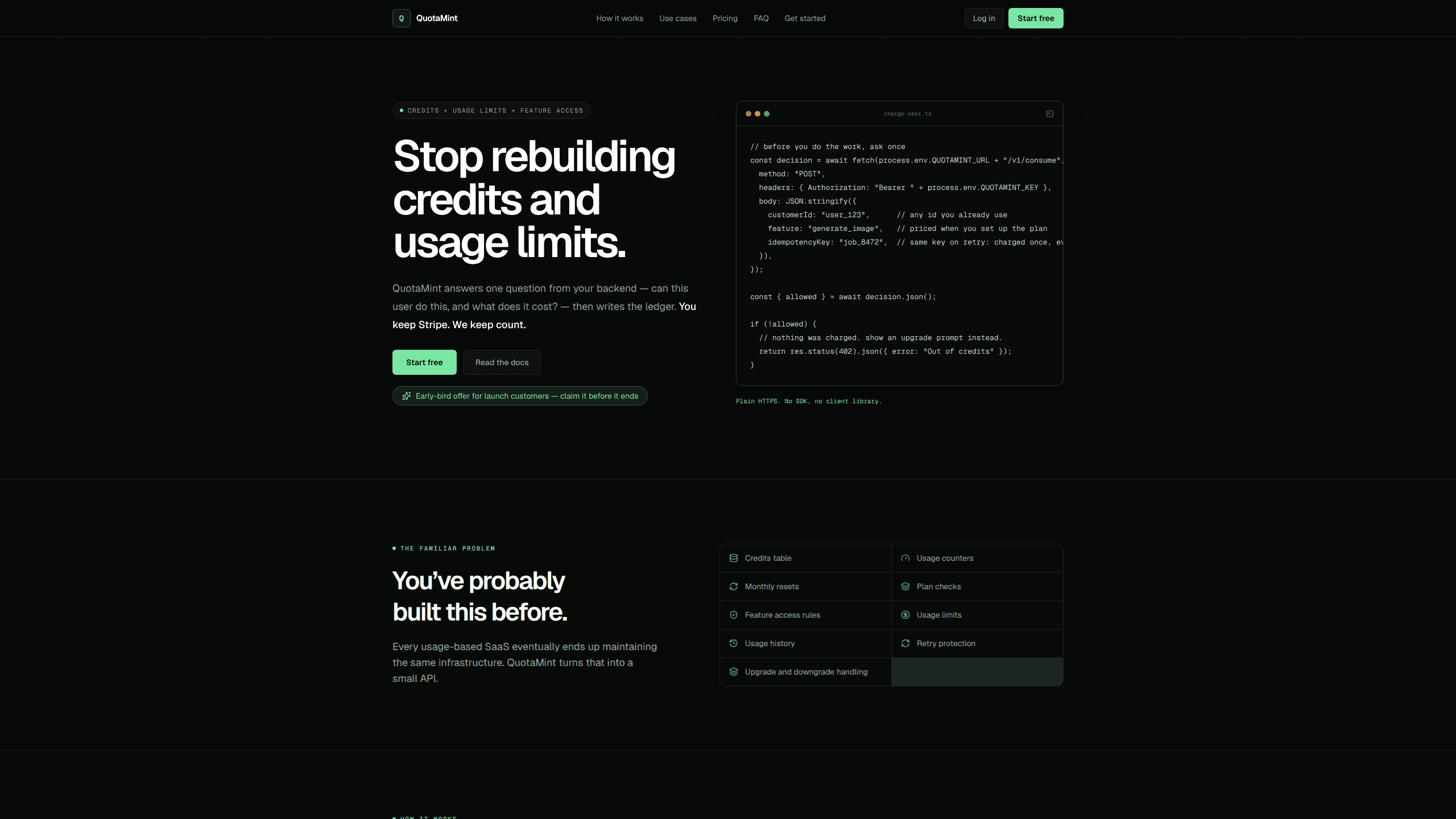
QuotaMint is a REST API that tracks customer plans, feature access, and credits for SaaS products. One call returns allow or deny, then records usage.
About QuotaMint
What Is QuotaMint
QuotaMint is a backend service for products that need to answer a single question on every request: can this customer use this feature, and what does it cost? Your server calls the API, QuotaMint checks the customer's plan, the feature entitlement, the credit price, and the remaining balance, then writes a usage record. Payments stay with your existing provider.
The problem it targets is familiar to anyone running usage-based billing. Plans, credit balances, retry handling, and the deny path all get rebuilt inside the application, usually as a table plus a service layer that grows every quarter. QuotaMint moves those rules into a hosted service. You define plans and feature costs in a dashboard, and a plan edit takes effect on the next API call without a redeploy.
The limits are worth knowing before you sign up. There are no SDKs, so your team writes plain HTTPS calls. Native billing integrations are still planned, which means plan changes after a Stripe or Paddle subscription event have to be pushed into QuotaMint by your own code or set by hand in the dashboard. QuotaMint also does not sit in front of your API as a gateway, so it will not route traffic, cache responses, or replace rate limiting at the edge.
Getting Started
- Create a workspace and a project in the dashboard. Each project keeps its own customers, plans, features, keys, and usage records.
- Add a plan with a monthly credit allocation, then create metered features and set a credit cost for each one, such as 10 credits for an image generation.
- Create a customer using the ID you already store in your product, and assign the plan to that customer.
- Generate a Test API key, call
/v1/checkto preview a decision, then call/v1/consumewith an idempotency key right before the billable work runs. - Switch your server to a Live key when the flow looks right. Test and Live data stay separate, so a test call cannot touch live balances.
Product Information
A quick look at QuotaMint's pricing, supported platforms, and performance.
Best for
The users, tasks, and scenarios where this tool fits best.
Users
- Backend developers at SaaS startups
- Technical founders shipping an AI product
- Platform engineers replacing an in-house quota table
- Small teams without a billing engineer
Tasks
- Charging credits per feature
- Enforcing plan-based access
- Adding subscription tiers to an existing app
- Auditing consumption
- Testing a pricing model
Scenarios
- Launching a paid tier before billing automation exists
- Replacing a spreadsheet or an admin panel that tracks balances
- Selling top-up credit packs
- Metering AI features with uneven costs
Key features
One endpoint that returns a decision
/v1/consume checks the plan, the feature entitlement, the credit cost, and the balance, then answers with allowed: true or allowed: false. A denial is a normal response, not an error, so your app can show an upgrade prompt instead of a stack trace. The same call writes the ledger entry when it approves the request.
A check call that changes nothing
/v1/check returns the same decision shape without reserving or deducting credits. Use it to gray out a button, show a remaining balance in a settings page, or warn a customer before a long job starts. Because nothing is written, it is safe to call while someone is still deciding.
Idempotent consumption for retries
Every consume request can carry an idempotency key that identifies the business operation rather than the HTTP attempt. If a request times out and your server retries with the same key, QuotaMint returns the original result and charges nothing extra. Concurrent requests with the same key wait for the first one to finish and then receive the stored response.
Plans and feature entitlements in a dashboard
You define plans such as Starter with 500 credits a month and Pro with 2,000, then set a cost per feature: 1 credit for text, 10 for an image, 50 for a video. Entitlements decide which features each plan can reach. A price change applies to the next call, and no deploy is needed.
Atomic balances with append-only history
Concurrent consumes cannot push a balance below zero. If twenty calls compete for ten credits at a cost of ten, one succeeds and nineteen come back denied with insufficient_credits. Each approved call leaves a ledger row, and the usage history shows when, where, and which feature spent the credits, which covers basic API usage tracking for support and finance.
Separate Test and Live environments
Each project ships with Test and Live keys, counted separately against the plan's key limit. Test data never mixes with live balances, so a developer can rehearse an upgrade, a downgrade, or a depleted balance against the real API before touching production.
Usage events for anything without a credit price
/v1/events records metered usage that has no credit cost, such as an API call, a document processed, or a minute of transcription. You can meter tokens, images, minutes, or custom units and still read one history per customer. Products that do not use credits can run on entitlements and events alone.
Plain REST from any backend
There is no client library to install or keep current. Any language that can send an HTTPS POST works, including TypeScript, Go, Python, and Ruby, and the request body stays under 64 KiB by default. Your server calls QuotaMint directly, so API traffic never passes through a proxy.
Pros and cons
Pros
- A single HTTPS POST covers the usage decision, the deduction, and the record, which keeps quota logic out of your product code.
- Plan and price changes land from the dashboard without a deploy.
- Idempotency keys make network retries and duplicate jobs safe by default.
- Atomic deduction holds up under concurrency, with no partial charges and no negative balances.
- The free plan includes 5,000 monthly runtime events, and paid plans start at $29 per workspace.
Cons
- Native billing integrations are not available yet, so subscription changes from Stripe or Paddle need your own sync or a manual plan edit.
- No SDKs or client libraries ship with the product, so every integration is hand-written HTTP.
- It is not an API gateway: no traffic routing, no response caching, and only per-key rate windows.
- Credit rollover is not supported yet, so unused credits reset on the first day of each UTC month.
- Upgrading the workspace plan goes through contact links, with no self-serve checkout.
Frequently asked questions
QuotaMint is a backend service that stores customer plans, feature entitlements, credit balances, and usage records for SaaS products. Your server calls it to get an allow or deny decision before running a billable feature.
Related content
Explore related tools, skills, and articles for QuotaMint.
QuotaMint Alternatives

Base Code
Base44 (Wix) · Coding · ProductivityBase Code is a shared cloud development environment from Base44. Teammates describe changes to an existing GitHub codebase in chat, preview them live and send them back as pull requests.

Google EmbeddingGemma 2
Google DeepMind · Writing · Image · CodingGoogle EmbeddingGemma 2 is a 740M-parameter open model that turns text, code, images, audio, and video frames into vectors in one 768-dimension space, running on phones and laptops.

GitGlow
GitGlow · Coding · ProductivityGitGlow is a local-first desktop Git client that lets independent developers review their own code and their AI agents' changes in one place before shipping.