

Qwiet AI
Qwiet AI (Harness) · Coding
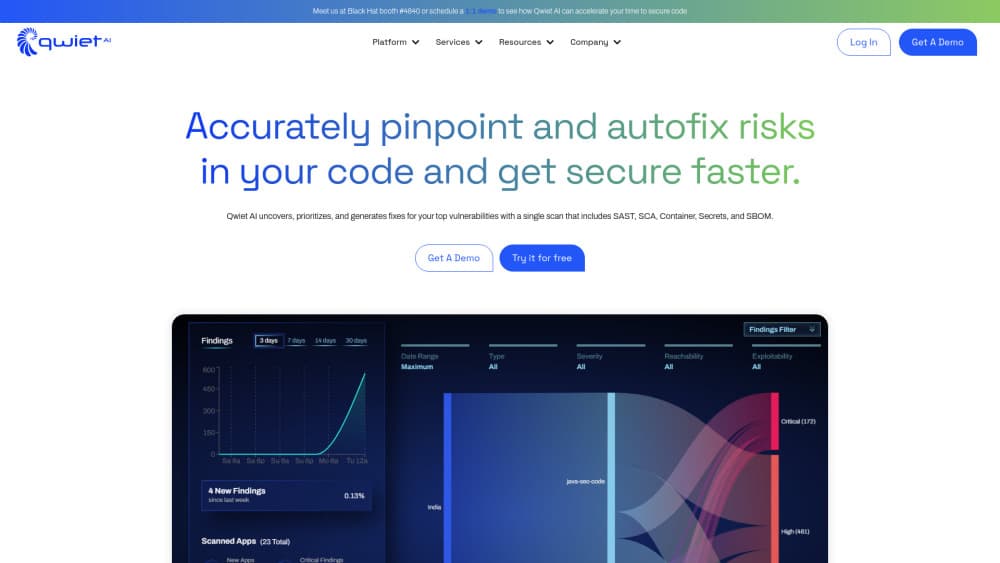
Qwiet AI by Harness is a code security platform: it runs static code analysis, ranks the risks attackers can actually reach, and drafts patches for review.
About Qwiet AI
What Is Qwiet AI
Qwiet AI is an application security testing platform for teams that ship code every day. One scan reads your source code, open source dependencies, infrastructure files, container images, and leaked secrets, so security engineers quit stitching five dashboards together. The company started as ShiftLeft and has belonged to Harness since September 2025, where it now sits inside the Harness security testing module.
The pitch is signal, not volume. Old scanners flag patterns that look dangerous. Qwiet AI builds a code property graph of your application and traces whether a risky line can be reached from user input at runtime. Findings that nothing calls fall down the list. The vendor puts its true positive rate at 97%, and that number comes from Qwiet's own testing rather than an outside lab.
Two limits matter before you sign. Pricing isn't published, so expect a sales call and a contract sized by lines of code or by application. And AI Autofix writes patches with a language model, which means someone still reviews every pull request. Treat the suggested fix as a first draft from a fast colleague.
Getting Started
- Connect a repository through GitHub, GitLab, Bitbucket, or a CI job. The first scan reads the code and builds the graph.
- Choose the applications to scan, then set a trigger. Most teams start with pull requests and add a nightly build later.
- Open the findings list, which sorts by reachability and by active exploitation. Each entry shows the data flow from source to sink.
- Run AI Autofix on a finding, read the patch and its unit test, then merge through your normal review.
Product Information
A quick look at Qwiet AI's pricing, supported platforms, and performance.
Best for
The users, tasks, and scenarios where this tool fits best.
Users
- Security engineers at mid-size and large companies
- Developers on teams with a security mandate
- Audit and compliance leads
Tasks
- Scanning pull requests before merge
- Clearing an old backlog of findings
- Checking open source dependencies
- Drafting first-pass patches
Scenarios
- A release gate in CI
- Audit preparation
- Inheriting an unfamiliar codebase
Key features
One scan, five scanners
A single analysis covers source code, open source libraries, infrastructure as code, container images, and hardcoded secrets. Consolidation is the selling point here: one onboarding, one findings list, one policy language instead of four vendor portals with separate logins.
Reachability and exploitability filters
Qwiet AI traces whether untrusted input can reach a vulnerable function, then weights findings that attackers already exploit in the wild. The practical effect is a shorter queue at the top of the list, which is where most security teams spend their morning. Unreachable findings stay available for audits without crowding the view.
AI Autofix with tested patches
Autofix generates a code change and a unit test for a finding, and the patch appears as a normal pull request. You review it like any teammate's work, so the model never commits on its own. The vendor reports a 95% cut in remediation time, a claim worth testing on your own repositories before you plan headcount around it.
Code property graph analysis
Instead of matching text patterns, Qwiet models variables, calls, and data flow across files and services. That model is what lets the scanner follow a value from an HTTP handler into a database call, and it's also how the tool spots logic that only looks safe in one file.
Pipeline and repository integrations
The scanner runs inside Harness pipelines and also connects to GitHub Actions, GitLab CI, Jenkins, Azure DevOps, and a command line client. Results land as build checks and as tickets in Jira or ServiceNow. Most teams keep their existing CI and add Qwiet as one more step.
Findings dashboard and exports
A web console groups findings by application, severity, and reachability, and supports SARIF export for other tools. Policy rules can fail a build on a severity threshold or on a specific category, which is how the tool turns into a release gate.
Pros and cons
Pros
- One scan replaces separate SAST, SCA, IaC, container, and secrets tools, which cuts both cost and tool sprawl.
- Reachability context makes a large findings list usable, and the noise reduction holds up better than severity labels alone.
- Findings appear in the pull request and in existing ticketing systems, so developers don't need a new habit.
- AI Autofix ships a patch with a matching unit test, which makes review faster on common bug classes.
- The scanner is available as a free tier and inside Harness pipelines, so a pilot doesn't require a procurement cycle.
Cons
- Pricing isn't public. You can't estimate cost from the site, and budget planning means a sales conversation.
- The 97% accuracy figure is vendor reported. Independent benchmarks for Qwiet AI are thin, so plan a trial on real code.
- Suggested fixes still need a reviewer with context. A patch that compiles can still change behavior in ways the model can't see.
- Deep customization of policies and graph queries leans technical, and small teams may never use the full rule set.
Frequently asked questions
Qwiet AI scans application code and its dependencies for security weaknesses, then ranks findings by whether an attacker can actually reach them. It also proposes fixes and runs inside CI pipelines as a release gate.
Related content
Explore related tools, skills, and articles for Qwiet AI.
Qwiet AI Alternatives

Base Code
Base44 (Wix) · Coding · ProductivityBase Code is a shared cloud development environment from Base44. Teammates describe changes to an existing GitHub codebase in chat, preview them live and send them back as pull requests.

Google EmbeddingGemma 2
Google DeepMind · Writing · Image · CodingGoogle EmbeddingGemma 2 is a 740M-parameter open model that turns text, code, images, audio, and video frames into vectors in one 768-dimension space, running on phones and laptops.

GitGlow
GitGlow · Coding · ProductivityGitGlow is a local-first desktop Git client that lets independent developers review their own code and their AI agents' changes in one place before shipping.