

RAGgenie
RAGgenie · Coding · Chatbot
RAGgenie is a low-code RAG builder that turns your own databases and documents into a shareable AI copilot, no engineering team required.
About RAGgenie
What Is RAGgenie
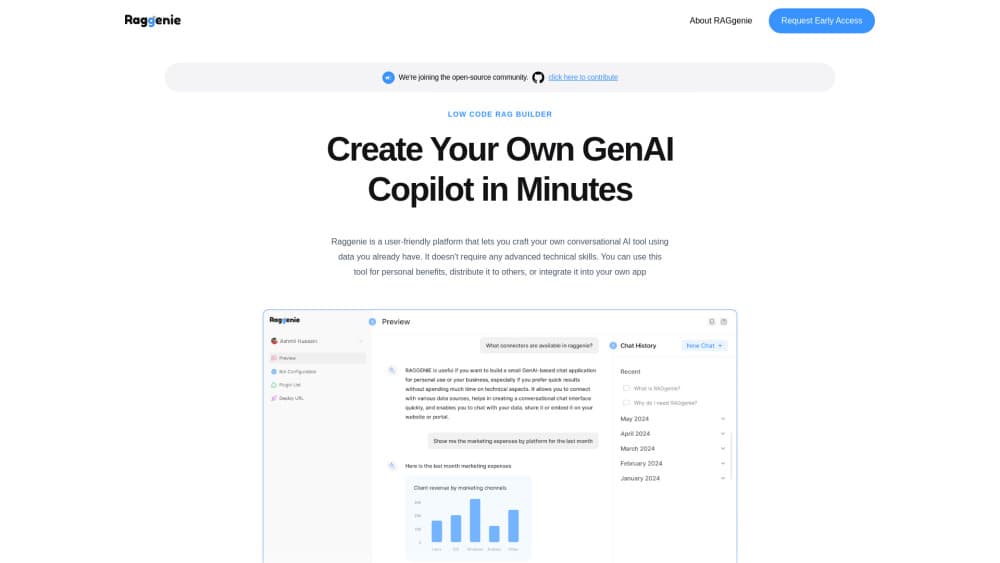
RAGgenie is a web platform for building a custom AI copilot on top of data you already own. You connect a database or a document source, and the tool wires up retrieval generation (a method where the AI looks things up in your data before it answers) so you can chat with that content in plain language. No data team needed.
The people behind it came out of AI, cloud, and DevOps consulting. They noticed that every client was rebuilding the same RAG setup from scratch, and that small teams and solo operators rarely had the budget to maintain one. RAGgenie packages that work into a hosted tool: you bring your own inference API key and vector store key, connect a source, and get a conversational interface you can share.
The main limit is scope. In the first release only one source runs at a time, PDF files aren't supported yet, and you supply your own model and vector store keys. It's built for quick, finished results rather than deep pipeline control. So keep expectations modest if you need layered retrieval or heavy orchestration.
Getting Started
- Sign up on the RAGgenie portal and open a new copilot project.
- Add your inference API key and vector store key so the assistant can generate and search answers.
- Connect a data source, such as MySQL, PostgreSQL, Google Drive, or a website.
- Test the chat on the portal, then share a link or embed it on your site.
Product Information
A quick look at RAGgenie's pricing, supported platforms, and performance.
Best for
The users, tasks, and scenarios where this tool fits best.
Users
- Small businesses without an engineering team that need an internal question-answering bot
- Solo founders and analysts who want to query their own data in plain language
- Support and ops teams that want a shareable chat layer over their existing records
Tasks
- Turning a MySQL or PostgreSQL database into a chat assistant that returns live rows
- Building a chatbot over Google Drive or SharePoint documents
- Embedding a data-aware assistant on a product site or internal portal
Scenarios
- Answering common customer questions without digging through spreadsheets
- Giving a new hire a bot that can explain internal documents
- Letting a sales team pull numbers from a live database during a call
Key features
Low-code copilot builder
You assemble a custom AI chatbot through a guided flow instead of writing a retrieval pipeline by hand. Pick a source, connect your keys, and the platform handles the retrieval and prompt wiring behind the scenes. The payoff is speed. A working chat over your data in minutes, not a sprint.
Structured database connections
RAGgenie links to MySQL, PostgreSQL, MSSQL, BigQuery, GraphQL, Airtable, and REST APIs. For these sources the assistant queries your live data at answer time rather than copying it into another system, so the numbers you see are current. That matters when the answer depends on today's inventory, tickets, or balances.
Document-based sources
For file-based content you can connect Google Drive, SharePoint, Dropbox, a website, or pasted text. The assistant reads that material and answers questions grounded in it, which suits policies, handbooks, and shared notes. Note that PDF support isn't in the first release, so scanned contracts and reports need converting first.
Shareable and embeddable chat
Once a copilot works, you can chat with it on the RAGgenie portal, send colleagues a link, or embed it on a website or portal. That turns a private experiment into no-code AI chat the whole team can use without each person rebuilding it.
Bring-your-own model and vector store
You supply your own inference API key and vector store key. The upside is control over which model answers your questions and where your vectors live. The trade-off is that you manage those accounts and their costs yourself.
Pros and cons
Pros
- Ships a working copilot over your data fast, with no retrieval code to maintain
- Connects live databases, so answers reflect current data instead of a stale copy
- Shareable link and embed options make it usable across a team
- Bring-your-own keys give you a say in model choice and data location
Cons
- Only one source at a time in the first release, which limits multi-source assistants
- PDF files aren't supported yet, so those documents must be converted
- You provide your own inference and vector store keys, adding setup and separate costs
Frequently asked questions
It builds a retrieval-based AI copilot on top of your own data. You connect a source, and it creates a chat interface that answers questions using that content. That's it.
Related content
Explore related tools, skills, and articles for RAGgenie.
RAGgenie Alternatives

Base Code
Base44 (Wix) · Coding · ProductivityBase Code is a shared cloud development environment from Base44. Teammates describe changes to an existing GitHub codebase in chat, preview them live and send them back as pull requests.

Google EmbeddingGemma 2
Google DeepMind · Writing · Image · CodingGoogle EmbeddingGemma 2 is a 740M-parameter open model that turns text, code, images, audio, and video frames into vectors in one 768-dimension space, running on phones and laptops.

GitGlow
GitGlow · Coding · ProductivityGitGlow is a local-first desktop Git client that lets independent developers review their own code and their AI agents' changes in one place before shipping.