

Ragie
Ragie, part of Ticketmaster · Coding
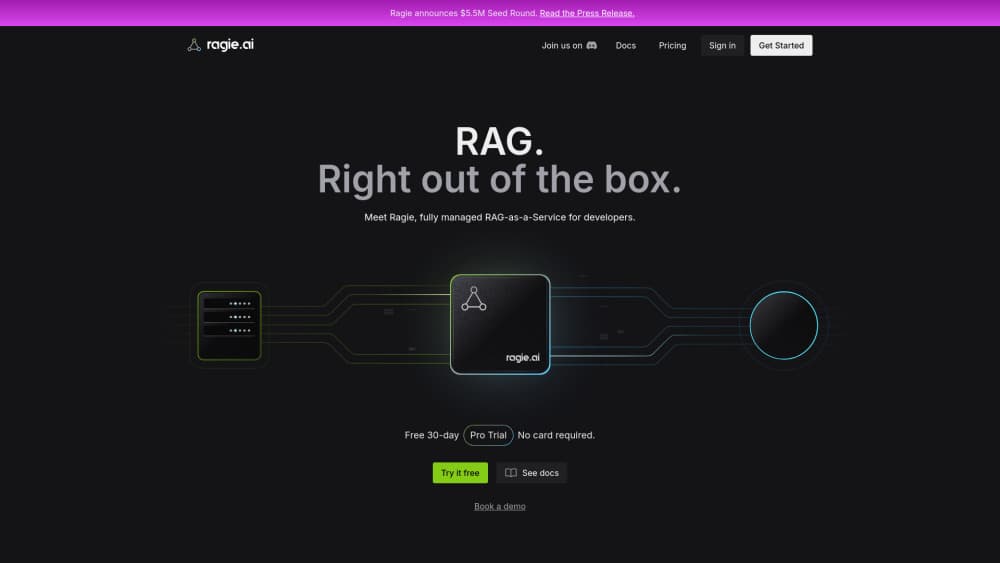
Ragie is a managed RAG platform that turns documents, images, audio and video into retrieval ready context for AI apps and agents, all through one API with connectors and hybrid search.
About Ragie
What Is Ragie
Ragie is a RAG as a service product for teams that want retrieval without building the pipeline behind it. You point it at files or at connected apps, it parses and indexes whatever it finds, and your application asks for context through a single retrieval augmented generation API. The company describes it as a context engine, and that label fits. The messy half of retrieval augmented generation, meaning chunking, table parsing, embedding refreshes and reranking, sits on their side of the line.
The product started as internal plumbing for Glue, a chat app backed by Craft Ventures, and launched publicly in August 2024. Since then it has grown into a broader platform with native connectors, a Model Context Protocol server, and support for audio and video alongside text and PDFs. In 2026 the company announced it was joining Ticketmaster.
The limits matter as much as the feature list. Pricing runs on pages processed and pages stored, so a document heavy project can cost more than the headline plan suggests. Embedded connectors are an add-on at $250 per month after the first one. Self-hosted deployment exists but sits behind an enterprise contract, not a signup form.
Getting Started
- Create an account at ragie.ai and generate an API key from the dashboard. The Developer plan needs no card, which covers a first experiment.
- Make a partition if your data belongs to different customers or workspaces. Skipping this step is fine for a single tenant app, and painful to retrofit later.
- Upload files through the documents endpoint or connect Google Drive, Notion, Slack, Confluence or SharePoint so the index refreshes on its own.
- Watch document status as files move from processing to ready, or subscribe to webhooks and let the callback tell you.
- Query the retrieval endpoint with a natural language question and get back scored chunks with source metadata you can cite.
Product Information
A quick look at Ragie's pricing, supported platforms, and performance.
Best for
The users, tasks, and scenarios where this tool fits best.
Users
- Backend and AI engineers
- Small product teams shipping an assistant
- SaaS builders with per customer data
Tasks
- Grounding a chatbot in company documents
- Searching long recordings
- Pulling structured fields from paperwork
Scenarios
- A legal or compliance team that needs every relevant clause
- A support product answering from help center content
- An agent inside Claude or Cursor that needs your own files
Key features
One Pipeline for Every File Type
Ragie handles PDFs, Office documents, spreadsheets, plain text, images, audio and video through the same ingest path. Images get processed in a high resolution mode that reads embedded charts and screenshots, and media files are transcribed with timestamps. The practical effect is that a mixed folder doesn't need three tools and a script to sort it.
Native and Embedded Connectors
Google Drive, Notion, Confluence, Slack, SharePoint, Dropbox, HubSpot, Jira, Intercom, Zendesk and Backblaze are supported out of the box, with sync handled on Ragie's side. Embedded connectors go further and let your own customers authorize their Drive or Notion inside your product, which is how a B2B app offers "connect your knowledge base" without building OAuth for every provider.
Hybrid Search Across Three Indexes
Every document gets indexed three ways: vector embeddings for meaning, keyword search for exact strings, and a summary index for the gist of larger documents. Queries hit all three and merge the results. That combination is why a search for a product code and a search for a vague question both return something useful.
Partitions for Multi Tenant Data
A partition is a walled section of the index. Documents in one partition don't appear in retrievals run against another, which covers both data isolation between customers and relevance, since a query only ranks against the corpus that matters. You scope a retrieval by passing the partition, and access control stays in your application.
Entity Extraction
This feature reads unstructured text and returns named values, such as dates, emails, amounts or whatever schema you define. It's the difference between retrieving a contract and knowing its renewal date. Teams use it for resume parsing, invoice fields and metadata that later becomes a filter on retrieval.
Reranking, Recency and Hierarchical Search
Retrieved chunks can be reordered by a reranker so the most relevant passage lands first. Recency bias pushes newer documents up when freshness matters more than depth. Hierarchical search works at the summary level first, then drills into the documents that survived, which helps on broad questions across a large knowledge base.
MCP Server and SDKs
The Model Context Protocol server runs over streamable HTTP, so Claude, Cursor and other MCP clients can query a knowledge base directly. Python and TypeScript SDKs wrap the REST API, and webhooks report document state changes. Between the two, most of the integration work is configuration rather than custom code.
Pros and cons
Pros
- One API covers ingestion, indexing and retrieval, so there's no vector database to operate or chunking strategy to tune.
- Hybrid search with reranking is included on every plan, not held back as an enterprise feature.
- Partitions solve tenant isolation without a second deployment, which matters for anyone selling to businesses.
- Multimodal coverage goes past text, with audio and video transcription priced per minute.
- Native and embedded connectors remove the OAuth work that usually eats the first month of a project.
Cons
- Page based billing punishes document heavy workloads. The Starter plan includes 10,000 pages, then charges $0.02 per page on top, and storage adds $0.002 per page each month.
- The jump from the $100 plan to the $500 plan is steep, with nothing in between for a team that outgrows 10,000 pages but doesn't need 60,000.
- Embedded connectors cost $250 per month after the first one, which can outweigh the plan itself for a product serving several integrations.
- The 2026 move to Ticketmaster leaves a question about how the standalone product evolves, so a long contract deserves a direct conversation with sales.
Frequently asked questions
It runs the retrieval layer of an AI application. You send documents or connect a data source, Ragie parses and indexes them, and your app calls a retrieval endpoint to get relevant passages back instead of building a pipeline from scratch.
Related content
Explore related tools, skills, and articles for Ragie.
Ragie Alternatives

Base Code
Base44 (Wix) · Coding · ProductivityBase Code is a shared cloud development environment from Base44. Teammates describe changes to an existing GitHub codebase in chat, preview them live and send them back as pull requests.

Google EmbeddingGemma 2
Google DeepMind · Writing · Image · CodingGoogle EmbeddingGemma 2 is a 740M-parameter open model that turns text, code, images, audio, and video frames into vectors in one 768-dimension space, running on phones and laptops.

GitGlow
GitGlow · Coding · ProductivityGitGlow is a local-first desktop Git client that lets independent developers review their own code and their AI agents' changes in one place before shipping.