

RapidAI
RapidAI (formerly iSchemaView) · Marketing · AI Assistant
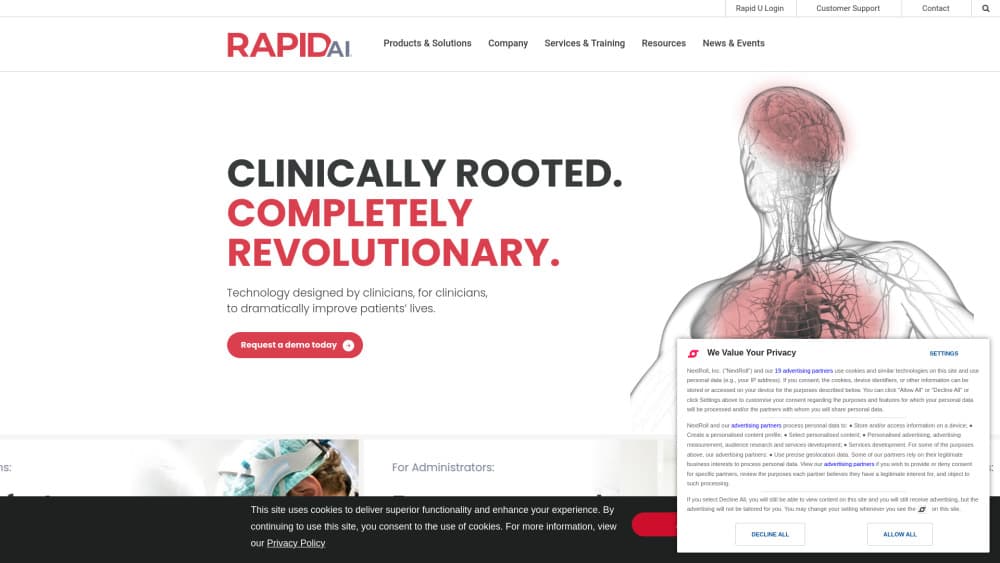
RapidAI is a clinical AI platform that reads stroke and neurovascular scans in minutes, quantifies what it finds, and alerts the care team before the patient leaves the scanner.
About RapidAI
What Is RapidAI
RapidAI is medical imaging software for hospitals, built around one question: how fast can a scan turn into a treatment decision. The company started as iSchemaView in 2013 and made its name in stroke care, where every minute of delay costs brain tissue. Its stroke imaging AI modules now cover blood clots, bleeding, aneurysm tracking, and aortic disease.
The platform sits between the scanner and the care team. Every neurovascular imaging study follows the same path: a CT or MR arrives, the software flags a suspected large vessel occlusion, scores early ischemic changes, or measures how much brain is still salvageable, then pushes the result to a phone or a workstation. According to RapidAI, its tools run in more than 2,500 hospitals across 100 countries, with over 20,000 scans processed daily.
The limits matter as much as the features. RapidAI is sold to health systems, not individuals, so there's no free tier and no public price list. Nothing here reads a scan on its own either. A clinician still makes the call, and the software is cleared as decision support.
Getting Started
- Request a demo through the RapidAI site and scope which service lines you want to cover, such as ischemic stroke, hemorrhage, or aneurysm.
- Work with the implementation team to connect the platform to your PACS, EMR, and CT or MR scanners.
- Choose the deployment shape: cloud through Rapid Edge Cloud, on-premises, or the hybrid setup with on-premises fallback.
- Train radiologists, stroke neurologists, and nursing staff on the mobile app and the alert thresholds for your site.
- Go live on one module first, review the analytics dashboard after a few weeks, then add modules.
Product Information
A quick look at RapidAI's pricing, supported platforms, and performance.
Best for
The users, tasks, and scenarios where this tool fits best.
Users
- Stroke neurologists and neurointerventionalists
- Radiologists and radiology departments
- Hospital administrators and IT teams
Tasks
- Screening a CTA for a suspected clot
- Scoring early ischemic changes on a non-contrast CT
- Estimating core and penumbra from a CT perfusion study
- Choosing between transfer and local treatment
Scenarios
- After-hours stroke calls with a thin night team
- Standardizing care across a multi-site health system
- Long-term aneurysm and hemorrhage follow-up
Key features
Rapid LVO for large vessel occlusion detection
Rapid LVO analyzes CT angiography studies and marks a suspected occlusion in the neck or brain, along with a confidence level. The result lands on a phone with the source images attached, so a neurologist can confirm the finding without opening a workstation. For transfer decisions, that head start often decides whether a patient gets thrombectomy inside the treatment window.
Rapid ASPECTS for early stroke scoring
This module grades early ischemic changes on non-contrast CT and produces both a visual map and a 0 to 10 score. ASPECTS scoring AI removes the inter-reader spread that comes from eyeballing subtle gray-white changes at 3 a.m. The score feeds directly into thrombectomy eligibility talks with the intervention team.
Rapid CTP and perfusion analysis
Rapid CTP processes CT perfusion studies and estimates the ischemic core and the penumbra, the tissue that's starved but not yet dead. Hospitals use the CT perfusion software to separate patients who'll benefit from clot removal from those who won't. The output includes color maps and volumes that can be dropped into a transfer note.
Hemorrhage and neurocritical modules
Rapid ICH flags intracranial hemorrhage on non-contrast CT, and the wider neurocritical set covers subdural hematoma, midline shift, intraventricular hemorrhage, and hyperdensity. Each finding comes with measurements rather than a yes or no, which helps a resident describe severity to an attending. Aneurysm modules add detection support, growth assessment, and longitudinal tracking for rupture risk.
Mobile app and care team coordination
The Rapid mobile app for iOS and Android pushes case alerts, opens AI outputs in a DICOM viewer, and carries in-app messaging for consults across sites. Notifications can be tuned to clinical thresholds, so a small hemorrhage doesn't wake the same people as a large vessel occlusion. Case summaries pull from the EMR when the integration is in place.
Enterprise platform, analytics, and partner AI
Rapid Edge Cloud runs the models in the cloud with an on-premises fallback, a setup RapidAI describes as the only hybrid in the industry. The enterprise layer adds dashboards for utilization, turnaround time, and clinical impact by service line. Hospitals can also run third-party algorithms from integrated partners inside the same platform.
Pros and cons
Pros
- Broad FDA-cleared coverage: RapidAI lists 30 cleared modules spanning ischemic stroke, hemorrhage, aneurysm, aortic, and cardiac imaging.
- Heavy clinical evidence: the company points to more than 750 peer-reviewed publications, including 11 in NEJM, which is unusual for imaging AI.
- Hybrid infrastructure: cloud performance with an on-premises fallback keeps the stroke workflow alive during network outages.
- Mobile-first delivery: alerts, DICOM review, and consult messaging work from a phone, which fits how stroke call actually happens.
- Workflow fit: vendor-agnostic integration with existing PACS and EMR means radiology keeps the tools it already knows.
Cons
- No public pricing and no self-serve trial: a hospital can't estimate cost or test the software without a sales conversation.
- Implementation is a project, not a download: PACS, EMR, and scanner integration typically runs for weeks and pulls in IT staff.
- No public API for outside developers, so custom or research pipelines can't call the models directly.
- Module licensing adds up: stroke, hemorrhage, aneurysm, and vascular tools are bought in pieces, and a full service line is a multi-year contract.
Frequently asked questions
RapidAI helps hospital teams read neurological and vascular imaging faster. It flags suspected clots and bleeds, scores early stroke changes, measures salvageable brain tissue, and sends the results to clinicians on their phones.
Related content
Explore related tools, skills, and articles for RapidAI.
RapidAI Alternatives
ngram 2.0
ngram · Video · Marketingngram 2.0 is an AI video generator for teams. It turns a prompt, a screen recording, or a product URL into a narrated explainer, product demo, or AI avatar video, and every scene stays editable.
shippedit.me
Krawlup · Marketing · Businessshippedit.me now redirects to Krawlup, a web platform that audits SEO, AEO and page speed every week, then hands the fixes to AI coding agents over MCP.

MePersona
MePersona, Inc. · Writing · Productivity · MarketingMePersona is an AI unified inbox for creators. It learns your voice, drafts replies to fan messages from 12 platforms, and sends only what you approve.