

RapidNative
RapidNative · Coding
RapidNative is an AI mobile app builder that turns a plain-English description into a real React Native app with a backend, then lets you export the code or publish to app stores.
About RapidNative
What Is RapidNative
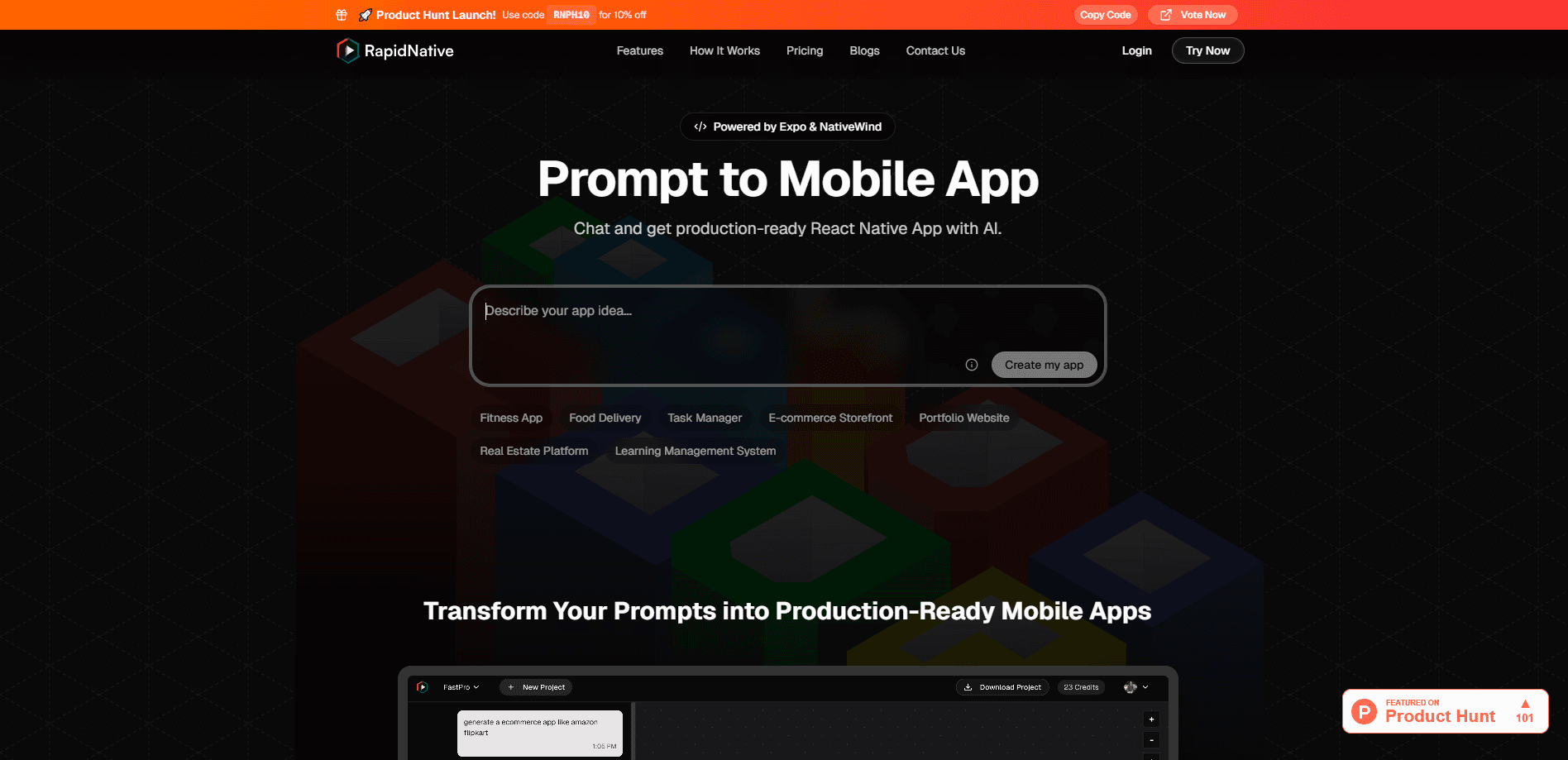
RapidNative is a collaborative mobile app builder that generates real React Native screens from a text prompt. You describe the app you want, and it builds the interface, navigation and the services behind them rather than stopping at a mockup.
The pitch is speed. A founder, designer or small team can go from an idea to a shareable app in minutes, preview it on a phone through a link or QR code, and then export production-ready code in React Native and Expo.
The main limits are scope and cost. Every generation spends credits, so large builds burn them faster than small edits. It also targets React Native specifically, which is great if you want a native mobile app, and the wrong fit if you need a web-first product or a language other than JavaScript.
Getting Started
- Create an account at rapidnative.com. The free plan starts with 20 credits, and the first day gives you 10.
- Describe the app in plain English, or drop a sketch, document or screenshot as the starting point.
- Refine the result in the browser editor or through the AI assistant, and preview it on your phone with Expo Go or a share link.
- Export the React Native and Expo code, or hand it to RapidNative to submit to the App Store and Google Play.
Product Information
A quick look at RapidNative's pricing, supported platforms, and performance.
Best for
The users, tasks, and scenarios where this tool fits best.
Users
- Startup founders
- React Native developers
- Freelancers and small agencies
Tasks
- Turning an idea into a working app
- Prototyping for feedback
- Exporting production code
Scenarios
- Validating an MVP before a funding round
- Solo builders shipping on a budget
- Teams iterating together
Key features
Prompt to real React Native screens
You describe the app and RapidNative generates actual React Native screens with navigation, not static images. It accepts a sentence, a sketch, a document or a screenshot as the seed, so you can start from whatever you already have. The output is real code you can run, not a design file.
Full-stack backend out of the box
Every project ships with authentication, file storage and realtime updates already wired up, so you skip the plumbing that usually slows a first build. Data lives in a Postgres database you can query, migrate and secure, and you can point it at your own Supabase from project settings.
Code export with no lock-in
You own 100% of what you generate. RapidNative outputs standard React Native and Expo code that lives in your project and your repo, so you can export anytime and keep working outside the platform. That is the difference between a builder that traps you and one you can leave.
Publish directly to the app stores
RapidNative converts your project into a production React Native app, creates the store listings, handles compliance and submits to both the App Store and Google Play. You can also export and publish yourself, since the project runs on Expo.
Real-time team collaboration
The whole team can work on the same project at once and watch changes as they happen. Paid plans add shared workspaces, member invites and role-based permissions, which fits a small product team rather than a single person.
Themeable design and live preview
You can bend colors, typography and components to match your brand or start from a built-in theme and adjust it. Preview happens on a real phone through Expo Go or a share link and QR code, so feedback comes from the actual device.
Pros and cons
Pros
- Generates real React Native and Expo code, not a web wrapper, so apps can pass store review and use device features like camera and push.
- Full-stack from the first prompt, with auth, file storage and a Postgres database already connected.
- You own the exported code with no lock-in, and you can keep building in your own IDE.
- Store submission is handled for you, including listings and compliance, for a flat fee.
- Free plan with 20 credits lets you test the builder before paying.
Cons
- Every generation spends credits, and full-stack builds cost more than a flat request, so heavy use runs out fast on lower plans.
- It is React Native and Expo only. If you want Flutter, native Swift or Kotlin, or a web-first product, this is the wrong tool.
- The free plan caps you at 5 screens per project and 5 credits a day, which limits real testing.
- Store submission is a separate service, so a fully published app costs more than the subscription alone.
Frequently asked questions
RapidNative is used to build real mobile apps from a text prompt. You describe the app you want and it generates React Native screens, navigation and a backend, which you can preview, export or publish to the app stores.
Related content
Explore related tools, skills, and articles for RapidNative.
RapidNative Alternatives

Base Code
Base44 (Wix) · Coding · ProductivityBase Code is a shared cloud development environment from Base44. Teammates describe changes to an existing GitHub codebase in chat, preview them live and send them back as pull requests.

Google EmbeddingGemma 2
Google DeepMind · Writing · Image · CodingGoogle EmbeddingGemma 2 is a 740M-parameter open model that turns text, code, images, audio, and video frames into vectors in one 768-dimension space, running on phones and laptops.

GitGlow
GitGlow · Coding · ProductivityGitGlow is a local-first desktop Git client that lets independent developers review their own code and their AI agents' changes in one place before shipping.