

Reason
Reason Machines · Coding · Productivity
Reason is a coding agent from Reason Machines that works in your repositories, runs on cloud computers or your own machine, and connects the AI plans you already pay for.
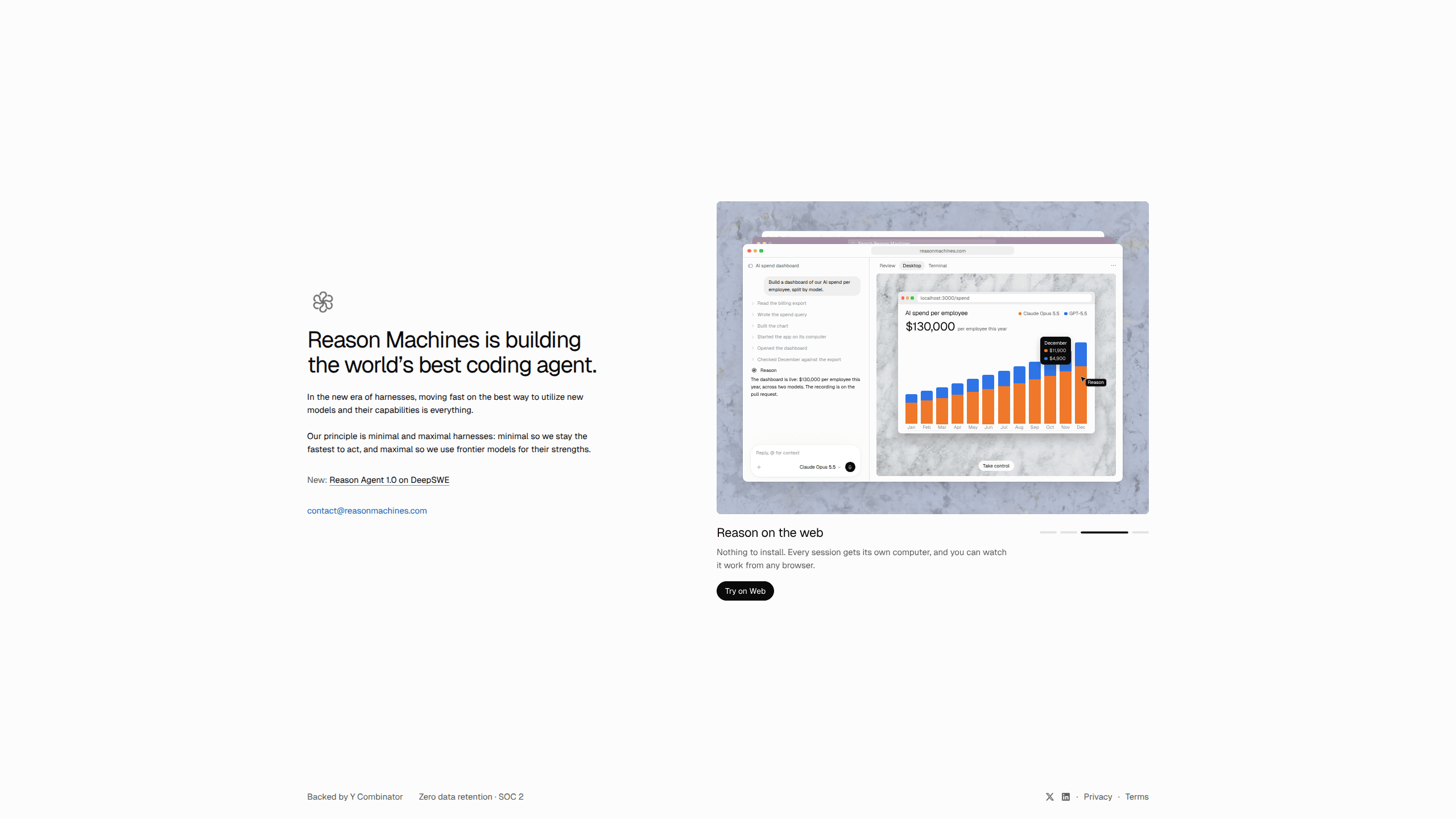
About Reason
What Is Reason
Reason is an autonomous coding agent built by Reason Machines. You open a session in the web app, describe a task such as fixing a failing test or adding an endpoint, and the agent reads the repository, edits files, runs commands, and opens a pull request for you to review. Sessions run on Reason's cloud computers, or on your own Mac through the desktop app when the code and services already live there.
What sets it apart is that Reason does not lock you into one model vendor. In Settings, you can connect a ChatGPT, Claude, GitHub Copilot or Grok subscription, add API keys, or use Reason's own model. That makes it closer to a coding workspace than a single-model assistant, because the work follows whichever account you have available.
The catch is cost and scope. There is no free plan for new accounts, only a three-day trial on the Pro tier, and usage is metered in credits that include cloud compute. Reason also expects a human to review what it produces. It opens pull requests rather than pushing straight to main, and that review step is where most of the quality control happens.
Getting Started
- Create an account at reasonmachines.com with Google, GitHub, Apple or email, then choose the Pro or Max plan. Pro includes a three-day trial for eligible new customers.
- Connect GitHub from the Plugins page and pick the repositories Reason may read. Access is scoped to what you select, and the agent works on a branch.
- Start a session and describe the task in plain language. Name the repository, the expected behavior, and anything the change must not break.
- Watch the run. The agent shows its tool calls, changed files and permissions, and you can send a follow-up or stop it from the same window.
- Review the diff and the pull request. Merge it when the change looks right, or leave a comment and let Reason take another pass.
Product Information
A quick look at Reason's pricing, supported platforms, and performance.
Best for
The users, tasks, and scenarios where this tool fits best.
Users
- Developers who already pay for several AI plans
- Solo builders and small teams
- Engineering leads who want reviewable output
- Founders and product managers with a technical teammate
Tasks
- Fixing a failing test or a red build
- Small feature work
- Repeating maintenance
- Codebase questions
Scenarios
- A weekly dependency update that nobody wants to own
- A bug that only reproduces on your machine
- A team already split between Claude Code and Codex
Key features
Cloud Computers per Session
Each session gets its own cloud machine with a terminal, a filesystem and the tools a project needs. Reason clones the repository, runs the build and the tests there, so nothing depends on your laptop staying awake. Long jobs keep going after you close the tab, and you can reopen the session later to read the transcript.
Bring Your Own Models
Reason ships with its own frontier model, and it also accepts the accounts you already pay for. ChatGPT, Claude, GitHub Copilot and Grok sign-ins sit next to API keys, gateways and custom endpoints in Settings. The model is picked per task, so a cheap refactor and a hard debugging job do not have to run on the same engine.
Fallback When a Limit Hits
Usage limits are the usual reason a coding session stalls at 2 a.m. When the account behind a turn runs out, Reason moves that turn to the same model on another connected account, then to workspace credits if the plan allows it. The conversation shows the switch, so you know which account paid for the work.
Memory Across Sessions
A Reason keeps its own conversation and instructions, and it remembers how your repository is organized between sessions. That cuts the repeated briefing that comes with terminal agents, where every new run starts from zero context. The memory belongs to that Reason, so a teammate's agent does not inherit your notes.
Loops and Slack Handoffs
Loops run work on a schedule, a webhook, a GitHub event or a Slack message. You can set a nightly dependency check, a morning CI sweep or a review pass on new pull requests. Mentioning Reason in a Slack thread starts a session from that conversation, which is useful when the request arrives while you are away from the editor.
Plugins, MCP and the API
Reason connects to outside tools through plugins and an MCP server at mcp.reasonmachines.com. The HTTP API exposes sessions, Reasons and workspace operations for scripts and internal tools, with scoped API keys and a documented rate limit. Reason Network, a separate free layer, lets Claude Code, Codex, Cursor and hosted assistants message each other.
Pros and cons
Pros
- The agent works in a real repository and ends with a pull request, so review stays in the normal GitHub flow.
- Model flexibility is genuinely useful. You can run Reason's model one day and your Claude or ChatGPT account the next without changing tools.
- Limit fallback keeps long tasks moving across accounts, which is more than most coding agents do when a quota runs out.
- Memory and Loops turn it into something closer to a teammate than a chat window, especially for recurring maintenance.
- Cloud sessions remove local setup, and the Mac app adds local files and ports when a task needs them.
Cons
- There is no free plan for new users. The three-day Pro trial is short, and Max has no trial at all.
- Credits cover model use and cloud compute, so heavy sessions can burn through a week's allowance faster than the plan price suggests.
- The hosted product is not open source, despite the open-source label on the Reason Network engine, which can confuse buyers who expect self-hosting.
- Most of the surrounding material is written for teams already using Claude Code or Codex, so a solo developer new to coding agents has more to read before starting.
Frequently asked questions
Reason is a coding agent for software work in existing repositories. It reproduces bugs, writes small features, runs tests and opens pull requests. It also handles recurring jobs such as dependency updates and CI checks through Loops.
Related content
Explore related tools, skills, and articles for Reason.
Reason Alternatives

Base Code
Base44 (Wix) · Coding · ProductivityBase Code is a shared cloud development environment from Base44. Teammates describe changes to an existing GitHub codebase in chat, preview them live and send them back as pull requests.

Google EmbeddingGemma 2
Google DeepMind · Writing · Image · CodingGoogle EmbeddingGemma 2 is a 740M-parameter open model that turns text, code, images, audio, and video frames into vectors in one 768-dimension space, running on phones and laptops.

GitGlow
GitGlow · Coding · ProductivityGitGlow is a local-first desktop Git client that lets independent developers review their own code and their AI agents' changes in one place before shipping.