

Rekor - Roadway Intelligence
Rekor Systems, Inc. · Other
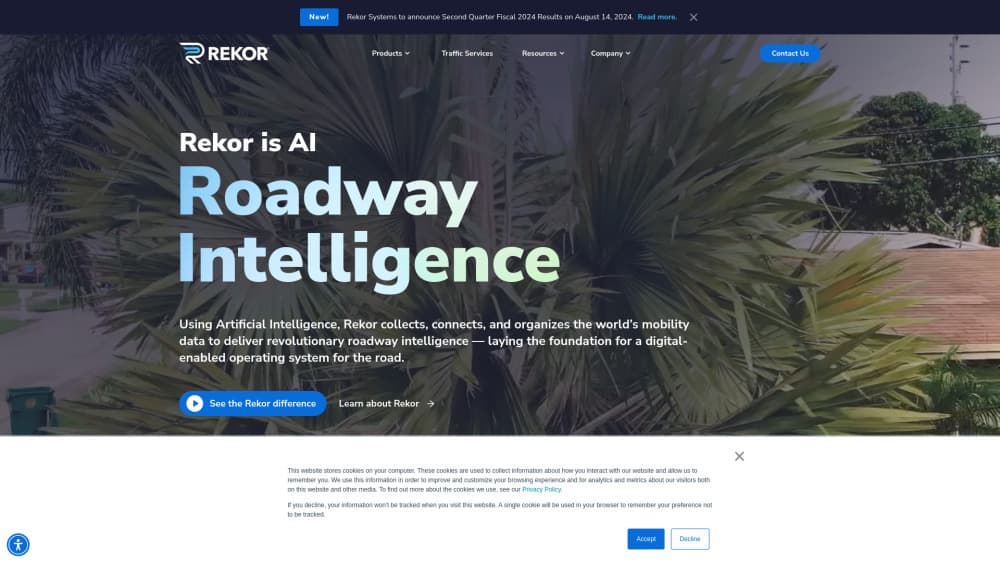
Rekor is a roadway intelligence platform from Rekor Systems that turns traffic and security cameras into license plate, vehicle, and traffic count data for road agencies, police, and businesses.
About Rekor - Roadway Intelligence
What Is Rekor
Rekor is a family of AI video tools that read roads. Point a camera at a street, a parking lot, or a highway shoulder, and the software pulls out plate numbers, vehicle make and model, speed, and vehicle class. Those results land in a web dashboard, an alert list, or a JSON response from an API.
The lineup splits by job. Rekor Scout handles license plate recognition (ALPR) and vehicle recognition on nearly any IP camera. Rekor Discover is the traffic study software for fixed or portable sensors, and it returns FHWA 13-bin counts. Rekor TrafficSight does the same study work from video files you upload, with no hardware at all. Rekor Command watches for incidents and pushes safety alerts to drivers. Rekor CarCheck sells the recognition engine as a REST API for developers.
Rekor Systems is a public company based in Columbia, Maryland, and trades on Nasdaq as REKR. Most of its customers are state DOTs, cities, police departments, and commercial sites with gates or lots. That customer base shapes how the company sells. Scout and CarCheck have published monthly plans, while Discover, Command, and the Edge camera hardware run on quotes. If you need a fixed count station on a highway, budget for a sales call and an installation crew, not a checkout page.
Plate data also comes with legal weight. Retention windows, audit trails, and who may query a hotlist depend on state rules, and Rekor leaves those policies to the buyer through configurable retention settings.
Getting Started
- Decide which product fits the job: Scout for plate alerts, Discover or TrafficSight for counts, CarCheck for code.
- Create an account or start the 14-day trial on Scout and CarCheck. Enterprise tiers start with a demo request.
- For Scout, install the agent on a Windows or Linux PC, add your camera stream, and draw the plate zone.
- Calibrate the lane or zone, load your alert lists, and set how long plate records stay in storage.
- Read results in the dashboard, push them to another system through Webhooks, or export counts as .PRN, .CSV, or .PDF.
Product Information
A quick look at Rekor - Roadway Intelligence's pricing, supported platforms, and performance.
Best for
The users, tasks, and scenarios where this tool fits best.
Users
- Traffic engineers and DOT staff
- Police analysts and investigators
- Small businesses and homeowners
- Developers
Tasks
- Short-term traffic counts
- Turning old footage into data
- Finding a car after an incident
- Automating violation notices
Scenarios
- Studying a corridor without closing a lane
- Sharing reads across agencies
- Watching a private driveway or lot
Key features
Plate and vehicle recognition on existing cameras
Scout runs on nearly any IP, traffic, or security camera, so the upgrade is software. It reads plates plus make, model, and color, and it keeps searching when a plate is dirty, tilted, or partly hidden.
FHWA 13-bin classification from video
Discover and TrafficSight deliver FHWA traffic classification, sorting each vehicle record into the 13 federal classes, then adding counts and speed. The output matches the format DOTs already submit, which saves a manual reclassification pass at the end of a study.
Traffic studies from uploaded video
TrafficSight skips hardware entirely. You upload footage, Rekor's team handles calibration and processing, and you download CSV files and reports within hours. The catch is turnaround: this is post-processing, not a live feed.
Real-time alerts and hotlists
Scout checks each read against custom, shared, and NCIC hotlists and fires an alert as soon as a match appears. Agencies can keep lists private or join a regional sharing network.
Vehicle recognition API and SDK
CarCheck takes a still image from a local file, a server, or a web URL and returns plate number, state, make, model, color, and vehicle orientation in JSON. The Vehicle Recognition SDK adds the same engine as a code library.
Incident awareness for highway operators
Rekor Command flags stopped vehicles, wrong-way drivers, and other events, then pushes alerts to roadside signs and traveler apps. Oregon DOT picked it in September 2026 to send safety alerts statewide.
Cloud or on-premise deployment
Data can sit in Rekor's AWS and GovCloud environment or on your own server. Retention runs from 5 days on Basic to 60 days on Pro, and Enterprise lets you set the window yourself.
Pros and cons
Pros
- Entry pricing is low and public: Scout Basic costs $12 per month per camera, and CarCheck starts at $40 per month for 2,500 API credits.
- Scout installs in about 20 minutes and works with cameras a site already owns, so pilots are cheap to run.
- Count data exports in .PRN, .CSV, and .PDF, and feeds Drakewell and MS2 without custom work.
- Recognition results come back as JSON through a REST API, and Webhooks let you act on a read without polling.
- Buyers can keep plate data on-premise, which helps agencies that can't send video to a vendor cloud.
Cons
- Discover, Command, and the Edge hardware have no published prices. You can't size a budget without talking to sales.
- The product is built for organizations with compliance staff. Retention limits and audit rules for plate data still land on you.
- Permanent count sites need hardware, power, and a 2 to 4 hour install for Edge Max, so the "no infrastructure" pitch only holds for portable or video-upload work.
- Accuracy depends on camera angle, lighting, and plate condition. A cheap camera pointed at a bad angle will underperform the demo footage.
Frequently asked questions
Rekor reads video from road cameras and turns it into structured data: plate numbers, vehicle attributes, counts, speed, and traffic class. Agencies use that data for studies, investigations, and compliance notices.
Related content
Explore related tools, skills, and articles for Rekor - Roadway Intelligence.
Rekor - Roadway Intelligence Alternatives

Odyssey 3
Odyssey · OtherOdyssey-3 is Odyssey's foundation world model. It simulates physics in real time, turns a prompt into an interactive environment, and adapts to robots, cars and games.

JarvisCore
Prescott Data · Coding · Productivity · OtherJarvisCore is an open source Python runtime where AI agents work as equal peers on an agent mesh, claim tasks from a shared ledger, and reach external services through a zero-trust broker.
Clef
Cloudflare · Business · OtherClef is Cloudflare's open-source decision model for Workers AI. It returns calibrated probabilities for typed questions, not generated text, so agents can classify, route, and act fast.