
ReSO AI
ReSO · Marketing · Business
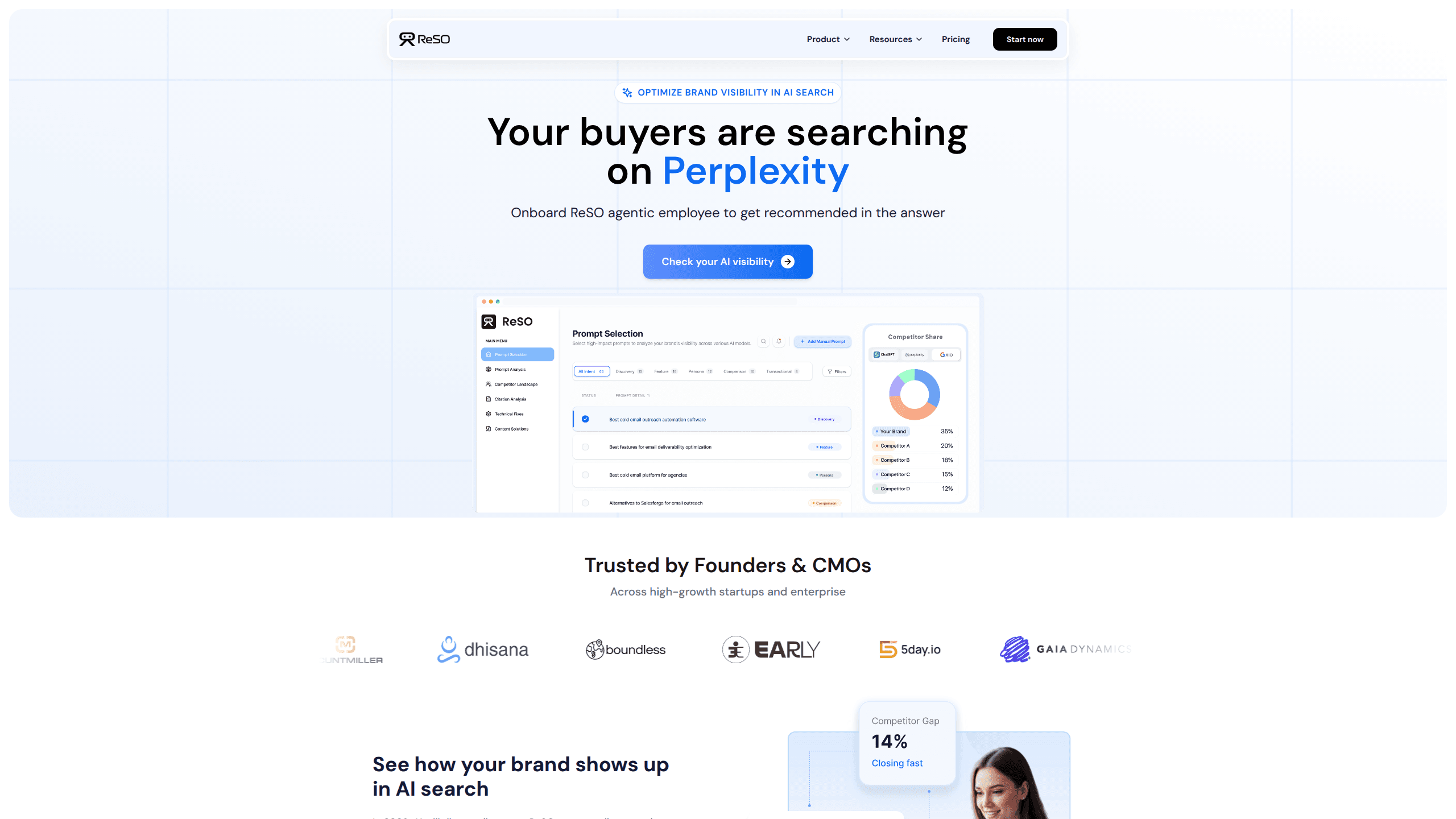
ReSO AI is a generative engine optimization platform that tracks how ChatGPT, Perplexity, and Google AI Overviews describe your brand, then points to fixes that raise citation odds.
About ReSO AI
What Is ReSO AI
ReSO AI is a web platform for generative engine optimization, usually shortened to GEO. It measures how often AI engines mention your brand when buyers ask category questions, then shows the content and site changes that would put you in more answers. Founders Swati Paliwal and Mohit Gupta launched it in October 2026 for B2B teams that sell through research-heavy funnels.
The product works like a standing audit. You give it a domain and a set of buyer prompts. ReSO scores your answer share against named competitors, lists the pages AI engines cite in your category, and flags technical issues that keep crawlers from reading your site. Paid plans add a publishing cadence with blogs, landing pages, and FAQ clusters written to be quoted.
The limits are mostly commercial. Paid access starts with a call, since there is no self-serve checkout. Engine coverage depends on the plan, as Claude, Copilot, and Gemini appear only at the custom tier. The free option is a one-time AISO report with six technical fixes and one blog, enough to test the diagnosis but not enough to track progress month over month.
Getting Started
- Start free or book a call, then add your domain.
- Choose the buyer questions you want to be visible for, and add the competitors you expect to meet in those answers.
- Read the baseline AISO report to see your current answer share and the prompts where you are absent.
- Work through the technical list or approve the content plan, depending on your plan.
- Recheck the dashboard on the schedule your plan allows, monthly at $599 and biweekly at the custom tier.
Product Information
A quick look at ReSO AI's pricing, supported platforms, and performance.
Best for
The users, tasks, and scenarios where this tool fits best.
Users
- B2B founders with a lean marketing team
- CMOs and growth leads
- Content marketers
- SEO teams adding AI search visibility to their remit
Tasks
- Auditing how a brand appears in AI answers
- Finding citation gaps
- Producing pages that get quoted
- Fixing technical blockers
Scenarios
- A competitor keeps appearing in recommendations for your category
- Launching a product into a category AI engines already answer
- Moving to a new domain or CMS
Key features
Prompt and intent discovery
ReSO builds its prompt set from buyer questions rather than keyword lists. Its intent model scores 30 or more signals per prompt, which helps separate early research from late-stage vendor comparisons. The free audit tracks 30 prompts, and paid plans expand that to 75 or more with custom entries.
AI visibility tracking and share of voice
Every report shows how often your brand appears in AI answers next to the competitors you named. Answer share is measured per engine and per prompt, so you can see where ChatGPT recommends you and Perplexity does not. Paid plans refresh this view monthly or biweekly.
Citation gap analysis
The platform lists the URLs and domains AI engines cite in your category and marks the ones you are missing from. A white gap view adds prompts where no vendor is cited yet, which is where a new page can claim a slot before competitors arrive.
Content built for citation
Paid plans include production, not only advice. ReSO writes blogs, landing pages, and FAQ clusters in formats that answer engines can lift and quote. The $599 plan covers five blogs a month and one landing page, and the custom tier connects the pipeline to your CMS so approved drafts ship without a handoff.
Technical AI readiness audit
The audit checks more than 500 factors that affect how AI crawlers reach and read a site. Free users get six fixes once. Paid users get ongoing work on schema, render and index problems, internal links, and crawler access.
Entity and authority signals
ReSO checks whether your brand name, product names, and descriptions stay consistent across pages, so engines resolve you as one company. Paid plans also review trusted-source alignment, and backlink work is available as an add-on.
Pros and cons
Pros
- Pricing is public: a free one-time audit, a $599 monthly plan, and a custom tier.
- Diagnosis and content production sit in the same place, which cuts the handoff between an audit and a fix.
- Competitor benchmarks are named, not aggregated into an industry average.
- Technical findings are specific enough to hand to a developer.
- Engine coverage includes the three systems most buyers use, ChatGPT, Perplexity, and Google AI Overviews.
Cons
- $599 per month is steep for a small team, and there is no self-serve checkout for paid plans.
- The free plan is a single report, so ongoing AI visibility tracking requires a paid contract.
- Claude, Copilot, and Gemini are tracked only at the custom tier, which leaves a gap for buyers who research in those tools.
- No public API is documented, so reporting runs through dashboards and calls instead of your own BI stack.
- Case study numbers come from ReSO, and no independent audit of the results is published.
Frequently asked questions
ReSO AI measures how your brand appears in AI-generated answers and then works on the content and technical issues behind that visibility. It covers prompt discovery, answer share against competitors, citation gaps, content production, and site fixes.
Related content
Explore related tools, skills, and articles for ReSO AI.
ReSO AI Alternatives

ngram 2.0
ngram · Video · Marketingngram 2.0 is an AI video generator for teams. It turns a prompt, a screen recording, or a product URL into a narrated explainer, product demo, or AI avatar video, and every scene stays editable.

shippedit.me
Krawlup · Marketing · Businessshippedit.me now redirects to Krawlup, a web platform that audits SEO, AEO and page speed every week, then hands the fixes to AI coding agents over MCP.

MePersona
MePersona, Inc. · Writing · Productivity · MarketingMePersona is an AI unified inbox for creators. It learns your voice, drafts replies to fan messages from 12 platforms, and sends only what you approve.