

Responsible AI Institute
Responsible AI Institute · Business
Responsible AI Institute is a nonprofit membership body that helps teams govern AI with shared frameworks, peer working groups, and independent TrustX verification.
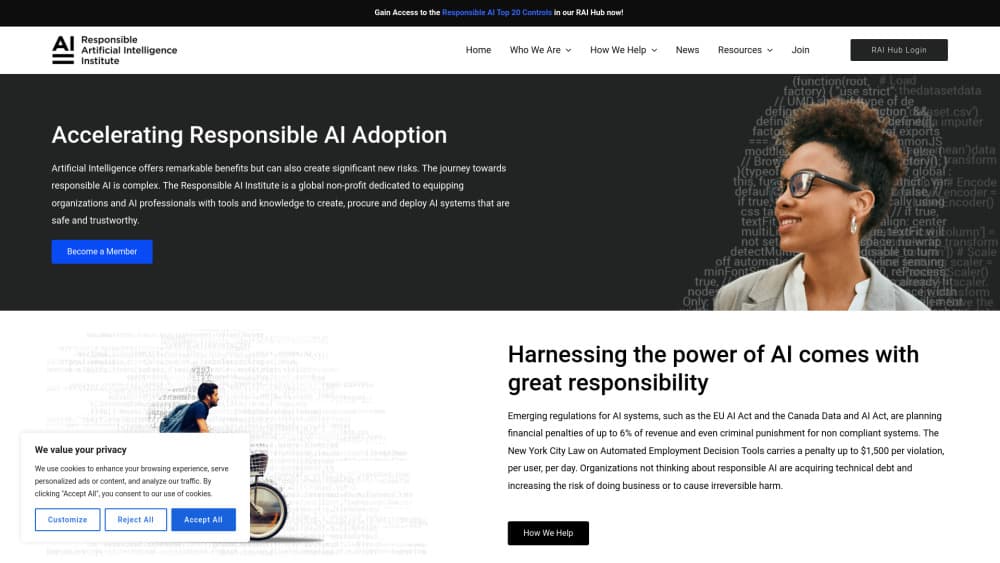
About Responsible AI Institute
What Is Responsible AI Institute
The Responsible AI Institute (RAI Institute) is an AI compliance nonprofit built as a do tank, not a think tank. It was founded in 2016, works out of Austin, Texas, and spends its time on the unglamorous part of AI: the controls, the evidence, and the paperwork that let a company defend an AI system to a board, a regulator, or a nervous enterprise customer. Its core product is an AI governance framework, a mapped set of controls rather than an opinion piece.
The problem it targets is simple. Plenty of teams can publish an AI principles page. Far fewer can prove those principles survived contact with production. RAI Institute sells the middle layer, a set of governance controls plus a peer community plus a third-party review, so a claim about responsible AI turns into something an auditor can read.
Its limits matter too. The useful depth sits behind a corporate membership, pricing isn't published, and verification runs through RAI's own TrustX framework rather than a government stamp. Small teams and solo builders will get more from the free tools than from the paid side.
Getting Started
- Create a free RAI Hub account if you want the community feed, guides, and webinar recordings without a sales call.
- Run the five-minute AI Maturity Assessment to get a rough read on where your governance work stands and which gaps to tackle first.
- Review the TrustX framework and the controls library, then decide whether your priority AI agent needs outside verification or just internal documentation.
- Contact the membership team for a corporate quote, and pick a tier based on how many agents you want verified and whether you need working group seats.
- If you go ahead with verification, collect your governance evidence, complete the assessment, and publish the resulting badge and evidence dossier for procurement and audit teams.
Product Information
A quick look at Responsible AI Institute's pricing, supported platforms, and performance.
Best for
The users, tasks, and scenarios where this tool fits best.
Users
- Chief risk officers and general counsel
- AI governance leads at mid-size and large enterprises
- Product and engineering managers shipping agentic features
- Consultancies and systems integrators
Tasks
- Preparing for an AI audit or procurement review
- Benchmarking an internal AI policy against peers
- Classifying risk for a new AI agent
Scenarios
- A financial services team facing model risk requirements
- A healthcare vendor answering hospital security questionnaires
- A company that has principles but no program
Key features
TrustX Agent Verification
TrustX is the institute's verification track for AI agents. It runs an AI risk classification on what a system actually does, works out which AI governance controls that workload needs, checks whether the controls exist and function, then issues a badge. The badge is the part that travels, since boards, auditors, and procurement teams can read it without hiring their own assessor.
AI Governance Controls Library
The library holds more than 1,700 controls built and maintained since 2016, mapped to NIST AI RMF, the EU AI Act, ISO 42001, SR 11-7, OWASP, and MITRE ATLAS. Teams pull the controls that match their system instead of rewriting a policy from a blank page. Mapping to named standards is the practical value here, because it cuts the translation work before an audit.
Free AI Maturity Assessment
The AI maturity assessment takes about five minutes and produces a read on current governance practice plus suggested next steps. It's a diagnostic, not a certification, so treat the output as a planning document. For a team that has never measured its AI compliance posture, it's the cheapest way to start.
RAISE Pathways Certification
RAISE Pathways is the structured responsible AI certification route, split into Foundation, Advanced, Domain-Specific, and Executive tracks. Each track runs through maturity evaluation, framework implementation, training, and a credential listed on the Responsible AI Registry. The domain tracks are aimed at regulated industries where generic guidance tends to stall.
Member Working Groups and Roundtables
Corporate members get seats in industry working groups, executive roundtables, and peer forums. The format is deliberately vendor free, which is the point: governance leads can say what failed in their own program without a sales deck appearing afterward. Working group output also feeds back into the published frameworks.
Sector Frameworks for Finance and Health
TrustX Finance and TrustX Health adapt the core framework to sectors with heavier regulatory load. Finance version handles model risk expectations, health version handles clinical and patient data concerns. Both keep the same four-step structure, so a team that learned the core framework doesn't start over.
Pros and cons
Pros
- Independent nonprofit status removes the obvious conflict of interest that shows up when a vendor audits its own product.
- Controls are mapped to six named standards, which shortens the work of proving alignment during procurement or regulatory review.
- A free individual membership and a free maturity assessment let a team test the material before asking for budget.
- Sector frameworks go past generic principles and name the controls that finance and healthcare reviewers actually look for.
Cons
- Corporate pricing isn't published, so budgeting requires a sales conversation and a wait for a quote.
- Verification follows RAI's own TrustX framework, which means the badge is credible but not a statutory certification in any jurisdiction.
- The heaviest material sits behind membership, so a solo developer or a tiny startup will hit the paywall quickly.
Frequently asked questions
It gives organizations AI governance controls, peer working groups, certification pathways, and independent verification for AI agents. The output is documentation and third-party evidence, not software you install.
Related content
Explore related tools, skills, and articles for Responsible AI Institute.
Responsible AI Institute Alternatives

Knocket
Knocket (Tencent RTC team) · Productivity · Business · ChatbotKnocket is a free live chat and contact page tool that lets visitors message you from your website, app, or a shareable link, with every reply handled from Telegram or one inbox.

shippedit.me
Krawlup · Marketing · Businessshippedit.me now redirects to Krawlup, a web platform that audits SEO, AEO and page speed every week, then hands the fixes to AI coding agents over MCP.

Ayven
Alknoma · Productivity · BusinessAyven is an AI control centre by Alknoma that turns a plain-language goal into a dated plan, hands the work to your people and AI agents, and asks for your approval only when the call is yours.