

Retell AI
Retell AI · Voice & Language
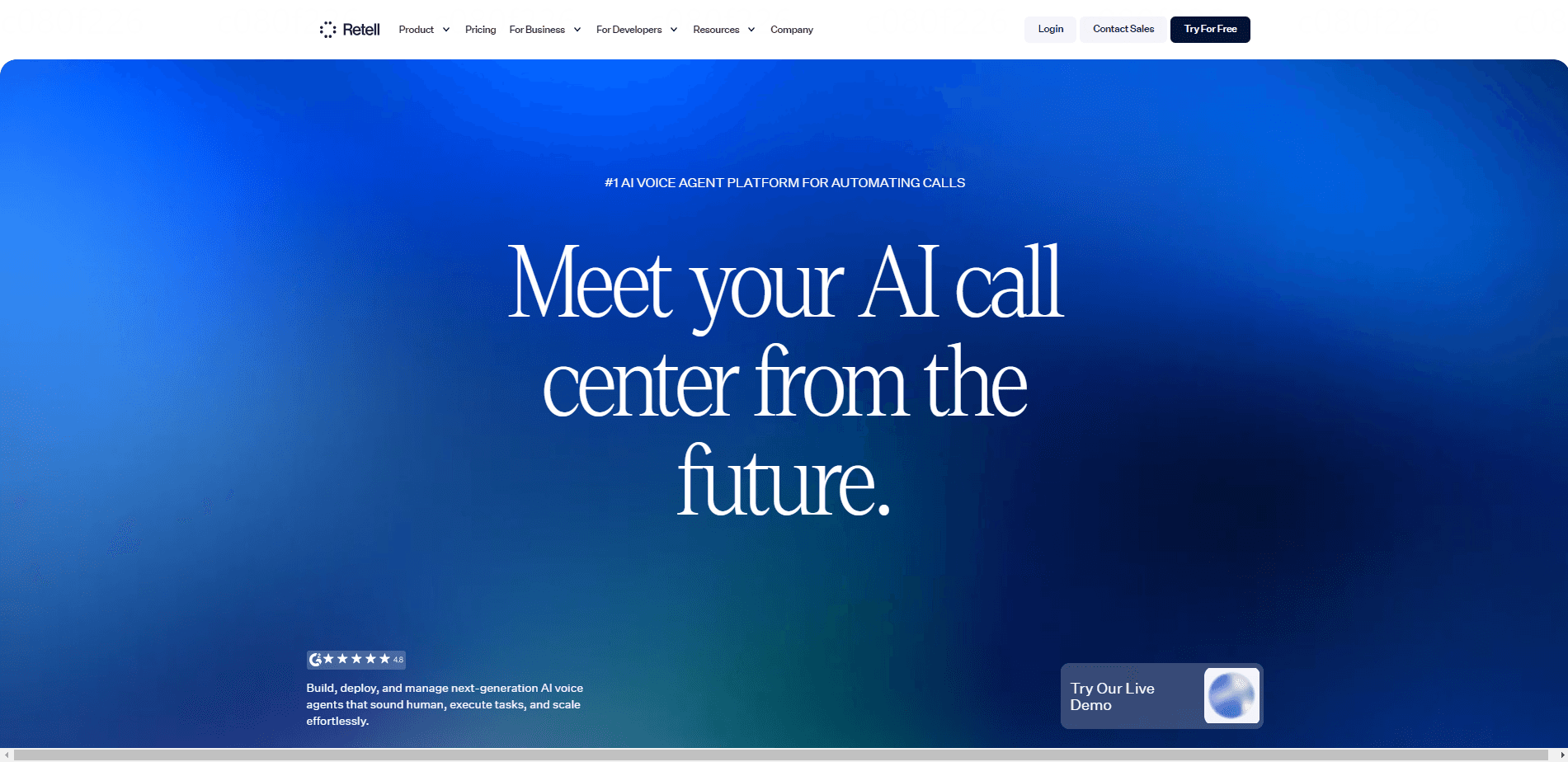
Retell AI is a voice AI platform for building AI phone agents that answer inbound calls, run outbound calls, book appointments, and hand off to people, with usage billed per minute.
About Retell AI
What Is Retell AI
Retell AI is a platform for putting an AI voice agent on a real phone line. You pick a model, a voice, and a script or a visual call flow, then attach a number and let it talk to callers. It handles the parts that usually need a telephony engineer: speech recognition, turn taking, interruptions, call transfer, and the recording you keep afterward.
The work it removes is the assembly. Most teams that want a conversational AI layer on their phone lines end up gluing a speech to text service, a language model, a voice provider, and a phone carrier together. Retell sells that stack as one meter, with a dashboard for testing and monitoring. What you get is closer to a small AI call center than a phone tree. The trade is that you pay per minute for every layer, and the bill grows with call volume rather than seats.
Two limits matter before you sign up. Call quality depends on the model and voice you choose, so a cheap configuration sounds different from an expensive one in ways callers notice. And the platform is a builder, not a finished receptionist. Someone has to write the prompts, test the flows, and keep them current.
Getting Started
- Create an account at retellai.com. The pay as you go plan starts with $10 in free credits, so you can test before adding a card.
- Build an agent. Start from a template or a blank conversation flow, write the prompt, and choose an LLM plus a voice from the built-in providers.
- Test it. Run simulation tests against sample conversations, then take a web call in the browser to hear how the agent handles interruptions and pauses.
- Buy a number or connect your own telephony. Retell sells US and international numbers through Twilio and Telnyx, and you can bring a SIP trunk if you already have a carrier.
- Publish and watch the logs. Calls land in the dashboard with transcripts, recordings, latency data, and any fields you extract after the call.
Product Information
A quick look at Retell AI's pricing, supported platforms, and performance.
Best for
The users, tasks, and scenarios where this tool fits best.
Users
- Support and front desk teams
- Appointment-driven businesses
- Developers building voice products
Tasks
- Answering inbound calls after hours
- Running outbound campaigns
- Booking and moving appointments
- Screening and routing
Scenarios
- A clinic that misses calls during peak hours
- A sales team testing outbound before hiring
- A support line with predictable questions
Key features
Conversation Flow Builder
The visual editor lets you wire an agent together from nodes: speak, listen, branch, call a function, transfer. You can also write a single long prompt and let the model steer. Flows are easier to audit when compliance asks what the agent will say, and single prompt agents are faster to iterate on. Most teams mix both, using flows for the opening and a prompt for the open-ended middle.
Model and Voice Selection
You choose the language model behind each agent, with GPT, Claude, and Gemini options priced per minute, plus realtime speech to speech models for lower latency. Voices come from ElevenLabs, Cartesia, OpenAI, Minimax, Fish, and Retell's own set, ranging from about a cent and a half to ten cents a minute. The cheap combinations work for reminders. They sound thin on a sales call.
Knowledge Base and Memory
Upload documents, help center articles, or FAQs and the agent can answer from them, billed at half a cent per minute on top of the base rate. Contact memory keeps details across calls so a returning caller doesn't repeat an account number. Conversation memory, added in late 2026, carries context between sessions, which matters for multi-step requests like a repair that spans several calls.
Telephony and Channels
Numbers come through Twilio or Telnyx at $2 a month, and you can connect a carrier you already use over SIP at no extra charge. Beyond voice, the same agent can run as a chat agent, answer SMS, or sit behind a website widget. International numbers are available in the countries listed on the pricing page, with per-minute call rates that vary by destination.
Testing and Quality Review
LLM simulation runs scripted conversations against the agent before it goes live, so you catch loops and wrong answers without burning phone minutes. A/B testing splits traffic between agent versions, and alert rules tell you when containment or latency drifts. AI Quality Assurance scores calls against your own criteria for the first 100 minutes free, then at ten cents a minute.
API, Webhooks, and Monitoring
Every action in the dashboard has an API equivalent, and there are SDKs plus an MCP server for wiring agents into other tools. Webhooks push call events and post-call extraction results to your CRM or helpdesk. Latency is broken down by component, which is the number that decides whether a caller waits or hangs up.
Pros and cons
Pros
- One meter covers speech recognition, the model, the voice, and telephony, so you skip four vendor contracts.
- Pay as you go starts at $0 with $10 in credits, and there's no platform fee or annual commitment.
- You can pick the model and voice per agent, which lets you trade cost against call quality instead of accepting one default.
- Call transfer, calendar booking, batch dialing, and SMS all live in the same product, so a receptionist flow doesn't need extra tools.
- The API, SDKs, and MCP server are documented well enough that a developer can ship a working agent in an afternoon.
Cons
- Costs stack per minute. A premium model with an ElevenLabs voice plus add-ons can run several times the headline rate, and busy lines add up fast.
- The platform builds agents, it doesn't staff them. Expect real work on prompts, testing, and revisions before calls sound right.
- Advanced compliance items like HIPAA, SSO, and role-based access sit behind the custom enterprise plan, which needs a sales call.
- There's no mobile app. Everything runs in a browser, so monitoring on the go means opening the dashboard on a phone.
Frequently asked questions
Retell AI runs AI voice agents on phone calls. Teams use it for inbound reception, appointment booking, lead qualification, outbound reminders, and support lines, with transcripts and call data landing in a dashboard. It also handles chat and SMS through the same agent setup.
Related content
Explore related tools, skills, and articles for Retell AI.
Retell AI Alternatives

Foley
Hanamori Labs, LLC · Voice & Language · Productivity · AI AssistantFoley is a voice to-do list that turns a spoken sentence into a filed task, complete with project, date and time, then helps you plan the day around what is already there.

HireKey
HireKey · Voice & Language · Productivity · LeaningHireKey is an AI job search copilot built by a former tech recruiter. It checks role fit, tailors resumes, runs interview practice and tracks every application.

Fluence
Yay Software (Yannick Huchard) · Writing · Voice & Language · ProductivityFluence is an Android app that reads PDFs, EPUBs, Word files and web articles aloud, follows each sentence as it speaks, and answers questions about the text on the phone itself.