

RevuX
RevuX · Coding
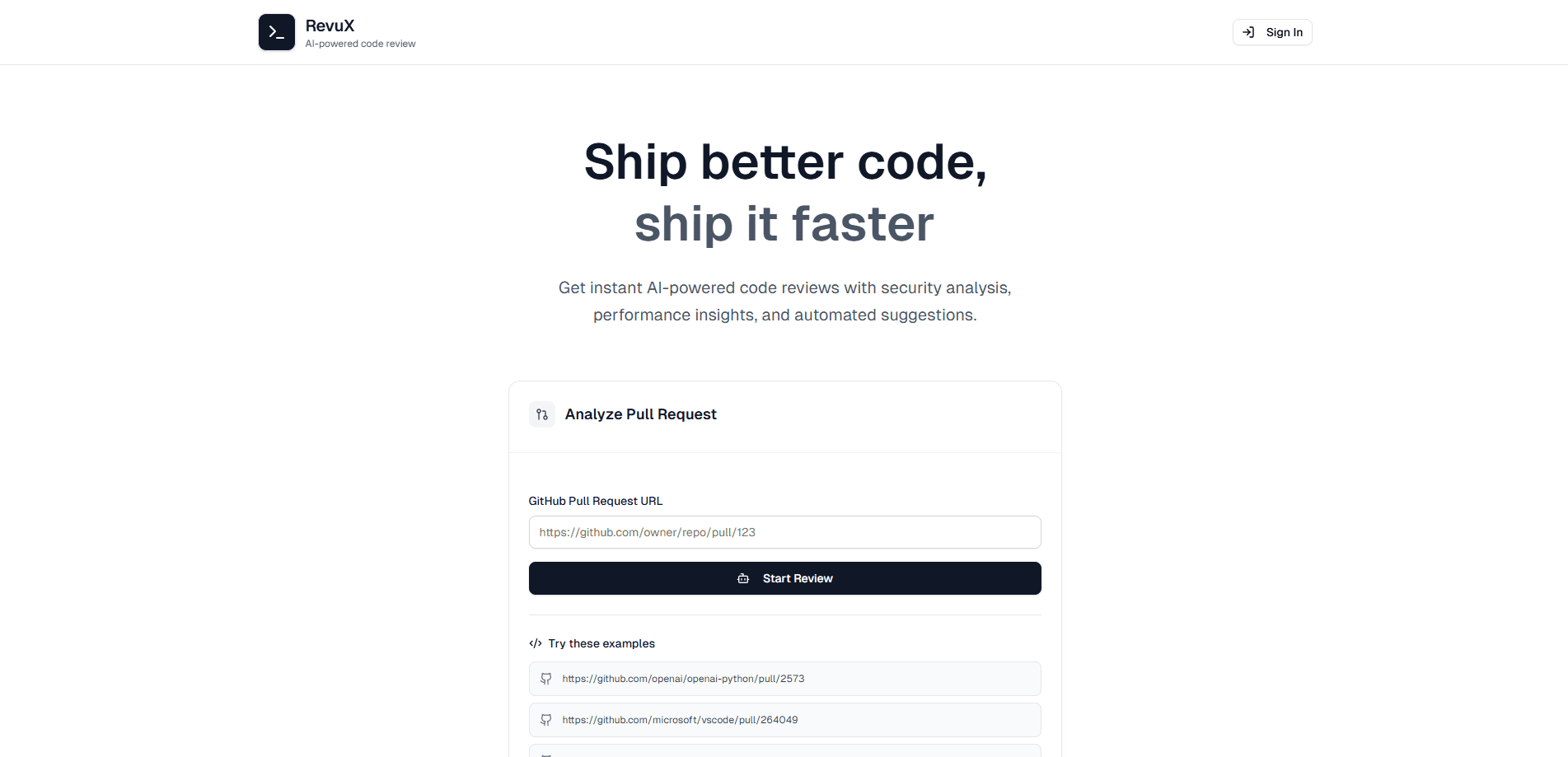
RevuX is an AI code review tool for GitHub pull requests. It scans each diff, flags security and performance risks, and suggests fixes in under two minutes.
About RevuX
What Is RevuX
RevuX is an AI code review platform that plugs into GitHub pull requests. When a pull request goes up, it reads the diff instead of the whole repository, then posts inline comments about bugs, risky patterns, and slow code. The team behind it built the tool around a single tag: mention @revux on a PR and the review starts on its own.
The pitch is speed with less noise. Most review tools either flood a PR with low-value alerts or take long enough that the feedback arrives after the merge. RevuX aims for the middle: comments that point to a real problem in the changed lines and finish before reviewers pick up the thread.
Its limits are worth knowing up front. GitHub is the only supported platform today, with GitLab listed as coming soon, so teams on other hosts can't use it yet. Advanced analysis depends on how much context the tool can read from the repo, and every suggestion still needs a human to confirm before it ships.
Getting Started
- Sign in at revux.dev and authorize repository access through the GitHub integration.
- Open a pull request, or tag @revux on one you already have.
- Let the AI analyze the diff and post its findings within minutes.
- Review the inline comments, apply or dismiss the fixes, and resolve any conflicts it flags.
- Re-run the review on the updated PR as needed.
Product Information
A quick look at RevuX's pricing, supported platforms, and performance.
Best for
The users, tasks, and scenarios where this tool fits best.
Users
- Small engineering teams
- Solo developers and founders
- Security-minded teams
Tasks
- Reviewing pull requests
- Security analysis
- Conflict detection
Scenarios
- High-volume PR queues
- Distributed teams
- Adding guardrails without new process
Key features
AI code review on the diff
RevuX reads the changed lines of a pull request and posts inline comments on them. It points to quality issues, style problems, and likely bugs, and it keeps the comments tied to specific lines so a reviewer can act on them without hunting through the full file.
Security analysis
The tool flags risky patterns and known vulnerability shapes inside the diff. Instead of a separate scan that runs on a schedule, the check happens as part of the review, which means a dangerous change can be caught before it merges.
Performance insights
RevuX notes hotspots and likely bottlenecks in the proposed code. That helps a reviewer tell the difference between a change that works and one that works but drags on the app, which is easy to miss in a fast review.
Smart conflict resolution
It detects merge conflicts early and suggests ways to resolve them. Catching conflicts at review time rather than at merge time avoids the scramble that happens when two branches collide late in the cycle.
Deep analysis with architectural signals
Beyond line-level comments, RevuX uses complexity metrics and architectural signals to surface risks that a plain linter would skip. That layer is meant for problems that only show up when you look at how the change fits the wider codebase.
Privacy controls
RevuX states that it encrypts code in transit and at rest and does not permanently store complete source files. It keeps analysis results and metadata for service improvement, and offers account-level controls, including deletion, so teams can align it with their own data rules.
Pros and cons
Pros
- Fast turnaround: reviews land in under two minutes, so feedback arrives while the change is still fresh.
- Diff-based focus: comments stay on the changed lines, which cuts the noise that plagues full-file scans.
- Free to start: the tool has run on a free basis, so a team can test it on real PRs before committing budget.
- Conflict and architectural checks: goes past basic linting by flagging merge conflicts and design-level risk.
Cons
- GitHub only: teams on GitLab, Bitbucket, or other hosts can't use it yet, since those integrations aren't live.
- No published pricing: with no public price list, teams can't plan costs without asking the vendor.
- No documented public API: it can't be wired into a custom pipeline or a larger toolchain through an API.
- Suggestions need review: an AI comment can miss project context, so a human still has to confirm each fix.
Frequently asked questions
RevuX performs AI code reviews on GitHub pull requests. It reads the diff, flags quality, security, and performance issues, and suggests fixes, all posted as inline comments.
Related content
Explore related tools, skills, and articles for RevuX.
RevuX Alternatives

Base Code
Base44 (Wix) · Coding · ProductivityBase Code is a shared cloud development environment from Base44. Teammates describe changes to an existing GitHub codebase in chat, preview them live and send them back as pull requests.

Google EmbeddingGemma 2
Google DeepMind · Writing · Image · CodingGoogle EmbeddingGemma 2 is a 740M-parameter open model that turns text, code, images, audio, and video frames into vectors in one 768-dimension space, running on phones and laptops.

GitGlow
GitGlow · Coding · ProductivityGitGlow is a local-first desktop Git client that lets independent developers review their own code and their AI agents' changes in one place before shipping.