

Reworkd AI
Reworkd · Coding
Reworkd AI is an LLM-powered AI web scraper that built and ran scrapers at scale, turning websites into structured data. It shut down on February 6, 2025.
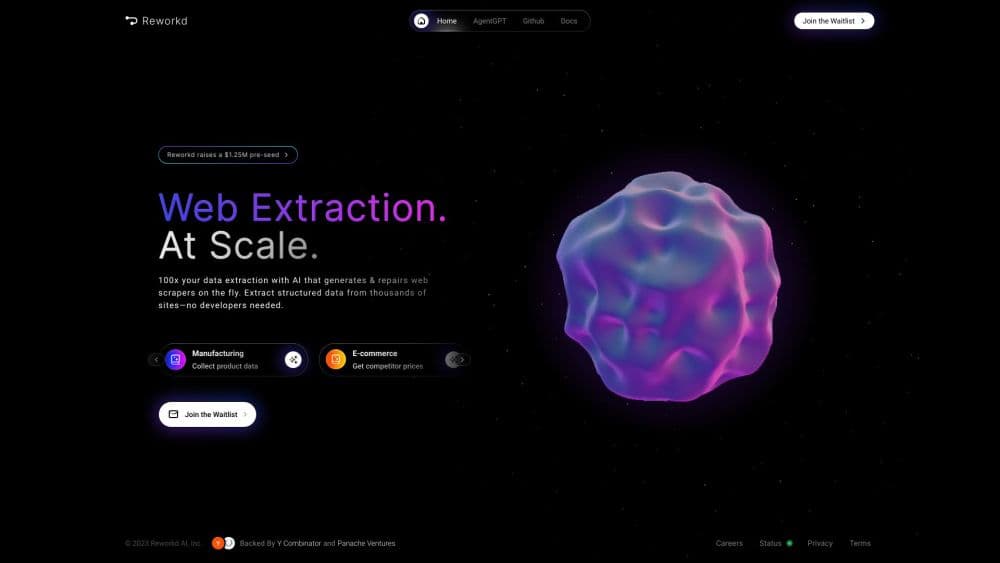
About Reworkd AI
What Is Reworkd AI
Reworkd AI is a web data extraction platform that used large language models to build scrapers and pull structured data from websites. That LLM web scraping approach meant you described the fields you wanted through a schema instead of writing selectors by hand, and the agents figured out how to collect them across a site and its subpages. Structured data scraping at this scale was the whole point, and the company targeted teams that needed data at volume, from product catalogs to pricing tables to reviews.
The framing was breadth. Reworkd said its customers extracted millions of rows to train domain-specific models and feed existing data pipelines, work that usually calls for a team of engineers maintaining brittle scrapers. Reworkd tried to collapse that into a schema plus a source list.
The biggest thing to know is that the product is gone. Reworkd announced it was sunsetting the platform on February 6, 2025, and pointed users to a migration contact. The team is also behind AgentGPT, an open source autonomous agent project on GitHub, and that one still runs. The commercial scraping product does not. That split matters if you land here expecting a working tool.
Getting Started
- Create an account and set up a group, which is the container for the URLs you want to scrape.
- Define a schema, the structured list of fields you want the scraper to return.
- Add source URLs to the group. Each URL becomes a job that flows through category, listing, and detail pages.
- Let the LLM build and run the scraper. Jobs enqueue child pages as they crawl, and runs report status and outputs.
- Export the results through the UI, the API, or a bulk export, then schedule the group to re-scrape on a set interval.
Product Information
A quick look at Reworkd AI's pricing, supported platforms, and performance.
Best for
The users, tasks, and scenarios where this tool fits best.
Users
- Data teams at startups
- Machine learning engineers
- Developers testing an idea
Tasks
- Building a product catalog from retailer sites
- Collecting reviews and ratings at volume
- Feeding a data pipeline on a schedule
- Enriching an existing dataset
Scenarios
- A research sprint where you need a few hundred thousand rows fast
- Keeping an internal dataset fresh
- Evaluating LLM scraping before you commit
Key features
LLM-Built Scrapers
The core idea was that you described the data you wanted in a schema, and the platform generated the scraper rather than making you write selectors. That lowered the bar for sites with shifting markup, where CSS selectors break the moment a redesign ships. For teams without a dedicated scraping engineer, it replaced weeks of setup with a form to fill in.
Groups and Schema-Driven Jobs
A group bundled source URLs that shared one schema and scraping frequency. Inside a group, each URL became a job that the platform broke into stages: a category page, then listing pages, then detail pages. That structure let one definition cover a whole site and its subpages, so scaling from ten URLs to ten thousand did not mean redoing the work.
Scheduled Re-Scraping
Groups could be scheduled to run again on a set interval, which is what separated Reworkd from a one-time crawl. Data pipelines need fresh records, and scheduling turned a manual scrape into a recurring one. The results came back as a deduplicated view, updated each time the group re-ran.
Exports and API
Scraped data left the platform three ways: bulk exports through the UI, an API for pulling outputs programmatically, and support for file downloads mid-scrape. The API is what made Reworkd usable inside an existing pipeline rather than as a destination you had to visit. Outputs were deduplicated and materialized per group, so consumers got a clean view instead of raw duplicates.
Session and Cookie Handling
Some sites gate content behind logins or store state in cookies and local storage. Reworkd exposed API endpoints to get and set cookies and local storage, so scrapers could reach pages that a plain HTTP client never would. That mattered for anything behind an account wall, and it's a common gap in simpler scraping tools.
Underlying Tech Stack
The platform ran on a streaming architecture, and the team wrote publicly about scaling real-time extraction with agentic AI and GenAI. Reworkd's co-founder described handling terabytes of data per day while avoiding blocks, which set the design target. It tells you the intended user was a team pushing serious volume, not someone grabbing a table once.
Pros and cons
Pros
- Schema-driven setup meant no hand-written selectors, so non-engineers could get a working scraper.
- One group covered many similar sites, which cut the cost of scaling across storefronts or directories.
- Scheduled re-scraping and deduplicated outputs fit real pipelines instead of one-off crawls.
- API exports and cookie handling made it work on gated sites and inside existing workflows.
- A free tier let teams test output quality before paying.
Cons
- The product is discontinued. Reworkd shut the platform down on February 6, 2025, so it cannot be used for new work.
- Migration is on the user. Reworkd pointed to a support contact for moving off, which means existing pipelines needed a replacement solution.
- Pricing was metered on top of the subscription, so costs climbed with volume and page counts rather than staying flat.
- The LLM approach suits broad extraction, but niche edge cases still needed review, since automated scraping on unusual layouts can return noisy results.
Frequently asked questions
Reworkd AI built and ran web scrapers with large language models. You defined a schema for the fields you wanted, added source URLs, and the platform collected structured data across a site and its subpages. Teams used it to assemble product catalogs, reviews, and other datasets at scale.
Related content
Explore related tools, skills, and articles for Reworkd AI.
Reworkd AI Alternatives

Base Code
Base44 (Wix) · Coding · ProductivityBase Code is a shared cloud development environment from Base44. Teammates describe changes to an existing GitHub codebase in chat, preview them live and send them back as pull requests.

Google EmbeddingGemma 2
Google DeepMind · Writing · Image · CodingGoogle EmbeddingGemma 2 is a 740M-parameter open model that turns text, code, images, audio, and video frames into vectors in one 768-dimension space, running on phones and laptops.

GitGlow
GitGlow · Coding · ProductivityGitGlow is a local-first desktop Git client that lets independent developers review their own code and their AI agents' changes in one place before shipping.