

RivalOut - Rival Company Analysis and Comparison Platform
RivalOut · Marketing
RivalOut is a competitive intelligence platform that scores rivals on traffic, SEO and social, builds battlecards, and emails alerts when a competitor moves. Plans start at $39/mo.
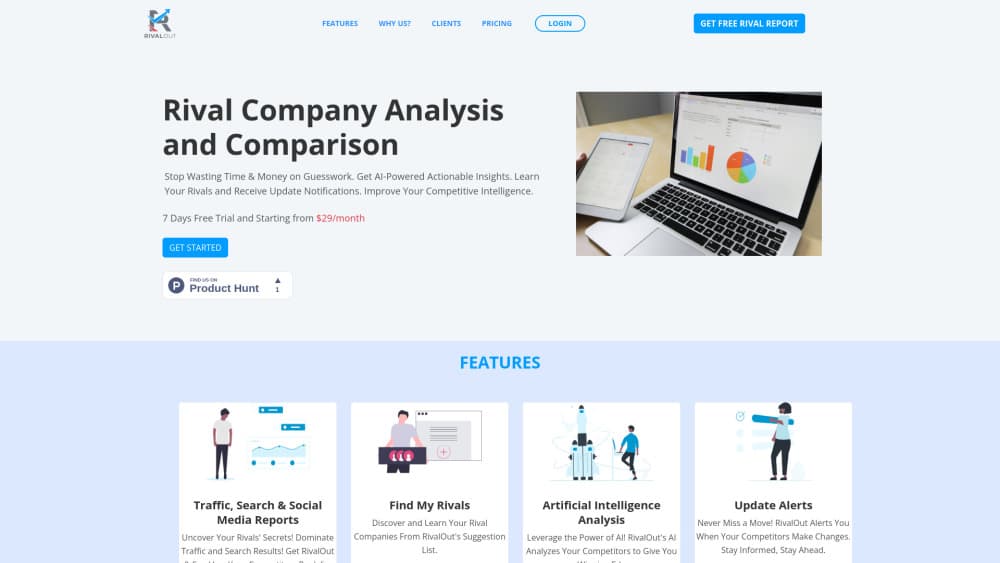
About RivalOut - Rival Company Analysis and Comparison Platform
What Is RivalOut
RivalOut is a competitor analysis tool built for people who don't have a research team. You add your domain and a handful of rivals, and the platform returns a scored report: visits, time on site, global rank, audience size, organic traffic and social reach, with the winner of each metric marked.
Most small teams handle competitor tracking by hand. Someone opens a traffic estimator, then an SEO tool, then four social profiles, copies numbers into a spreadsheet, and repeats the routine next week. RivalOut replaces that loop with one scheduled run and a digest that lands in your inbox. It sits in the competitor tracking software category rather than in the full SEO suite camp, and RivalOut pricing starts at $39/month.
The limits are worth knowing up front. Every plan caps how many competitors you can follow, so a company watching 30 rivals needs the Enterprise tier and a conversation with sales. Alerts cover traffic, SEO, social, campaigns and on-site positioning changes. They don't watch review sentiment, job postings or ad spend, so those signals still require another tool.
Getting Started
- Create an account at app.rivalout.com with your work email and confirm the one-time code.
- Enter your own domain, then add the competitors you want to track. Team plans and above can also let RivalOut suggest rivals you haven't listed.
- Pick the alert triggers you care about. Campaign launches, traffic and SEO shifts, website and positioning changes, and performance declines each switch on separately.
- Open the first report, read the scorecard against industry averages, then export the competitor battlecards or wait for the weekly digest.
Product Information
A quick look at RivalOut - Rival Company Analysis and Comparison Platform's pricing, supported platforms, and performance.
Best for
The users, tasks, and scenarios where this tool fits best.
Users
- Solo founders and indie marketers
- Marketing and product teams
- Agencies and consultants
Tasks
- Replacing the weekly manual check
- Benchmarking your own site
- Preparing sales battlecards
- Catching a rival's campaign early
Scenarios
- Positioning research before a launch
- Monthly client reporting at an agency
- Ongoing monitoring without an analyst
Key features
Competitive Scorecards
Every tracked rival is scored against your domain on visits, time on site, global rank, audience, organic traffic and social following, with the leader of each metric marked. The scorecard is the core artifact: one table answers who is ahead and by how much before you read anything else.
Competitor Battlecards
Each competitor gets a head-to-head card built from scorecard data, ready to export or print. Sales and marketing teams use these competitor battlecards to prepare for calls where a buyer names a rival, without asking an analyst for a fresh deck.
Threshold-Based Alerts
RivalOut compares every new report against the previous one and only writes when a trigger crosses its line. Four triggers are available: campaign launches, traffic and SEO shifts, website and positioning changes, and performance declines. The point of these competitor alerts is signal, not volume. Email alerts ship on every plan; Team and above can also POST each alert as JSON to a webhook.
Traffic, SEO and Social Monitoring
The weekly run collects visit estimates, keyword footprint and ranking movement, plus social growth, posting frequency and engagement for each rival. For SEO competitor analysis that's a tracking layer, not a full research suite: you see that a competitor gained rankings, then use a keyword tool to find out why.
AI Action Plans
Each report closes with a short list of next steps generated from the gaps between you and the rivals you track. Treat it as a prompt for the team meeting rather than a strategy document, since the recommendations only know what the tracked metrics show.
Competitor Discovery and Industry Benchmarks
The platform proposes rivals you didn't list, which matters in crowded categories where the fastest-growing competitor is often one you haven't heard of. Competitor benchmarking puts your numbers next to sector averages, so a decline looks different when the whole market is down.
Agency Workspaces and White-Label Reports
Agency plans split tracking into 10 client workspaces with 3 competitors each, then apply your branding to reports and schedule PDF exports. That structure keeps client data separate without buying ten subscriptions.
Pros and cons
Pros
- One weekly digest replaces a dozen manual checks across traffic, SEO and social tools.
- Alerts fire on thresholds, so a quiet week stays quiet instead of filling your inbox.
- Battlecards come from the same data as the scorecard, which keeps sales material consistent.
- Entry pricing is low for the category: $39/mo covers 3 competitors, and annual billing takes 30% off.
- White-label client reports at $199/mo cost far less than the enterprise platforms RivalOut positions against.
Cons
- There's no free plan, only a 7-day trial, so you can't keep a dormant account running at zero cost.
- Competitor caps are tight: 3 on Solo and 10 on Team, which pushes anyone tracking a broad market into a sales conversation.
- Monitoring covers traffic, SEO, social and site changes. Pricing pages, ad spend and review sentiment sit outside the tracked signals, so a price cut may only surface through a positioning change alert.
- There's no public API. Webhooks arrive with Team, and custom connections are an Enterprise topic.
Frequently asked questions
Traffic estimates, keyword rankings, social growth and engagement, plus changes to a competitor's website and positioning. Each report compares new numbers against the previous run and scores your domain beside every rival.
Related content
Explore related tools, skills, and articles for RivalOut - Rival Company Analysis and Comparison Platform.
RivalOut - Rival Company Analysis and Comparison Platform Alternatives

ngram 2.0
ngram · Video · Marketingngram 2.0 is an AI video generator for teams. It turns a prompt, a screen recording, or a product URL into a narrated explainer, product demo, or AI avatar video, and every scene stays editable.

shippedit.me
Krawlup · Marketing · Businessshippedit.me now redirects to Krawlup, a web platform that audits SEO, AEO and page speed every week, then hands the fixes to AI coding agents over MCP.

MePersona
MePersona, Inc. · Writing · Productivity · MarketingMePersona is an AI unified inbox for creators. It learns your voice, drafts replies to fan messages from 12 platforms, and sends only what you approve.