

Rocket Journal
HealthRx Ventures Private Limited (Rocket Health) · Voice & Language · AI Assistant
Rocket Journal is a voice-first AI journaling app and mood tracker by Rocket Health that turns spoken thoughts into emotional insights and guided reflections.
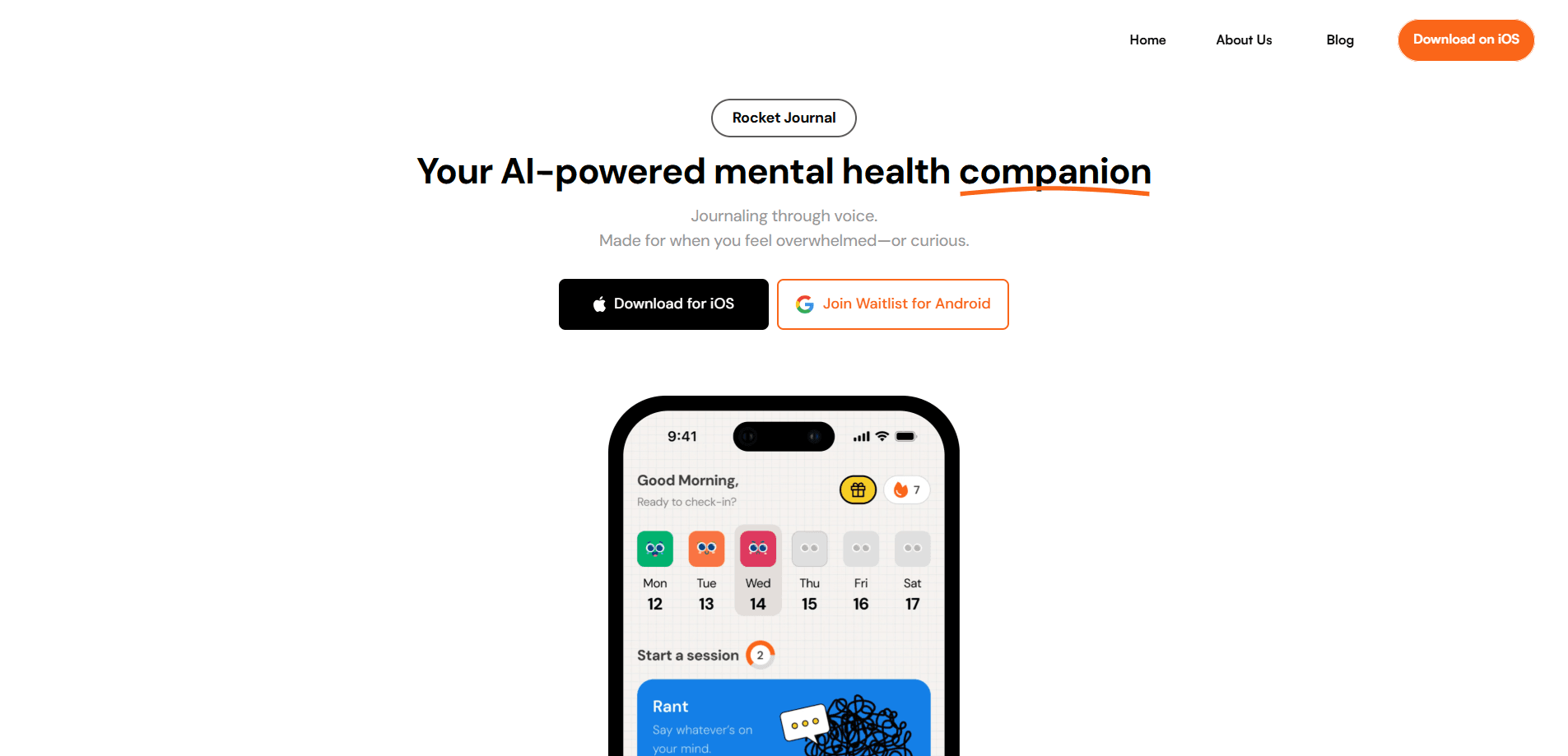
About Rocket Journal
What Is Rocket Journal
Rocket Journal is an AI diary built around talking rather than typing. You speak your thoughts out loud, and the app transcribes them, listens without judgment, and turns each entry into short insights about your mood and the themes that keep coming up. It comes from Rocket Health, a Bengaluru-based digital health company that runs therapy, psychiatry, and diagnostics services, so the app is designed as a companion to professional care rather than a replacement for it.
The idea behind it is simple. Typing out a journal entry takes energy, and most people quit within a week. Speaking takes seconds, which makes a daily check-in far easier to keep. The app offers two paths: Rant Mode for raw, unfiltered venting when you just need to get something off your chest, and Reflect Mode for guided prompts when you want structure.
It is not therapy, and the app says so plainly. The insights are suggestions for self-reflection, not clinical advice. If you are dealing with serious mental health concerns, this mental health app works alongside a licensed professional, not instead of one.
Getting Started
- Download Rocket Journal from the App Store and create an account with an email address.
- Choose your mode: Rant Mode for freeform voice entries or Reflect Mode if you want guided prompts to structure your reflection.
- Speak your entry, or type it if you would rather not talk. Sessions run about five minutes.
- Read the AI insights that follow, which highlight emotional themes, recurring thoughts, and shifts in your mood.
- Check the progress view to see streaks and longer-term patterns, then delete any data you no longer want with the built-in controls.
Product Information
A quick look at Rocket Journal's pricing, supported platforms, and performance.
Best for
The users, tasks, and scenarios where this tool fits best.
Users
- People who think out loud
- New journalers
- Therapy clients
Tasks
- Evening wind-down
- Emotional check-ins
- Spotting recurring thoughts
Scenarios
- Processing a rough day
- Building a daily habit
- Preparing for therapy
Key features
Rant Mode
Rant Mode is the app's freeform space for saying whatever is on your mind, messy and unfiltered. You speak, the AI listens, and it responds with the kind of warm acknowledgment you would get from a patient friend. There are no prompts to follow and no structure to maintain, which makes it the fastest way to unload when emotions are running high.
Reflect Mode
Reflect Mode trades freeform venting for guided prompts that nudge you toward deeper self-reflection. Each prompt gives your entry a direction, so instead of circling the same complaint you end up examining what sits underneath it. You can speak your answers or type them, and the app keeps a record you can revisit.
AI Insights
After you record, the app analyzes your entry and surfaces emotional themes, recurring thoughts, and takeaways in plain language. Over time these summaries reveal patterns you would miss reading entries one by one, like a worry that keeps returning or a mood that lifts on certain days. The company has also added CBT-driven insight cards that draw on your past entries for more structured observations.
Mood Tracking and Streaks
Rocket Journal keeps a running picture of how your mood moves, alongside a streak counter that shows how long you have stayed consistent. Seeing a streak build is a small nudge that makes the habit easier to keep, and the trend view turns scattered check-ins into a timeline you can actually read.
Voice-First Journaling
The whole app is built around talking, not typing. Voice entries are transcribed automatically, so you can journal on a walk, in the car, or lying in bed with the lights off. For anyone who has abandoned a written journal because it felt like homework, removing the keyboard is the feature that matters most.
Scrapbook and Stickers
Beyond text, you can save moments and decorate them with stickers in a scrapbook view that turns your entries into something visual. It is a lighter, more playful layer on top of the reflection tools, and it gives people who like to personalize their space a reason to come back.
Pros and cons
Pros
- Voice-first design cuts the friction that makes most people quit written journals.
- Two modes cover both spontaneous venting and structured reflection, so one app handles different moods.
- AI insights and trend summaries surface patterns without you re-reading old entries.
- Free to start, which makes it easy to try this self-care app before deciding whether it earns a place in your routine.
- Built by a health company with a team of psychologists, and it positions itself honestly as a companion to therapy.
Cons
- iOS only for now, so Android users have to wait for the planned 2026 release.
- No Android or Apple Watch support yet means the app stays tied to your iPhone.
- As a young product, its long-term track record and feature set are still limited compared to established journaling apps.
- No public API, so you cannot pull your entries into other tools or build your own workflows around it.
Frequently asked questions
No. Rocket Journal is a self-reflection companion, not a treatment. The insights it offers are suggestions for thinking about your feelings, and the company recommends a licensed professional for any serious mental health concern.
Related content
Explore related tools, skills, and articles for Rocket Journal.
Rocket Journal Alternatives

Prosp
Prosp · Writing · Voice & Language · MarketingProsp is an AI LinkedIn outreach tool built for agencies and sales teams, and it writes the message and the voice note in your own voice for each prospect so they actually reply. You connect your accounts, find leads, and let the AI draft and send personalized messages at scale, all from one inbox. It's built for people running outbound at volume. That's the whole pitch. Every touchpoint still has to feel human.

Wordly AI Translation
Wordly · Voice & Language · ProductivityWordly AI Translation is a real-time AI translation and captioning platform built for meetings, conferences, and events. It delivers live translation, captions, transcripts, and summaries in more than 60 languages, and attendees join by scanning a QR code or opening a link instead of using dedicated headsets. The platform works with Zoom, Microsoft Teams, Google Meet, and Webex, and it's designed for organizations that want multilingual access without hiring human interpreters for every session. Simple as that.
Musicful
Musicful AI · Voice & Language · VideoMusicful is an AI music generator and AI music video maker that turns text to music in minutes. Give it a text prompt, a set of lyrics, or a hummed melody and it returns a finished track with vocals and instruments. It also doubles as an AI song generator, produces music videos from the songs you create, and offers an AI cover tool plus a developer API. The platform runs in a web browser and through an Android app, so you can start a song on desktop and pick it up on your phone.