

Roundtable
Roundtable · Other
Roundtable is an AI bot detection platform built on behavioral biometrics. Its Proof of Human API spots bots, AI agents, and fraudulent sessions in real time without CAPTCHAs.
About Roundtable
What Is Roundtable
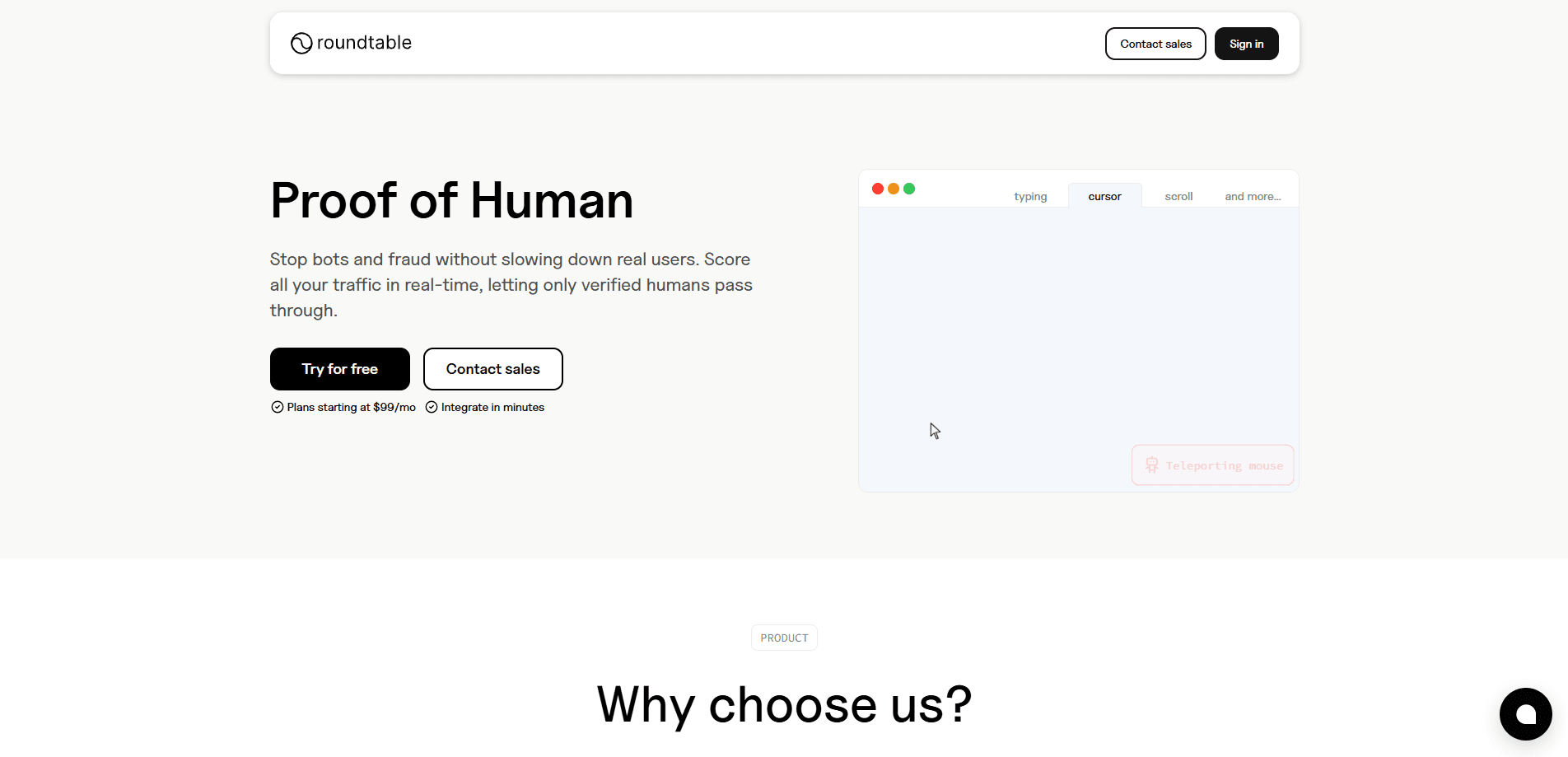
Roundtable is a bot detection and fraud prevention platform that separates real people from automated traffic. Its main product, Proof of Human, is a JavaScript tracker and API that studies how a visitor actually interacts with a page, then returns a risk score for that session. It works as a CAPTCHA alternative for teams that want human verification without a puzzle. Instead of asking users to solve a puzzle, it reads the process behind their behavior: typing rhythm, mouse movement, pasted text, and how they scroll and click.
The company came out of Y Combinator and started by fighting fraud in online surveys and research panels, where paid respondents and AI-generated answers had quietly contaminated the data. That background shapes the product today. It's aimed at teams that collect high-stakes responses, run panels, or protect signup and onboarding flows, and it leans on cognitive science ideas rather than device fingerprints or IP blocklists alone.
The tradeoff is that Roundtable is not a consumer toy. Pricing isn't published, setup needs a developer to drop in the script, and detection quality depends on having enough interaction data per session. Its accuracy claims come from the company's own held-out benchmarks, so outside teams should run a pilot before trusting the numbers.
Getting Started
- Book a demo with the sales team and get a site key for an account.
- Add the Proof of Human JavaScript tracker to the target page with a single script tag.
- Optionally pass a user id or tags to track visitors beyond a single session.
- Watch live sessions and risk scores in the dashboard, or pull them through the API.
- Route sessions by risk tier and export the evidence behind each flag for review.
Product Information
A quick look at Roundtable's pricing, supported platforms, and performance.
Best for
The users, tasks, and scenarios where this tool fits best.
Users
- Market research and survey teams
- Trust and safety engineers
- Product and growth teams protecting signup flows
Tasks
- Bot and AI agent detection
- Fraud triage
- Data quality assurance
Scenarios
- Cleaning survey and panel traffic
- Hardening a signup or trial flow
- Reviewing high-stakes sessions
Key features
Behavioral biometrics scoring
Proof of Human reads how a session unfolds, not just what it submits. It watches typing cadence, mouse trajectories, pasted text, scroll patterns, and clicks, then turns more than 150 behavioral signals into a continuous risk score. The point is to catch sessions that look correct in the final answer but slip on the process underneath.
Cognitive and behavioral challenge
The platform draws on cognitive psychology to make automation expensive. By looking at how people hesitate, correct mistakes, and react to conflicting cues, it targets the gap between a bot that copies human output and one that would have to copy human thinking. This is the layer the company calls an invisible Turing test.
Real-time, frictionless detection
The tracker runs without interrupting the user. Scoring is built for flows that can't tolerate delay, with the company reporting sub-200ms p99 latency. That matters for surveys and onboarding, where a visible check costs completions and drop-off.
Interpretable evidence
Rather than a bare score, every flagged session carries a heuristic breakdown, an action log, and replay context. Reviewers can see why a session was flagged, such as programmatic typing or teleporting mouse movement, and can defend or challenge that call with evidence.
Dashboard and API access
Sessions, risk tiers, and flags are visible in a live dashboard, and the same data can be pulled through the API into internal decision systems or QA tools. Teams can filter by route or tag traffic by campaign, survey, or product surface.
Privacy-forward design
Roundtable says session data stays in-tab for the life of the visit, which sets it apart from approaches that lean on invasive biometric scans or cross-site cookie tracking. That positioning matters for teams under GDPR-style scrutiny.
Pros and cons
Pros
- Invisible by design: no CAPTCHA or puzzle, so legitimate users keep moving through the flow.
- Behavior-based detection catches polished AI agents that pass device and IP checks.
- Interpretable output: flags, action logs, and replay context give reviewers something to act on.
- API and exports make it usable inside existing decision and QA systems.
Cons
- No published pricing, so budget planning needs a sales conversation first.
- Setup requires developer work to add and configure the tracker.
- Accuracy figures come from the vendor's own benchmarks, so real-world performance needs a pilot to confirm.
- Best fit is survey, panel, and onboarding traffic, so broader web security teams may find it narrow.
Frequently asked questions
Roundtable is a bot detection and fraud prevention company. Its Proof of Human product uses behavioral biometrics to tell real users apart from bots and AI agents, then returns a risk score for each session.
Related content
Explore related tools, skills, and articles for Roundtable.
Roundtable Alternatives
BinkBink
BinkBink · OtherBinkBink is a free online game platform and AI game maker that lets anyone turn a short text description into a playable browser game. You can jump into hundreds of community-made games. Or describe your own idea and play it in seconds, then share it with friends. Want to create your own game? You don't need to code. No engine setup, no download, no hassle.

Audiogen
Audiogen Inc. · OtherAudiogen is an AI music generator built by Audiogen Inc., a small research team that spent about 2.5 years training its own generative music model and designing a web interface around it. Instead of a plain text box, this AI music tool turns the timeline into a beginner-friendly Generative Audio Workstation, or GAW, where inpainting, extending, remixing and stem editing work more like painting on a canvas. The product is still in beta, so access runs through a waitlist or an invite. Paid plans aren't published yet.

Aiml API
AIMLAPI OÜ · OtherAiml API is a unified AI model API that puts more than 1000 models from OpenAI, Google, Anthropic, and others behind one endpoint and one bill. You write code against a single OpenAI-compatible schema, then switch between chat, image, video, and audio models by changing a model string. It suits developers and small teams who want multi-model access without juggling a dozen separate provider accounts, and it removes the usual billing headache that comes with testing several vendors. One key covers it all.