

Routebase
Routebase · Coding
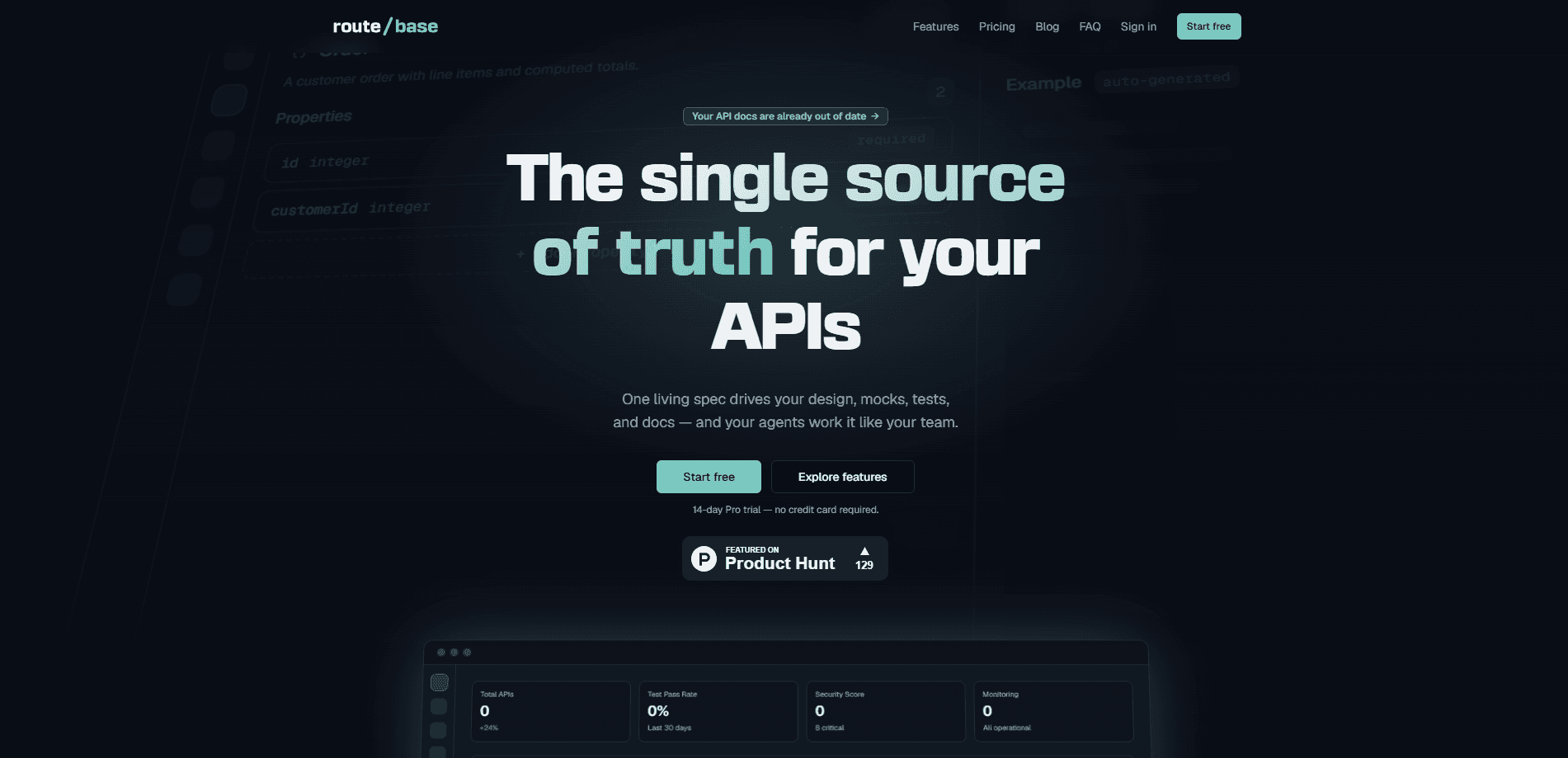
Routebase is an API lifecycle management platform built around one living OpenAPI spec. Think API design tool, API documentation platform, and API mocking tool rolled into one contract. You design that contract, publish it, and Routebase generates the docs portal and mock server while your tests and monitors validate against the same version. Routebase keeps every downstream tool honest, so the thing you documented is always the thing you actually shipped to consumers. It ships an MCP server too, so AI agents design, lint, and test APIs through the same workflows your team already uses. Routebase handles the busywork, and you handle the design decisions.
About Routebase
What Is Routebase
Routebase is a platform for teams that build and maintain APIs, and its core idea is simple: keep one spec as the single source of truth. Change that spec once and the documentation, mock server, tests, and monitors follow in a single publish. If your team already writes OpenAPI by hand and then re-syncs everything downstream, that loop is what Routebase removes. One edit. Everything downstream follows.
The product covers the whole lifecycle rather than one slice of it. You design contracts in a visual editor, branch and review specs like code, catch breaking changes before merge, and monitor live responses for drift. Each piece reads from the same spec, which means a field that drifts shows up as a diff before a consumer ever sees it. No more surprise breakages in production.
The biggest limitation is scope. Not ideal if you don't use OpenAPI. Routebase assumes you work in OpenAPI, so teams on other description formats won't get the same fit without converting first. It's also a newer product, so if you need a long track record or a large partner integration library, that's worth weighing before you commit.
Getting Started
- Sign up at app.routebase.dev, either on the free plan or the 14-day Pro trial with no credit card.
- Import an existing OpenAPI spec or start a new contract in the visual editor with endpoints, schemas, and versions.
- Publish a version so Routebase generates the docs portal and mock server from it.
- Point your CI test suites and monitors at that published version, and connect agents over MCP if you want them working the same spec.
- Track drift in the monitoring dashboard, then branch, review, and merge changes as your API evolves.
Product Information
A quick look at Routebase's pricing, supported platforms, and performance.
Best for
The users, tasks, and scenarios where this tool fits best.
Users
- Backend and API engineers who own an OpenAPI contract
- Small API teams that need governance without a platform team
- Documentation writers and developer-experience folks
- AI agent builders
Tasks
- API design
- API mocking
- API testing
- API governance
- Drift monitoring
Scenarios
- Shipping a new API version without breaking existing consumers
- Onboarding a frontend team before the backend is ready
- Keeping docs honest as an API grows
- Wiring AI agents into an existing API workflow
Key features
One Living OpenAPI Spec
Routebase treats a single spec as the source of truth for everything downstream. You publish a version once and the docs portal, mock server, tests, and monitors all read from that same contract. It means there's one place to change and no scattered copies to reconcile. Sound familiar? That's the mess it cleans up.
Visual OpenAPI Editor
You design contracts in a visual editor with endpoints, schemas, and versions, so nobody has to hand-edit YAML. Reusable schemas cut repetition across endpoints, and spec branches let people draft changes without touching the main line. It's aimed at teams who'd rather click through a schema than fight indentation. That's the whole point. If your team spends hours reconciling a hand-written OpenAPI file against the docs portal, the mock server, and the test suite every time an endpoint changes, a visual editor with reusable schemas removes most of that busywork.
Generated Docs and Mock Server
Publishing a version generates a docs portal and mock server straight from the spec. Frontend developers build against the mock while the real backend is still in progress, which shortens the wait between contract and usable endpoint. No more guessing at shapes. A custom domain for the docs portal is available on the Pro plan and above. Published once. Docs and mocks stay current.
Built-in MCP Server
Routebase ships an MCP server out of the box, exposing the full feature set as agent tools. Agents can create endpoints, run test suites, and lint specs through the same interface your team uses. There's no glue code to write, which matters if you're testing how AI agents fit into an API workflow. Agents get their own lane.
Continuous Drift Monitoring
Scheduled monitors replay live responses against your spec and flag every divergence, from missing fields and type mismatches to undocumented additions. Each difference is classified with field-level diffs, so a breaking change shows up as a concrete delta rather than a vague warning. That's the part that keeps docs from quietly lying. Trust me, that matters more than it sounds.
Spec Branching and Review
You draft on a spec branch, open a merge request, and ship what survives review. Breaking-change and conflict detection run before merge, so risky edits surface while they're still cheap to fix. It brings the same review discipline developers expect from code to the API contract itself, which means a bad schema change gets caught in a merge request instead of in production after a mobile client has already shipped against the old shape. Reviews catch the messy stuff early. That's the win.
Governance and Security Scanning
Governance rules lint specs against your style guide, straight from the editor or from an agent over MCP. On the Pro plan you also get security scanning alongside the governance checks. For teams that care about consistency across many APIs, this is the layer that keeps them from drifting apart in style. Consistent APIs are easier to document, consume, and support over time.
Pros and cons
Pros
- Single source of truth means docs, mocks, and tests can't quietly fall out of sync.
- Built-in MCP server makes AI agent integration a first-class feature, not an add-on.
- Free plan is genuinely usable for personal projects, and the trial needs no credit card.
- Transparent flat pricing ($0 to $39 per user per month) with no sales call required.
- Branching, review, and breaking-change detection bring code workflow discipline to API specs.
Cons
- It's OpenAPI-centric, so teams on other description formats have to convert first.
- The product is relatively new, so there's a limited public track record to lean on.
- The most useful bits, like unlimited projects and monitoring, sit behind the Pro plan.
Frequently asked questions
Routebase keeps your API documentation, mocks, tests, and monitors in sync with a single OpenAPI spec. You design and publish the spec once, and everything downstream regenerates from it in a single publish instead of being maintained by hand.
Related content
Explore related tools, skills, and articles for Routebase.
Routebase Alternatives
Forefront
Forefront · CodingForefront is a web platform for building with open-source AI. It lets you fine-tune leading open-source language models on your own data, evaluate how they perform, and run them through an API or export them to host yourself. Developers who want the convenience of a closed-source platform but insist on owning their models and data are the target audience here.

Startkit
StartKit.AI · CodingStartkit is a boilerplate for building AI SaaS and AI wrapper products. Think of it as an AI startup boilerplate with the boring parts already wired up: authentication, Stripe and Lemon Squeezy payments, usage limits, transactional email, and an AI API starter that talks to OpenAI, Anthropic, Groq, or Llama. You clone the repo, set your price, and start on the part of your product that people actually pay for. It's Next.js under React and Tailwind, so most of the boilerplate code already feels familiar.
Testim
Tricentis · CodingTestim is an AI-powered test automation platform for building and running end-to-end tests across web, mobile, and Salesforce applications. It leans on machine learning to keep tests stable when an interface changes, so teams spend less time fixing broken selectors. Not bad for an automated testing tool you can start using today. You create tests by recording actions in a browser, then optionally add JavaScript when you need more control. It's a solid pick for busy QA teams.