

Sailhouse
Sailhouse · Coding
Sailhouse is an event-driven infrastructure platform for AI agents, billed as an agent control plane. Developers publish events, run push or pull subscriptions and coordinate parallel work.
About Sailhouse
What Is Sailhouse
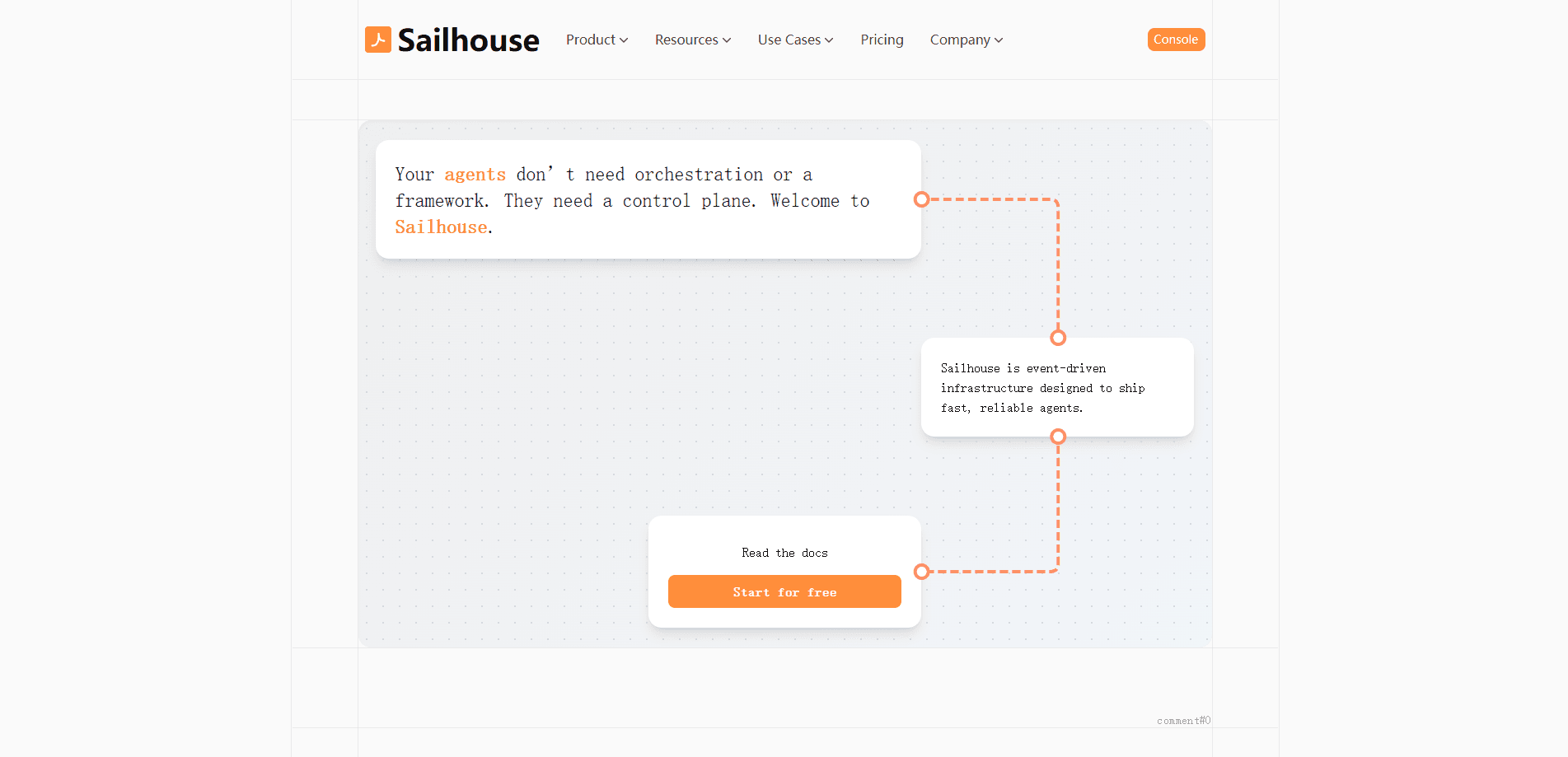
Sailhouse (sailhouse.dev) is a globally distributed pub/sub platform that gives AI agents a control plane instead of a framework. The idea is simple: agents don't need a heavy orchestration layer to work together. They need a reliable place to send events, subscribe to them and coordinate when a batch of work finishes. Sailhouse is that layer, built as hosted infrastructure you call from your own code.
The problem it targets is coordination. When you build agents that call tools, wait on other agents or run work in parallel, you end up writing the same plumbing every time: retry logic, queues, fan-out and fan-in, scheduled runs. Sailhouse takes that plumbing off your plate. You publish an event to a topic, attach subscriptions, and the platform handles delivery, retries and dead letters.
The tradeoff is scope. Sailhouse is infrastructure for developers, so it is not a no-code builder and it won't write your agent for you. It also leans on your code running somewhere it can reach, since events are delivered over HTTP or pulled by a worker. If you don't write code, this isn't the tool you pick first.
Getting Started
- Create a Sailhouse account and an app in the console, then grab a token
- Install a native SDK, TypeScript, Go, Python or Rust, or call the REST API directly
- Publish an event to a topic; if the topic doesn't exist, Sailhouse creates it automatically
- Attach a push subscription that posts to your HTTP endpoint, or a pull subscription your worker reads from
- Acknowledge events when they're processed, and let the platform retry and dead-letter the ones that fail
Product Information
A quick look at Sailhouse's pricing, supported platforms, and performance.
Best for
The users, tasks, and scenarios where this tool fits best.
Users
- Backend and platform developers
- AI agent builders
- Startups shipping fast
- Full-stack engineers on serverless
Tasks
- Publishing and consuming events
- Coordinating parallel agent work
- Scheduling future work
- Running recurring jobs
- Filtering and rate limiting
Scenarios
- An agent reviews a pull request
- A billing cycle runs every few hours
- A downstream service is briefly down
- A payment needs to process later
- A newsletter goes out daily
Key features
Topics and Events
Topics are the buckets your events are grouped into. You publish a JSON event to a single topic, identified by a slug, and the platform fans it out to every subscription attached to that topic. Events carry metadata too, which is how the platform attaches trace IDs or tags a cron-triggered event with its schedule. Topics and subscriptions are the two core resources, and everything else builds on them.
Push and Pull Subscriptions
Sailhouse supports both delivery models. A push subscription sends a POST request to your endpoint when an event arrives, and expects a 200 response within 5 seconds. A pull subscription flips it: your worker asks for events on its own schedule, which suits processing-heavy jobs like a billing cycle or a weekly summary. Teams pick per subscription, so a single topic can feed a real-time webhook and a batch worker at the same time.
Wait Groups for Fan-Out and Fan-In
Wait groups are the feature that makes parallel agent work practical. You hand the platform a list of events to fire and a topic to notify on completion; Sailhouse runs them and publishes one event when the whole group is done. Without this, you'd write duplicate checks or a race-prone "is everything finished yet" loop. It's the same pattern as a wait-group in a programming language, moved out to an event-driven system where retries don't cause extra calls.
Self-Healing Topics and Subscriptions
Sailhouse creates resources on demand. Send an event to a topic that doesn't exist and the platform makes it using your slug, then stores the event against it. Pull subscriptions can be created the same way, with a time window of up to 24 hours that pulls in everything from a topic over that period. The goal is fewer schema steps between writing code and shipping, which matters when you're iterating on an agent.
Scheduled Events and Cron Jobs
You can queue work for later in two ways. Scheduled events set a time on a single event or a subscription, handy for processing a payment 14 days after an order or sending a reminder. Cron jobs, currently in private beta, fire events into a topic on a repeating schedule, all in UTC, for daily roundups or hourly usage calculations. Both reuse the same subscription model, so there's no separate scheduler to learn.
Filters, Rate Limiting and Deduplication
Subscription filters let you keep topics generic while cutting noise and cost. Instead of splitting a topic into a dozen narrow ones, you filter at the subscription with a JSON path, so a consumer only sees the events it cares about. The platform also supports rate limiting and deduplication in the same layer, which is where you'd put guards against duplicate deliveries or a burst from a misbehaving publisher.
Native SDKs and Observability
Sailhouse ships first-party SDKs for TypeScript and JavaScript, Go, Python (beta) and Rust (beta), plus a CLI and a REST API for everything else. The observability side covers tracing events, so you can attach trace IDs and follow an event through the system. Because it's hosted, the ingest regions currently span London, Ashburn and San Jose, with data written centrally and encrypted in transit and at rest.
Pros and cons
Pros
- Removes the queue, retry and fan-out plumbing you'd otherwise write and maintain yourself
- Wait groups handle parallel agent tasks and fan-in without a race-prone completion check
- Push and pull subscriptions on one platform mean real-time webhooks and batch workers share topics
- Self-healing topics and subscriptions cut schema work, so you send an event and it just exists
- Native SDKs for TypeScript, Go, Python and Rust, plus a REST API and CLI, cover most stacks
Cons
- It's developer infrastructure, so there's no visual builder and no way to use it without writing code
- Delivery relies on your endpoints being reachable, so it doesn't fit work that runs offline or behind a firewall
- Cron jobs are still in private beta, and you have to email support to enable scheduled recurring runs
- Data is stored centrally in the UK, which may not suit teams with strict regional data residency needs
Frequently asked questions
Sailhouse is a globally distributed pub/sub platform and control plane for AI agents. You publish JSON events to topics, attach push or pull subscriptions to consume them, and use features like wait groups and scheduled events to coordinate work. It's infrastructure you call from your own code, not an app you use directly.
Related content
Explore related tools, skills, and articles for Sailhouse.
Sailhouse Alternatives

Base Code
Base44 (Wix) · Coding · ProductivityBase Code is a shared cloud development environment from Base44. Teammates describe changes to an existing GitHub codebase in chat, preview them live and send them back as pull requests.

Google EmbeddingGemma 2
Google DeepMind · Writing · Image · CodingGoogle EmbeddingGemma 2 is a 740M-parameter open model that turns text, code, images, audio, and video frames into vectors in one 768-dimension space, running on phones and laptops.

GitGlow
GitGlow · Coding · ProductivityGitGlow is a local-first desktop Git client that lets independent developers review their own code and their AI agents' changes in one place before shipping.