
Sanas
Sanas · Voice & Language
Sanas is a real-time speech AI platform that translates accents and 25+ languages, cleans up noisy audio, and analyzes live calls without recording them. Companies use it in contact centers and remote teams.
About Sanas
What Is Sanas
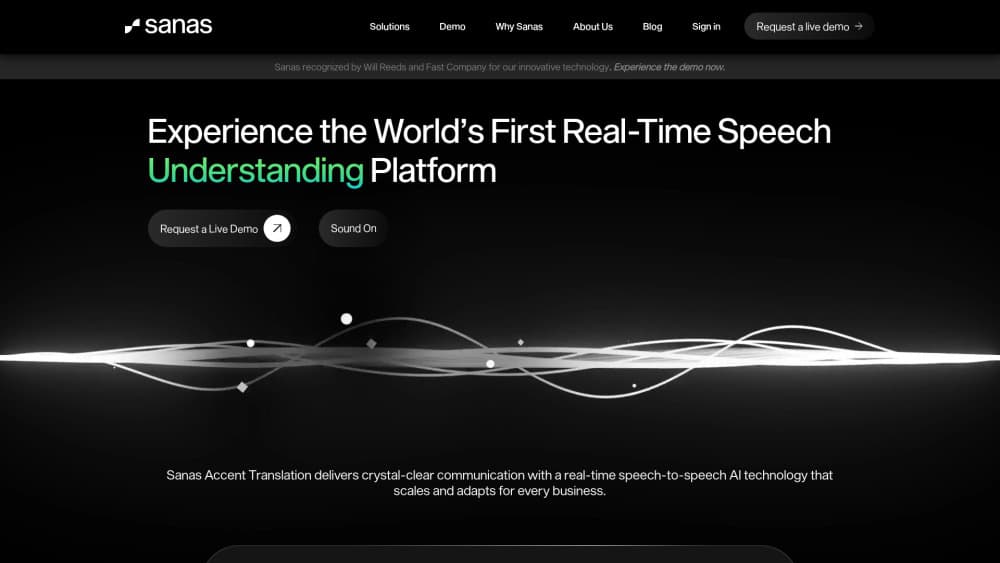
Sanas is a speech AI platform built for live conversations. It sits inside a phone or video call and changes how speech comes out on the other end. Instead of shipping recorded audio to a server and waiting, Sanas works while you talk. The tool got attention first for accent translation: an agent in Manila can speak in a Manila accent, and a customer in Ohio hears something close to a neutral American accent. The company's stated goal is to remove communication barriers. Critics argue that flattening accents raises its own questions about language and identity.
The service now covers four areas. Accent translation changes how a speaker sounds while keeping the voice recognizable. Language translation covers more than 25 languages in real time and keeps the speaker's tone. Speech enhancement cleans up background noise and muffled audio. Speech intelligence reads live conversations to surface insights. Sanas sells to businesses, mainly contact centers, healthcare providers, banks, retailers, travel companies, and telecom operators.
There are real limits. This is not a consumer app you download and use alone. Pricing is quote-based, so you cannot self-serve, and there is no free tier. The accent translation also only makes sense inside a supported call path, which usually means your company has to wire it into its own phone system first.
Getting Started
- Contact Sanas sales and describe your call volume, languages, and systems.
- Agree on the deployment path, either a cloud integration or an on-premises setup inside your network.
- Connect your call platform or contact center software to the Sanas audio layer.
- Test accent translation, language translation, and enhancement on a sample of live calls.
- Roll out to agents, then review the speech intelligence dashboards for trends.
Product Information
A quick look at Sanas's pricing, supported platforms, and performance.
Best for
The users, tasks, and scenarios where this tool fits best.
Users
- Contact center agents
- Customer support leaders
- Healthcare and finance call teams
Tasks
- Handling inbound calls with a heavy accent
- Taking calls in a second language
- Working from a noisy home office
Scenarios
- A bank routing overseas support calls to a central team
- A telehealth line where patients struggle to hear the nurse
- A retailer scaling support for a holiday rush
Key features
Accent Translation
Accent translation is the feature Sanas is known for. It changes how a speaker's accent sounds in real time while keeping the voice and the emotion behind it. The goal is that callers hear a familiar accent without the speaker forcing one. It applies to live calls, not recordings, and it works only inside a call path your company has connected.
Real-Time Language Translation
Live language translation covers more than 25 languages as people speak, and keeps the speaker's tone and intent rather than reading out a flat voice. An agent can talk in their own language and a caller hears theirs. Latency matters here, since anything that slows the audio down breaks a live conversation.
Speech Enhancement
Speech enhancement cleans up muffled, quiet, or noisy audio before the other side hears it. It keeps vocal detail so voices still sound like people, not like a cleaned-up robot. This is the feature that helps most when agents work from a home office or a busy floor.
Speech Intelligence
Sanas reads live conversations to pull out insights for teams, and the company says it does this without monitoring, recording, or storing call data. Managers get trends rather than raw audio. That design matters for businesses that cannot keep recordings for legal reasons.
Security and Compliance
Sanas markets itself as secure by design and holds a stack of certifications, including HITRUST, HIPAA, SOC 2, SOC 3, ISO 27001, GDPR, and PCI DSS. For regulated buyers, the certifications often decide whether the tool can be used at all. The no-recording stance fits industries where call data is sensitive.
Carrier and Partner Deployments
Sanas runs inside telecom and platform partner setups, including a partnership with Mavenir that lets operators deliver voice AI from their own mobile core network. For a business already buying through an operator, that can mean the speech layer arrives as part of the phone service rather than as a separate project.
Pros and cons
Pros
- Accent translation, language translation, enhancement, and speech intelligence live in one platform, so teams do not stitch together four vendors.
- The no-record, no-store design fits healthcare, finance, and other settings where call data cannot be kept.
- Wide compliance coverage (HITRUST, HIPAA, SOC 2, ISO 27001, PCI DSS) that regulated buyers actually check.
- Available through telecom partners, which helps companies that prefer to buy voice AI with their phone service.
Cons
- No public pricing and no free plan, so you cannot test it as an individual and every deal starts with a sales call.
- It is an enterprise deployment that needs integration with your phone or contact center system, which means setup time and IT involvement.
- Real-time accent translation depends on stable audio and low latency, so a weak connection can leave the output uneven.
Frequently asked questions
Sanas changes how speech sounds during a live call. It translates accents and 25+ languages in real time, cleans up noisy audio, and analyzes conversations without recording them.
Related content
Explore related tools, skills, and articles for Sanas.
Sanas Alternatives

Foley
Hanamori Labs, LLC · Voice & Language · Productivity · AI AssistantFoley is a voice to-do list that turns a spoken sentence into a filed task, complete with project, date and time, then helps you plan the day around what is already there.

HireKey
HireKey · Voice & Language · Productivity · LeaningHireKey is an AI job search copilot built by a former tech recruiter. It checks role fit, tailors resumes, runs interview practice and tracks every application.

Fluence
Yay Software (Yannick Huchard) · Writing · Voice & Language · ProductivityFluence is an Android app that reads PDFs, EPUBs, Word files and web articles aloud, follows each sentence as it speaks, and answers questions about the text on the phone itself.